not all saints

(watch and listen here)

There is more than one saint, in the city of Assisi.

There is of course Saint Francis of Assisi, the city’s most venerated saint; his feast day is celebrated each year by the Catholic Church, on October 4th, the anniversary of his death.

But then there is also Saint Clare, who was a disciple of Francis and founder of the order of the Poor Clares. She is remembered each year on August 11th, the feast of Saint Clare.

The official patron saint of Assisi, however, is neither Clare not Francis, but Saint Rufino, the city’s first bishop. His feast day is also on August 11th, but in Assisi they celebrate it on the 12th, to avoid conflict with the feast of Saint Clare.

There are more than 10,000 saints officially recognized by the Catholic Church, so with only 365 days in a year, some overlap was inevitable. It would be impossible to mark each saint’s passing with a separate feast day; and so in time, the Church designated a day for the collective celebration of ALL saints – the well-known, the lesser known, and the unknown.

Yesterday, November 1st, was the celebration of All Saints.

But today, November 2nd, is the celebration of All Souls.

What is the difference between these two days, between these two words?

The phrase “all souls” is a term of universal embrace, including at the very least all humans, and possibly others as well. The word “saint,” on the other hand, has been traditionally used to describe a subset of all souls. In common parlance, we use it to describe an especially giving or virtuous person. Someone who cares for others. Someone of courage, and integrity. In Hebrew, a tzaddik, perhaps, or in Yiddish a mensch. A good person.

The apostle Paul (himself commonly called “Saint Paul”) used the word with a slightly different sense. In every one of his letters, “the saints” refers to al those who have been baptized, living or dead. So he can write, please send some money for the needs of the saints. He’s writing about living people.

In the Catholic church, the title of Saint has come to have a more narrow meaning still. A person is designated a saint only after death, and then only after a lengthy process of canonization. A life of virtue is a necessary for sainthood, but not sufficient. The exact criteria for Catholic sainthood have evolved over the centuries, but they are basically threefold: first, of course, the candidate must be Catholic; second, they need to have lived a life of heroic virtue; and third, there must be miracles attributable to their intercession. A saint must be a blessing, even in death.

There is more than one saint, in the city of Assisi. There is Saint Francis, and Saint Clare, and Saint Rufino; and there is Saint Carlo – Assisi’s newest saint.

Carlo Acutis, the only child of his parents Andrea and Antonia, died suddenly of acute leukemia in the year 2006, at the age of fifteen. In life he was by all accounts a kind, generous, bright boy with a gift for computer programming. He was also a boy with what has been described as “a precocious hunger for God.” From a surprisingly young age, he developed a passionate interest in the eucharist – the ritual of the Lord’s supper. He made a website about it. He even created a travelling exhibit on the subject. After his death, his parents petitioned the church to declare their son a saint.

This past September, nineteen years after his death, Carlo Acutis was formally canonized in the city of Assisi by Pope Leo, making him the first millennial saint. The first saint of the digital age.

Last month I went on pilgrimage to Assisi, in the company of a group of other clergy women. We arrived in Assisi, by chance, just days before the first celebration of the feast of Saint Carlo, on October 12th.  On our first day there, despite our jet lag, a few of us took the short but steep walk uphill, to get our first glimpse inside the old city walls.

We had come to Italy primarily walk in the footsteps of Saint Francis and Saint Clare, but on that first walk the first thing we saw was a shop front entirely filled with images of Saint Carlo. His youthful face appeared on t-shirts and tote bags and magnets and figurines, all celebrating Assisi’s newest saint.  It was the same throughout the city; the image of Carlo’s youthful face appeared everywhere. There were posters on the street announcing his canonization. There were crowds of teenagers, Catholic youth groups, come to venerate the body of a perpetually teenage saint, and to light candles, asking for his care and guidance.

Of course, there are also images of Francis everywhere, on the walls and in the churches and in the shops.

But I confess that something about Carlo’s omnipresent image bothered me, so I had to think about that. Because it continued to bother me each time we came across another poster, or statue, of this young boy. I did not go to see his body; somehow it felt inappropriate for such crowds to be gazing upon one so young.

I found that I could not think of him as a saint. I could think of him only as a kid. As precious and extraordinary as every kid.

I came home from Assisi to a message from a local family whose teenage son had died suddenly the week before. Like Carlo, he was an only child.

Was he, also, a saint?

Does it matter?

As I look around this room, at the prayer flags above and the faces below, I cannot help thinking that most of the souls here, living or dead, would probably never be considered candidates for sainthood – at least, not according to the criteria applied to Saint Carlo.

Some – many, perhaps – were saints in the sense that the Apostle Paul used the word, having been baptized into the body of Christ, either as infants or as adults. And some – many, perhaps – were saints in the everyday sense of the word: loving and giving, brave and just.

But maybe – just maybe – they were not all saints.

But that’s okay. Because All Saints Day was yesterday. Today, we celebrate All Souls.

And the thing that all souls have in common, is that they were, and are, beloved. Beloved of God. Beloved of us. Beloved to those whose hands made these prayer flags in remembrance of them. Perhaps they were not all saints, but they all mattered.

And the thing, I think, that all saints have in common, is that they know that.

And so today, we give thanks, for all these souls.

May their memories be a blessing.  Amen.
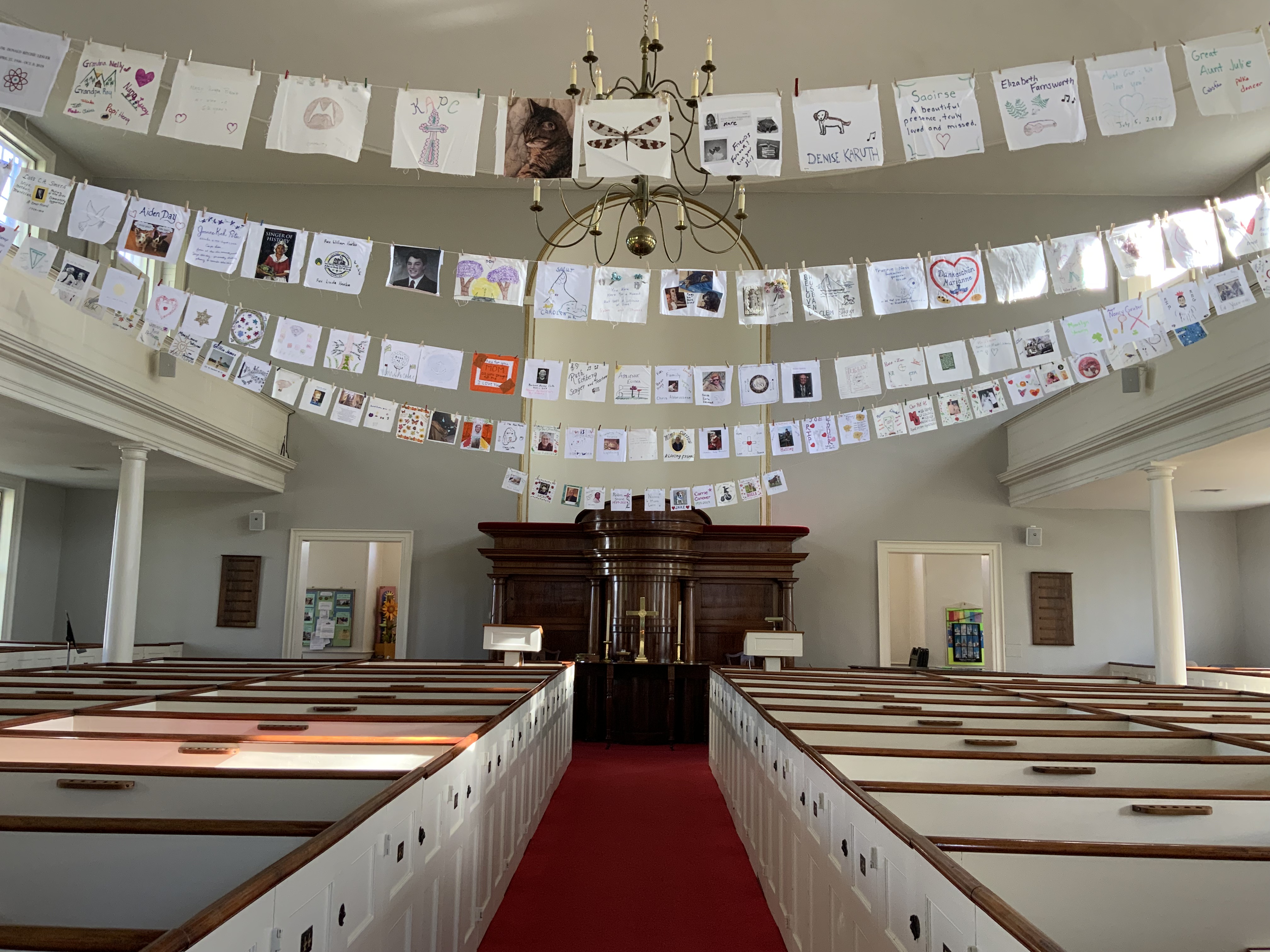
hand-decorated prayer flags stretch from balcony to balcony, high above the empty pews of a old New England church meetinghouse.

Rev. Liza B. Knapp
The First Church of Deerfield
November 2, 2025 – All Souls Sunday
all rights reserved

photographs (by Liza):
Street posters in Assisi, celebrating the 800th anniversary of Saint Francis’ Canticle of Creation and the first celebration of the feast day of Saint Carlo.
Prayer flags hung in remembrance of loved ones at the First Church of Deerfield, Massachusetts.

Working the Clay


In college I studied both biology and religion. Upon finding this out, people would sometimes ask me, “Do you believe in creation or evolution?”

And I would say, “Yes.” 

The staunch creationists of the day – the biblical literalists – were firmly committed to the belief that God created all living things ex nihilo – out of nothing – in their present, fully realized form. Like a magician, pulling a rabbit out of an empty hat. Many creationists do acknowledge the existence of now-vanished life forms, like dinosaurs; although I have encountered some who believe that fossils are a giant hoax perpetrated by God, to test our faith. But most creationists believe there were dinosaurs once; they just believe humans existed alongside them. They accept extinction, sure; but evolution, no.

This is the Biblical story of creation as told in the first chapter of Genesis, in which an omnipotent God brings forth living things, each distinct, according to precise divine specifications. God makes everything exactly according to plan, like an almighty engineer.

But then we get to the second chapter of Genesis, where we find an entirely different creation story.

We know it is a different story, because the order of creation is re-arranged. In the first story, God fills the earth with plants and animals, and only then creates humans – which makes sense, because how could we survive without them? But in the second story, God creates humans before the animals, “when no green things had yet sprouted.”

In the first story, God creates humans, plural, male and female, simultaneously – all, we are told, in God’s apparently non-binary image. In the second story, God makes one human out of clay, and then borrows a bit from it to make another human.

Think about that: no sooner does God create this work of art, than God tears it apart – but not to destroy it. God re-worked the clay, so that we might be not one groundling, but two. What a lovely, generous act, on God’s part – to create a rival, for his creature’s affection! From the beginning, God wanted us to love, not God alone, but one another. 

Here creation begins with clay, which is, essentially mud. God is playing in the mud. In the first chapter of Genesis, God calls us forth with a word; but in the second chapter, God gets God’s hands dirty. In the first we have God the Senior Engineer; in the second, we have God the Artist.

**

When I was deeply immersed my biology and religion studies, in my senior year, I decided I needed to have some break from these subjects, so I took a single introductory class in studio arts. It was taught by a dynamic young artist* whose own work was primarily three-dimensional. I remember an exhibit of his work in the college library; it consisted of large wooden sculptures – human sized – that all look somehow biological, like something that you might see through a microscope.

One day, as I was painting my beginner still life (which still hangs in my kitchen because I was so proud of it) our teacher spoke with us about his own artistic process. He told us that he never knew when he started a series, what a given piece would look like when it was done. “If I know exactly how the sculpture will look when its finished,” he said, “then there’s no point in making it.”

He did not desire absolute control over his medium; he wanted an interactive relationship.

“If we are to keep in touch with reality, we must work with some material substance that resists us, and against which we have to pit ourselves to reshape it.” So writes Cistercian monk Andre Louf, in his book The Cistercian Way. He goes on to say, “whatever it is – the soil, clay, wood, water, metal, cheese or chocolate – the monk needs this simple material to measure himself against every day. He will thus be kept in contact with reality, for these things come from God, and are solidly rooted in the earth, of which they are a part.”

As human beings — groundlings, beings of earth, creatures of clay — we are in the paradoxical position, the almost unique position, of being both creators and creatures, both the sculptor and the clay. We are the material God works with, the substance that resists God’s hand. We are the clay on the wheel that sometimes slips so far off center, that the potter has no choice but to start again, and re-form us from scratch.

**

So we come to the prophet Jeremiah, who visited a potter at his wheel, and saw there a parable.

Under the potter’s steady hand, the clay begins to take shape, and something beautiful and useful emerges; but, as Jeremiah observed, sometimes the clay slips off center, and there is nothing for it but to return to the clay to its original formless lump, and start again.

Jeremiah saw in this a parable for his people. Jeremiah lived in tumultuous times. During his lifetime, he would bear witness to the collapse of his nation; he would see his people carried into exile, and his sacred temple razed to the ground, the sculpture reduced to dust. But before these events – before it all spun out of control — he tried to warn them, to tell them, some thing is off center here.

But the powers that be censored his warnings, which they found unpatriotic.

When Jerusalem finally fell, when the clay finally collapsed on the wheel of history, Jeremiah’s people lamented, feeling that God had abandoned them. But Jeremiah, the former prophet of doom, became suddenly, oddly hopeful in their midst. Perhaps he remembered that afternoon in the potter’s shed. He remembered, how the potter patiently reworked the clay, to make it pliable, to see what beautiful thing might yet arise from such a stubbornly resistant medium.

**

In the history of a people, in the life of an individual, there are times when things seem to be taking shape: when we see our family thriving, our vocation unfolding, our nation progressing toward justice and peace. When the form on the wheel becomes lovely, as if shaped by some unseen potter’s hand.

But then how suddenly the shape of our lives can change. The emerging peace vanishes and all is chaos again. Perhaps there was some flaw in the foundation, some persistent imbalance, some bit of resistance and rigidity in us.  I know that many of us are experiencing this loss of balance now – some of us in our personal lives, and most of us in our collective life as a nation. The center has shifted, and we are become de-formed. We can no longer recognize our own shape, and we lament the loss of our former beauty.

But let us remember the lesson of the potter’s shed. And let us not despair. There is good clay here still.

We are God’s work in progress. We know what we are, but not what we may be. Or to quote the poet Jan Richardson: “All those days you felt like dust, like dirt… Did you not know, what the Holy One can do with dust?”

O patient artist
shape us for love.
Keep us right-sized and malleable.
Center us, and save us from rigidity.
And when we collapse
under the weight of our own
obstinacy,
cradle us again in your hand,
and warm us
until our hardness yields to mercy.
Amen. 

Rev. Liza B. Knapp
The First Church of Deerfield, Massachusetts
Sunday, September 21, 2025
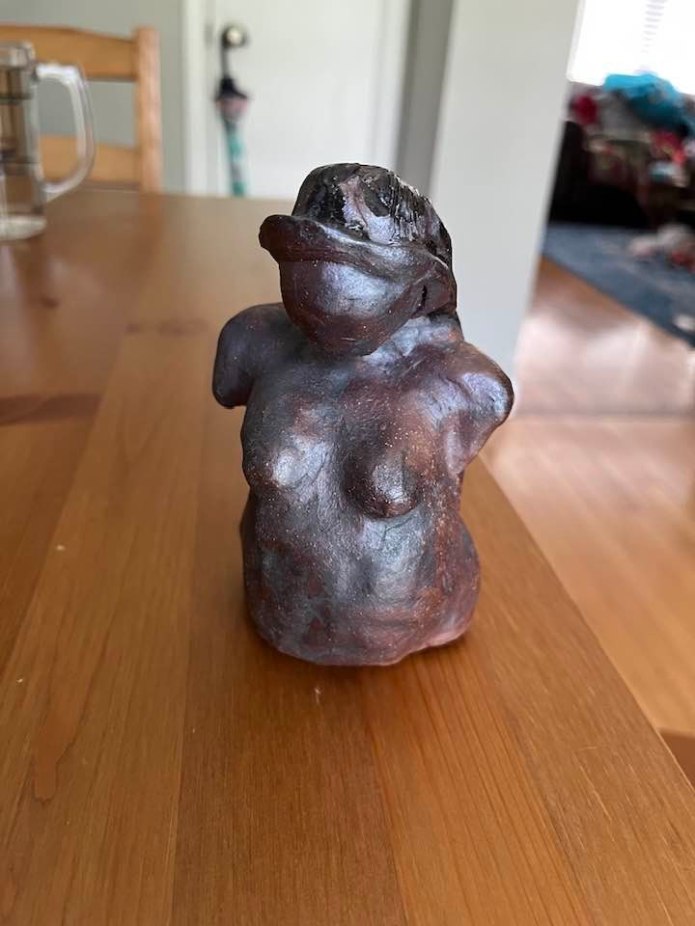
Pottery and photos by Audra Teague Mackey
*my professor was artist Brian Meunier; you can see his sculpture here.

On the Death of an Enemy

I did not wish him pain, or sudden death.
I did not wish his children to suffer bereavement and trauma.
I did not wish for a world where disputes are settled by gunshot.

But now that he is dead, what am I to say?
In life, he was my enemy.

I say this not to describe my feelings for him. In calling him my enemy, I speak only of his actions toward me. I want you to note the direction of the action here, because it’s important and I want to be very clear about this. My enemy is someone who seeks to harm me, not vice versa. If you seek to harm me, you are my enemy. If I seek to harm you – well then, I’m yours.

He was my enemy, but I was not his enemy. He was not my target, but I was his target.

Not me, personally, mind you. I have had very few, if any, personal enemies in my life — for which I count myself very lucky, because it is at least as much due to luck as anything else.

Charlie Kirk was not my personal enemy, because he never met me. Nevertheless, he bore ill will toward me, and people like me, and people that I love. He stirred hatred against us. He tried to convince his followers that I was their enemy, which I was not; but, believing him, some of them became mine.

In the moments before he was shot, Charlie Kirk was engaged in a conversation, about whether transgender people are more likely to be mass shooters. (They are not.) But for Kirk, it was just the latest of his many statements vilifying LGBTQ people – a group which includes me and many of my loved ones, including my dad. He has called us an “abomination” and once said the execution of gay people was part of “God’s perfect plan.”

So what am I to say, now that he is dead?

I did not grow up watching the sort of action films in which avenging superheroes gets to violently destroy the villains in the final scene. Except I did grow up watching the Wizard of Oz, in which not one but two wicked witches are killed, the first by a tornado and the second by a bucket of water. The first death is an act of God, the second an accident. It’s not like the Munchkins took matters into their own hands to rid themselves of their enemy. But when their oppressor dies, the friends of Dorothy celebrate. The little people dance in the streets, singing “Ding Dong the Witch is Dead.” And there were some who took to social media last week, to proclaim essentially the same thing. As the more recent musical version of the same story says, “No one mourns the wicked.”

Except, of course, that someone always does. To quote another musical, “No one is alone.” One person’s enemy is another person’s beloved. Did the shooter know, when he pulled the trigger, that Charlie Kirk’s three-year-old daughter was there in the crowd? I love the Wizard of Oz, but the Wizard of Oz is a fable; in the real world, violence never harms just one person. Trauma and bereavement spread out like ripples from any sudden death.

Charlie Kirk’s alleged murderer is now in custody, delivered to the FBI by a member of his own family. He is 21 years old. He appears to have been radicalized through his online activities. He is therefore part of a pattern, of young men increasingly embracing violence as their personal manifesto. It was initially assumed he must be a far-left extremist; it now appears he may have been a far-far-right extremist. Does it matter? It is the same action, either way. People of all religious beliefs and political ideologies are drawn to the simplicity of a loaded weapon, and its illusion of power.

But the fact that the very same act might have been the result of diametrically opposed political goals should give us pause; and cause us to question, whether the ends justify the means. Or vice versa.

Three months before I was born, civil rights activist Medgar Evers was assassinated. By the time I turned five, John F. Kennedy, Malcolm X, Martin Luther King Jr, and Robert Kennedy had all been shot and killed. It was a dangerous time for public figures in America. Now half a century later, we appear to be in such a dangerous time once again. Just two months before Charlie Kirk’s death, Minnesota state legislator Mellisa Horman was shot and killed in her home.

Does it matter, which side the dead were on? Does it matter, which side the shooter was on? Is the enemy of my enemy my friend? or another enemy?

To make sense of this, I turn as I ordinarily do, to Jesus.

Jesus said, LOVE YOUR ENEMIES.

Not, conquer your enemies. Not, kill your enemies. LOVE your enemies.

For three hundred and fifty years, the First Church of Deerfield has aspired to follow the teachings of Jesus. For some of that time the congregation identified as Trinitarian, and for some of that time the congregation identified as Unitarian, and now we are a sort of theological chimera, a hybrid; but still after all of these permutations our mission statement reads, “as his followers, we accept the religion of Jesus, holding in accordance with his teachings that practical religion is summed up in love to God and love to humanity.” Those of us here today differ in our beliefs about the divinity of Jesus, but we have historically been united by a desire to embody the love of Jesus. So I suggest we at least take his words seriously, and consider them.

Do we take him seriously, when he says, Love your enemies?

The apostles took that teaching seriously. When Jesus was arrested, one of his friends drew a sword to defend him, but when Jesus told him, “NO MORE OF THIS,” he put down his weapon for good. In the early years of the church, Christians had many enemies to fear; but no one had anything to fear from them. It wasn’t until the emperor merged church and state, that the defenders of the faith began using weapons.

What do we make of this teaching? Do we take Jesus seriously, when he says, Love your enemies? Or do we carve out some exceptions, to this rule?  The Reverend Dr. Martin Luther King Jr took him seriously; the German pastor carved out at least one exception, when he joined an assassination plot against Adolph Hitler.

Most of us are not likely to attempt a political assassination. (I’m tempted to say, if you are, don’t tell me – but maybe I should say, if you are, let’s talk.) But do we cheer secretly – or not so secretly – when someone else does it for us? Ding dong, the witch is dead?

What then, am I to say about Charlie Kirk, now that he is dead?

“The evil that men do lives after them; the good is oft interred with their bones.” So says Shakespeare’s Marc Antony, in the play Julius Caesar. In my experience the reverse is just as often true; people are loathe to speak ill of the dead. Marc Antony says those words and then goes on to preach a eulogy so unabashedly praising of Caesar that by the end of his speech, a crowd of mourners has turned into a mob of avengers. We’ve seen a little of that, too, in the last few days. And meanwhile, the family and friends of Charlie Kirk are trying to scrub the internet of any posts that point out his sins.

When I’m working with a family preparing a memorial, they will sometimes share with me difficult things, about the deceased. And they wonder whether perhaps these aspects of the deceased’s life should be avoided, in the eulogy. Should I mention that she was an alcoholic? Can I say that he was really hard on me, when I was a kid? Do we admit that the cause of death was overdose? Just how honest should a eulogy be?

I leave that up to the family, but I do tell them, that when we gather to mourn, we need to mourn the whole person.  If we remember only some sanitized or simplified or glorified version, then we aren’t really remembering the real person at all. It’s some other person we are describing, if we turn our very human neighbors and friends into saints.

Jesus knew who his enemies were. He was under no illusions about their intentions toward him. He loved them anyway. He did not tell his followers, praise your enemies; he said, love them.

So when we speak of the dead — whoever they are — let us speak with both love and honesty. Let our eulogies be honest eulogies, admitting of good and evil. Only in this way, can our love be an honest love.

For this is as good a working definition of grace as any I have heard:  Grace is the experience of being fully known — and yet beloved.

Grace be unto you.

Amen.

Rev. Liza B. Knapp
The First Church of Deerfield
September 14, 2025

all rights reserved

In the Beginning Was the Water

Labor Day has come and gone. School has begun. Vacation days have been spent.

We like Thoreau, have left Walden behind, and are once again sojourners in civilized life. We have returned from our summer retreat of longer days and lowered demands. And maybe our souls have been renewed, and maybe our minds have been refreshed, by this respite. Or maybe not. Either way, as we return from our summer pilgrimage, we wonder, how long until our routines re-assert themselves? How long before the numbness returns, how long before the exhaustion claims us again, how long before we return to autopilot?

I used to savor my summer tan, which lasted well into winter. I understand now, of course, that a tan is not something to be sought, but in my younger years I took it as a hopeful sign, that I had been marked and changed by my time at the seashore. That the ocean’s edge was imprinted on my skin – not a permanent tattoo, but long-lasting enough to see me to the next summer. My father was a teacher, and had a long vacation; for a full month, I was baptized daily in the salt water, and my thoughts were scoured clean by the wind and the water.

Peace of the running wave to you, says the ancient blessing.

And then it would be back to the sweaty city and the long list of labors. But something of the salt clings to us. After the ocean, there is a deep coolness in our core that will take some time for the heat to penetrate.

I wonder if church shouldn’t be more like this: A bracing immersion that shocks us into full presence, and a moment of wonder at the great immensity from which we emerged. A pilgrimage to the edge of the known world, where words fail us and we become our true, nameless selves.

My mother taught me this trick as a child: Hold a seashell up to your ear, and its curving labyrinth will echo back to you the sound of the blood coursing through your veins. It is the sound of the sea. God within, God without. There is no holier place than the ocean’s edge. There is no better sermon, than a seashell.

Today we begin a new season, in our yearly cycle of faith. It is a fairly young liturgical season, only recently adopted by churches around the world. It is the season of creation, when we turn our attention to the abundance and fragility and wonder of the earth. And so this week, and in the weeks to come, we will be considering the stories of creation. For there are several; in the Bible alone, there is more than one creation story. Today, we start with the most famous: the first chapter of Genesis. It goes like this:

In the beginning, there was… water.

Some of us may remember another creation song from the Gospel of John, which begins, In the beginning was the Word. But the song at the start of Genesis begins differently. In this, the first of the Bible’s creation stories – for there are several – we begin with water. There is no point at which God says, Let there be water. It is there, before God speaks a word. In the beginning, all was without form; and the breath of God moved over the waters.

For how long? An instant? An eternity? How does one measure time, when all is without form?

Then God speaks, and shapes the formless chaos, separating light from dark, and the waters below from the waters above; the ocean depths, from the depths of space – both blue by day and black by night, both immense beyond measure. The ancient people who told this story imagined the seas and the skies to be of one substance, separated by a great dome from horizon to horizon like an inverted bowl. A “firmament,” in the old King James translation. When it rained, the waters of heaven return to touch the waters of the ocean.

I touched the ocean only briefly this year, out on Cape Cod, near the town of Wellfleet. The waves there have a strong pull, on both body and soul. I am not a strong swimmer, so my body has a healthy respect for the ocean, a fear of its power. At the same time, my soul is drawn to it, with a sense of wonder and longing. This, I imagine, is the psalmists meant, when they spoke of “the fear of God.” Not some petty or craven fear of punishment, but the fear of a great wave coming toward us, bearing the immensity of the unknown, from which we came.

Life began in water; we only moved onto dry land when our ancestors figured out how to carry some of that brine with us, enclosed in our skins or shells or cell walls. Even now, each of us begins life submerged, in the water of the womb. In touching the water, we touch our source.

Deep peace of the running wave to you.

**

There are other creation myths, some older than Genesis. Some tell of a primordial battle, in which a heroic god slays a primordial sea monster, and forms the earth and sky from the monster’s severed body. The fact that the monster is female – and is in fact the hero’s mother – adds a disturbingly Freudian and misogynistic dimension to the story. Humans fear the chaos from which we came, our primordial formlessness.

While I was on the Cape, I picked up a copy of Moby Dick — and yes, I did read it. To any of you who found it a slog in high school English class, I can only say it is better when read voluntarily.

The plot of Moby Dick is well known: the narrator, Ishmael, sets sail from Nantucket on a whaler under the command of the one-legged Captain Ahab. Once at sea, Ahab reveals to the crew that he sails with a single purpose only: to seek vengeance on the whale that took his leg, the legendary white whale known as “Moby Dick.” The book ends with a catastrophic encounter between the great whale and the ship.

In his first encounter with the whale, Ahab has encountered something greater than himself: not the orderly god of heaven, but the chaos monster of the deep. That this beast should dismember Ahab, and yet live; this, to Ahab, is the unbearable injury. He dreams of conquering the monster, of literally cutting it up into pieces.

It is an old, old story.

But this is the thing that surprises many first-time readers of Moby Dick. The book has 135 chapters; the ship sets sail in chapter 22, but the white whale does not actually appear in person until chapter 133. In between, there are a great many chapters devoted to the subject of whales, in general, and to the sperm whale, in particular. But all this knowledge comes to nothing, in the face of the living whale. When Moby Dick finally appears, it is all over, in three short chapters.

I am reminded of the final chapter of the book of Job, where after many chapters of theological debate, God shows up, in person. God speaking from the whirlwind, and silences Job’s theology with a single question: “Can you catch Leviathan with a hook? Think of the battle. You will not do it again.”

The scripture we read today does not tell of a God who destroys the sea monster. Yonder is the sea, great and wide, sings the psalmist; there go the ships, and Leviathan, whom you formed to sport in it. This no warrior god, at war with nature; but a God at play, among the waters of creation.

Much like the children I saw, on the beach at Wellfleet, suntanned and salty, at play in the waters, at the edge of the great unknown.

Amen.

Deep peace of the running wave to you
Deep peace of the flowing air to you
Deep peace of the quiet earth to you
Deep peace of the shining stars to you
Deep peace of the gentle night to you
and to your dear ones. Amen.

Sermon by Rev. Liza B. Knapp
The First Church of Deerfield, Massachusetts
September 7, 2025

Scriptures references: Genesis 1: 1-10, Job 41:1-8, Psalm 104: 24-30

Photo above by Leslie Chappell on Unsplash
Photo below by Silas Baisch on Unsplash

Who Told You?

Who was it who told you?

Was it a classmate, a stranger, a teacher, a relative?

Who was it who told you, that there was something wrong with you – with the shape of your body, or the texture of your hair, or the color of your skin, or your accent, or your gender, or your country of origin?

Did you read it in a book, or see it in a television advertisement? Did you hear it from your parent, or your pastor, or your president?

Who was it who first told you, that you should be ashamed of your self?

The Book of Genesis tells us that, in the beginning, God created all things, and pronounced all things to be good. But Adam and Eve – which is to say, all of us – desired to know both good and evil. Tempted by the serpent, they tasted the fruit of the tree. And so they learned to judge. To divide the world up, into the good and the not-so-good. To compare. To contrast. To condemn. And no sooner had they done that, then they began to fear: perhaps they themselves were not-so-good.

So God comes walking in the garden, and Adam hides. Why are you hiding from me? God asks. I am ashamed because I am naked, Adam replies. And God asks,

Who told you that you were naked?

And I imagine God thinking, because you didn’t hear it from me.

But Adam and Eve – which is to say, all of us – have fallen into the serpent’s trap.

As a parent, I wish I could protect my children from that fall; that no one would ever make them feel ashamed of their appearance, or their abilities. I tell them daily that I love them, and that I am proud of them, in the hopes of somehow building up their immune system against the serpents of self-doubt.  And I am aware, at the same time, that some folks have more of those serpents to battle than I do. How early must we vaccinate our children against racism? or homophobia, or sexism, or ableism, or xenophobia? How often do they need a booster shot of love and affirmation?

Every day, our children venture forth into a society that relentlessly judges them. How we teach them that in God’s eyes – which is to say, in reality – they are not naked, but beautiful?

After all, God forbid us to eat that fruit. God forbid, that we should be ashamed of our wondrously created selves. God forbid, that we should see our neighbors, or ourselves, as anything other than beloved. God forbid, that we should see God’s creation through the serpent’s eyes.

Who tells you who you are? Which voice do you believe?

Which brings me to another Bible story.

John the Baptist invites the people of Israel to come to the River Jordan to confess their sins and be baptized. To come clean, both literally and figuratively. Jesus, too, comes to be baptized by John, to bare his soul before God. And as Jesus rises from the water, something happens. He sees something, and he hears something.

He sees the heavens being torn apart. He sees the Spirit of God coming right to him, like a dove – or a homing pigeon. And he hears a voice, that speaks to him, and says: “You are my Son, my Beloved. On you, my favor rests.”

The first part of that message – You are my Son – is actually a quote from the psalms. The last part – with you I am pleased – is a quote from the prophets. In between, there floats a single, new word: beloved.

You are Beloved.

With that word, God transcends all of our categories of good and bad, of worthy and unworthy.

After all, this is the very first chapter of Mark’s gospel. It’s the very beginning of Jesus’ story, not the conclusion. God’s love isn’t a reward for Jesus’ good deeds and faithful service. It’s just how it is. Jesus is God’s beloved.

Imagine, for a moment, that these words were for you. What if your story began with that voice? What if each and every day, began with those words? How would your life change, if you knew that this was true? That you were God’s beloved, and that was just how it was?

So now ask yourself: what makes you think it’s not?

You are God’s Beloved.

Don’t let anyone tell you otherwise.


Rev. Liza B. Knapp

Note: a version of this sermon was published by The Greenfield Recorder
All other rights reserved.

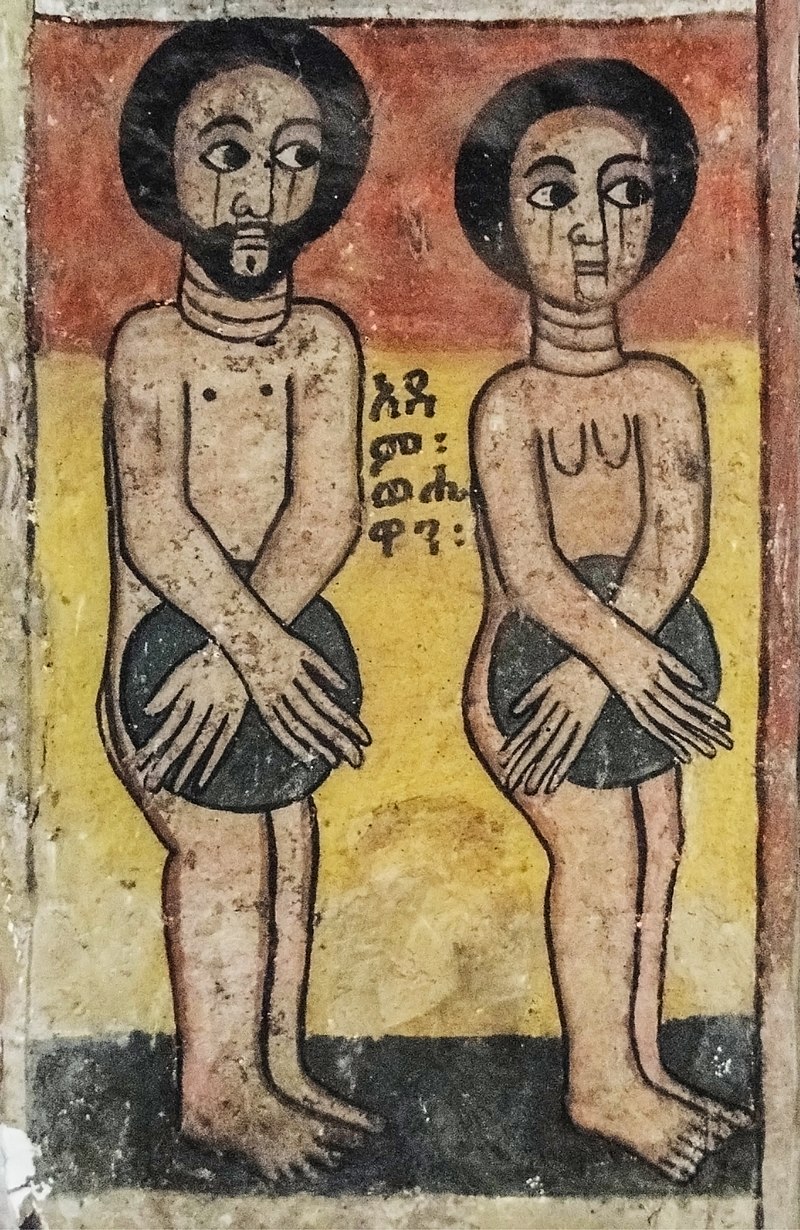
Image: Painting of Adam and Eve inside Abreha and Atsbeha Church, Ethiopia. Photo by Bernard Gagnon, CC BY-SA 3.0

Unfit

(Isaiah 6:1-8; Luke 5:1-11; 1 Corinthians 15:3-10)

When I was a teenager, a dear friend gave me a copy of The Once and Future King, by TH White. The book is an imaginative and introspective re-telling of the story of King Arthur and his knights. I had never read anything quite like it before, and it became an important book to me.

I remember one tale that made a particularly lasting impression on me. A man comes to Arthur’s court because he is suffering from a terrible wound, that will not heal – the result of a curse. He has been told that only the greatest knight in the world can heal his wound; so he has come to Camelot.

Arthur assembles all the knights to have a try, but of course everyone knows that it will be Sir Lancelot who will succeed. Lancelot is known far and wide not only as the mightiest of warriors, but also as the noblest and purest of heart.

But Lancelot knows otherwise. He knows he has betrayed his King through his love affair with the Queen. And he knows, that when he places his hands on the poor wounded man, he will fail; everyone present will know the truth, and Lancelot will be exposed for the fraud he truly is.

Most of us will probably never find ourselves in so fantastical a circumstance.

But perhaps many of us can relate to that persistent doubt, that we are not the person that others have taken us to be, that we are not worthy in fact of their friendship, or their trust. Many of us are familiar with that persistent doubt, that we are not the person God wants us to be, that we are not worthy in fact of God’s trust. That we are, in a word, unfit.

We are in good company.

The lectionary for today sets before us three accounts, from the Hebrew and Christian scriptures, of individuals who declared themselves unfit for duty.  First, we have the prophet Isaiah, in the presence of God and the seraphim, crying out, “Woe is me, for I am a man of unclean lips.” Then, we have the apostle Simon Peter, telling Jesus, “Depart from me, Lord, for I am a sinful man.” And finally, the Apostle Paul, writing to the church he planted in Corinth, telling them that he is in fact “unfit to be an apostle.”

The lectionary could have included other examples. Moses, at the burning bush, tells God to send someone else, for “I am not eloquent, I am slow of speech and tongue.” Jeremiah, called by God to prophesy, tells God that he is too young for the task.

Moses and Jeremiah were concerned about their skill level, their job qualifications, their ability to get the job done; but today’s trio of express a deeper doubt. Isaiah, Peter, and Paul insist that they are unfit for God’s service, not because they are insufficiently skilled, but because they are fundamentally unworthy.

Are all these Biblical figures just being excessively modest?

There is a psychological pattern known as Imposter Syndrome, in which a person persistently fears that they are not as competent as others perceive them to be. It’s fairly widespread; maybe some of you are prone to it. A person suffering from imposter syndrome carries a hidden anxiety, that eventually someone will realize that they are in over their head, that they are faking it, and they will be exposed as a fraud.

A key feature of imposter syndrome, however, is that this anxiety is unsupported by the evidence; the person in question may be performing quite well at their job, and still they fear they don’t belong in their position. A diagnosis of imposter syndrome implies the person is, in fact, quite capable. Hence a cartoon I saw recently, in which a woman is pondering, “I wonder if I’m good enough to have imposter syndrome?”

But what if our assessment is accurate? What if we really are unfit?

We don’t know much about Isaiah’s early life, prior to his prophetic call. We don’t know much about Peter’s life, either, other than his profession. But the Peter of the gospels is overeager, overconfident, and unreliable. The story of Peter in the gospels would almost be a comedy of errors, were the stakes not so high.

As for the author of the Letter to the Corinthians – he was not always named Paul. He was originally named Saul, and he was an aggressively, intolerantly devout Pharisee. In the earliest days of the church, Saul was part of an effort to quash the Jesus movement; in the Book of Acts we learn that he stood by approvingly as one of Jesus’ followers was stoned to death by an angry mob.

Then, one day, Saul was on the road to Damascus when he saw a blinding light, and heard a voice which asked him: Saul, why are you persecuting me? It was the beginning of his conversion, from Saul the persecutor, to Paul the evangelist.

So when Paul tells the Corinthians that he is “unfit to be an apostle,” he is not exhibiting imposter syndrome. He knows what he was, and what he is. “By the grace of God,” he writes, “I am what I am.”

For Paul, as for Peter and Isaiah before him, the experience of call was an experience of grace. His very calling meant forgiveness; and so the proclamation of forgiveness became, in turn, his call.

You might be wondering, what happened to Lancelot, in TH White’s story. White tells us, that after all the other knights had tried and failed, Lancelot came forward to lay his hands on the afflicted man’s head – whereupon his wounds “shut like a box” and his bleeding ceased. The people break into cheering; but Lancelot kneels on the ground, weeping. White writes, “This lonely and motionless figure knew a secret which was hidden from the others. The miracle was the he had been allowed to do a miracle.”

Before God, there can be no imposters. God knows who we are; what we have done, and what we have left undone. We can stop keeping up appearances or worrying that we have been called by mistake. God’s invitation is unconditional; you didn’t receive it in error, it was addressed to you. Go ahead, and open it, and read the good news.

Sermon by Rev. Liza B. Knapp for The First Church of Deerfield, Massachusetts, January 30, 2022.
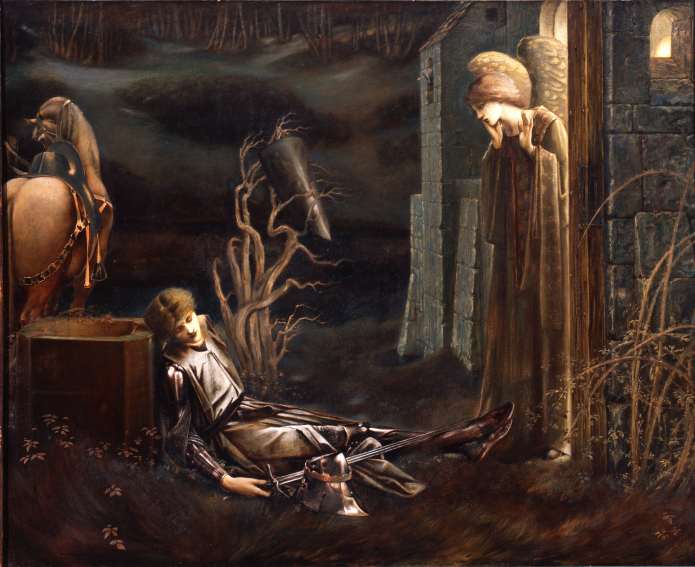
Sir Lancelot at the Chapel of the Grail, by Sir Edward Coley Burne-Jones (1833 – 1898)

A short prayer for “Columbus Day”

Beloved,
You send us messengers of love,
but we prefer other prophets.

For those times when we have
praised the wrong heroes,
followed the wrong leaders,
and chosen the wrong path,
forgive us.

Teach us a better way.

Repenting of the harm we have done,
we ask for another chance
to become your people
by loving your people. AMEN.

Lent 1

(Matthew 3:14)

Out of the depths, we cry to you;
the waters are rising, and there is no foothold.
We call out for rescue, ask you to pull us out;
but instead you dive in with us.

You are the One whose firm hand
is supposed to support us —
the One whose head will stay above the water,
the One whose feet will stay firmly on the rock,
the One who will hold us, against the current —

but instead you lean into our arms,
floating,
and we tremble.

For there is an undertow,
to these waters, to this season

and we are afraid that you will slip
from our grasp
into the deep
and we will have no choice
but to follow
or to lose
you


___
Liza B. Knapp 3.1.2020
for the First Church of Deerfield, MA

Salt

You are the salt of the earth. – Matthew 5:13

The ocean is about four percent salt — and so, more or less, are you.  Life on this planet began in the oceans, and to this day, each cell of our body encloses a small ocean of its own. We may need fresh water to drink, but we have salt water in our veins. About four percent salt, to be specific.

Four percent is only a small part, a tiny fraction. The ocean’s salt is far outweighed by its waters; easily dissolved, the salt is invisible. But that tiny part flavors the whole.  In this respect, salt is more powerful than sugar; an equivalent amount of sugar in water would give it a faintly sweet taste, but 4% salt is enough to give it some bite.

You are the salt, Jesus said. Not the sugar.

Salt nowadays is inexpensive and commonplace, but in the ancient world it was hard to come by and therefore valuable. Soldiers in Ancient Rome were given a ration of salt as part of their wages. This was called the salarium— from which we get the modern word, salary. A hard-working soldier was said to be worth his salt.

But Jesus told his followers, you are the salt.

Salt is not simply a flavor but a seasoning. It enhances other flavors. It strengthens them, heightens them, brings them out of hiding. Salt, added to a chicken, makes it more tender. Salt, added to eggplant, makes it less bitter.

Salt in fact is not only a seasoning, but also a preservative. In the ages before refrigeration and canning, salt was used to store food for long journeys or lean times. Here in New England an entire colonial economy was built upon the export of cod; but without salt, most of that cargo would have been spoiled before it ever came to market. The salt, it turns out, not only helps to dry the fish but also has antimicrobial properties. The presence of salt resists corruption and slows decay.

You are the salt, said Jesus.

Salt is not always a welcome thing; after all, no one enjoys having salt rubbed in their wounds. As an idiom, to rub salt in the wound generally means to make a painful situation more painful. And I can certainly imagine that rubbing salt in a wound would be painful indeed.

But why would anyone apply salt to a wound in the first place? Well it turns out, salt was an ancient medical treatment for trauma. The presence of salt creates an antibacterial environment that resists infection. Salt in the wound can help prevent it from festering, and spreading disease throughout the body.

You are the salt, said Jesus.

Jesus’ followers were just a tiny drop in the ocean — a minority within a minority within a mighty and brutal empire. Yet Jesus told them, you are the salt of the earth — be salty.
Do not lose your distinctive flavor. Keep your edge. Love your enemies, forgive your debtors, do not return evil for evil. Be the salt.

Friends, we too are just a tiny part of the whole. We are wounded people, living in a wounded nation, on a deeply wounded planet. And like all wounded creatures, we are afraid to let anyone touch the site of our pain. And so, we lash out in anger, or withdraw in fear. We try to numb the pain, by turning it into rage or apathy. And meanwhile, the infection spreads.

But you and I are the salt of the earth.

A spoonful full of sugar may make the medicine go down — but we are not the sugar, we are the medicine. We are not called to sugarcoat the truth, or to sweeten the deal. We are not called to dull the world’s pain, but to heal it.

We are not the sugar. We are the salt.

Be salty.


(February 9, 2020, by Rev. Liza B. Knapp for the First Church of Deerfield, MA)

(photo: sea salt crystals, by Liza B. Knapp)

(all rights reserved)


Blessed

#BLESSED

Yesterday* I did a quick search on twitter using the hashtag #blessed.

I found a lot of tweets from young athletes, who reported feeling #blessed after receiving college admissions offers. Other tweeters reported being #blessed with a fresh new haircut, an A on an exam, and an awesome gynecologist.

A surprising number of the tweets were about food; black beans, enchiladas, tacos – apparently Tex Mex is especially blessed, although there was also a memorable reference to “pillowy pockets of Nutella heaven.”

All this blessedness is a somewhat new thing. Growing up I don’t remember people claiming a blessing every time something positive happened in their life. In fact, I don’t remember my family ever using the word except when someone sneezed, and even then, we favored “gesundheit” over “bless you.”

I thought maybe this was maybe just a regional thing, but it turns out that blessing has in fact been on the rise. One historian of religion has traced the sudden increase of blessedness in the past decade to the  rise of the prosperity gospel – a particular interpretation of Christianity that promises material wealth and health to its believers.

The prosperity gospel may be on the rise lately, but it is nothing new; it is the televised American reboot of an idea at least as old as the book of Proverbs, where we read: Misfortune pursues sinners, but prosperity rewards the righteous. It is a program of divine behavior modification, in which good things come to those who are good, or who believe. We get what we deserve, or what we have earned.

#LUCKY

Out of curiosity, I also searched the hashtag #lucky. I found many references to the Chinese New Year. I also found many folks who felt lucky in love. Some felt lucky to have children. One felt lucky to be traveling to Barcelona. There was less Tex Mex food here, but one person did report feeling lucky to be eating popcorn.

We often use the two words – blessed and lucky – as if they mean the same thing. If we experience good fortune, we say we are blessed. But there’s a difference between a blessing and a stroke of luck; for starters, fortune is a noun, but blessing – to bless – is a verb. There is a subject, an actor, a source of every blessing. Luck, on the other hand, just happens.

The third possibility, of course, is that we are the masters of our own fate, and that nothing befalls us by grace or by luck, but only by our own effort or merit. In which case perhaps we should speak of our rewards instead of our blessings.

But there is a difference, between a reward and a blessing and a stroke of luck. It is a difference that becomes more stark, when our luck runs out.

#BROKEN

When I was in my late twenties, I was injured in an accident; I was riding along the Potomac with a friend and for reasons I still don’t know my bike flipped and I came down hard. I was wearing a helmet, but I actually hit my face. I cracked the bone behind my upper lip, lost seven teeth, herniated a disk, and cut my face and mouth so that I needed three dozen stitches.

When I say all that aloud, I still think, wow, that sounds really bad. And it was, pretty bad. But I haven’t told you the whole story. Here’s the rest of it:

My friend rode with me in the ambulance, and waited for me while I got x-rayed, stitched up, and discharged. I was pretty dazed, and it wasn’t until we were leaving that I thought to ask: How are we going to get home?

I called Sarah, she said, and she’s on her way to pick us up.

What happened to our bicycles? I wondered.

They’re at the police station, she said. Cathy will pick them up tomorrow.

Okay, good. I remembered something else. My housemate’s out of town this weekend. I’m not sure I should be alone.

Don’t worry, she said. Simon and Carin are coming over to spend the night. They’ll have to go to work in the morning, but Deb can come and spend the day with you.

In the time it took me to get my stitches, an entire team of friends had assembled to get me through the night. By the time we got to  my house, there was even chocolate pudding waiting for me – which, by the way, is exactly what a traumatized toothless person needs.

I was unlucky that day. But I was also blessed.

My bike accident, bad as it was, was really just a temporary trauma. There are injuries far more lasting, and losses far greater than the loss of a few teeth. And not everyone has a circle of friends ready to pick them up when they fall.

When suffering is prolonged and severe – when we experience, not one, but a whole series of unfortunate events – the question of blessing becomes all the more urgent. For which is easier to believe: that God still loves us, broken as we are; or that God would fix us, if only God still loved us? Catholic writer Henri Nouwen once observed that for many of us, the sense of being cursed often comes more easily than the sense of being blessed. Our brokenness is all the more painful to us, because we see it as evidence of that curse.

For if prosperity is a sign of God’s favor, what are we to make of adversity – our own, or our neighbor’s?

#JESUS

Enter Jesus, on a hillside in Galilee.

Some of you were probably wondering, when I was going to get to him. I sometimes take a roundabout path, but I do get to the scripture, sooner or later.

Jesus begins the Sermon on the Mount with a lavish litany of blessings.

Blessed are the peacemakers, and the pure in heart, and the merciful. Right.

Blessed are the meek, and the poor in spirit. Okay.

Blessed are those who mourn. Umm… Jesus?

Blessed are you, when people revile you and persecute you and utter all kinds of evil against you. Okay, what is going on here?

Jesus radically uncouples God’s blessing from our good luck, by extending it not just to the healthy and wealthy but also to the broken and bankrupt. What sort of blessing is this, then, that belongs even to the meek, the merciful, and the mourning?

This is no prosperity gospel, my friends. This is an adversity gospel.

If we read the Beatitudes as a prosperity gospel, a gospel of reward for righteousness, we come away with the impression that God desires for us to be meek and mourning and reviled. This is how I used to read this scripture, as a list of desirable traits for which we would be rewarded.

But what if that was not the point of these blessings at all? What if Jesus was trying, not to instruct us, but simply to bless us? To bless us, in our adversity? To bless all the folks he saw on that hillside in Galilee – not just the lucky ones, but even the unlucky ones – especially, perhaps, the unlucky ones?

As Lutheran pastor Nadia Bolz-Weber puts it: “Maybe Jesus was simply blessing the ones around him that day who didn’t otherwise receive blessing, the ones who had come to believe that, for them, blessings would never be in the cards. I mean, come on, doesn’t that just sound like something Jesus would do? Extravagantly throwing around blessings as though they grow on trees?”

And those of us who wish to follow Jesus: should we be any less extravagant? If there is a lesson here, perhaps it is not that we should be meek, but that we, too, may bless the meek? Not that we should mourn, but that we, too, may bless the mourning? Not that we must earn our blessing, but that we, like Jesus, like Abraham, may become a blessing to our neighbor?

It isn’t really that hard to do. Sometimes all it takes is some chocolate pudding.

The evening after my accident, I sat in my living room, surrounded by my friends, eating chocolate pudding. If I was in pain, I do not remember it. I remember only two feelings: hunger and happiness. Broken though I was, I was blessed.

And so are you, my friends. So are we all.

For this is the story at the heart of our scriptures:
that even an enslaved people may be God’s chosen people,
that even a condemned man may be God’s beloved son,
that even the broken may be blessed.


For I the LORD am your God
You are precious in my sight,
and honored,
and I love you
(Isaiah 43:3,4)


*Sermon preached February 5, 2017,
at the First Church of Deerfield, MA.

Photo: Carl Nenzen Loven, unsplash.com