Working the Clay


In college I studied both biology and religion. Upon finding this out, people would sometimes ask me, “Do you believe in creation or evolution?”

And I would say, “Yes.” 

The staunch creationists of the day – the biblical literalists – were firmly committed to the belief that God created all living things ex nihilo – out of nothing – in their present, fully realized form. Like a magician, pulling a rabbit out of an empty hat. Many creationists do acknowledge the existence of now-vanished life forms, like dinosaurs; although I have encountered some who believe that fossils are a giant hoax perpetrated by God, to test our faith. But most creationists believe there were dinosaurs once; they just believe humans existed alongside them. They accept extinction, sure; but evolution, no.

This is the Biblical story of creation as told in the first chapter of Genesis, in which an omnipotent God brings forth living things, each distinct, according to precise divine specifications. God makes everything exactly according to plan, like an almighty engineer.

But then we get to the second chapter of Genesis, where we find an entirely different creation story.

We know it is a different story, because the order of creation is re-arranged. In the first story, God fills the earth with plants and animals, and only then creates humans – which makes sense, because how could we survive without them? But in the second story, God creates humans before the animals, “when no green things had yet sprouted.”

In the first story, God creates humans, plural, male and female, simultaneously – all, we are told, in God’s apparently non-binary image. In the second story, God makes one human out of clay, and then borrows a bit from it to make another human.

Think about that: no sooner does God create this work of art, than God tears it apart – but not to destroy it. God re-worked the clay, so that we might be not one groundling, but two. What a lovely, generous act, on God’s part – to create a rival, for his creature’s affection! From the beginning, God wanted us to love, not God alone, but one another. 

Here creation begins with clay, which is, essentially mud. God is playing in the mud. In the first chapter of Genesis, God calls us forth with a word; but in the second chapter, God gets God’s hands dirty. In the first we have God the Senior Engineer; in the second, we have God the Artist.

**

When I was deeply immersed my biology and religion studies, in my senior year, I decided I needed to have some break from these subjects, so I took a single introductory class in studio arts. It was taught by a dynamic young artist* whose own work was primarily three-dimensional. I remember an exhibit of his work in the college library; it consisted of large wooden sculptures – human sized – that all look somehow biological, like something that you might see through a microscope.

One day, as I was painting my beginner still life (which still hangs in my kitchen because I was so proud of it) our teacher spoke with us about his own artistic process. He told us that he never knew when he started a series, what a given piece would look like when it was done. “If I know exactly how the sculpture will look when its finished,” he said, “then there’s no point in making it.”

He did not desire absolute control over his medium; he wanted an interactive relationship.

“If we are to keep in touch with reality, we must work with some material substance that resists us, and against which we have to pit ourselves to reshape it.” So writes Cistercian monk Andre Louf, in his book The Cistercian Way. He goes on to say, “whatever it is – the soil, clay, wood, water, metal, cheese or chocolate – the monk needs this simple material to measure himself against every day. He will thus be kept in contact with reality, for these things come from God, and are solidly rooted in the earth, of which they are a part.”

As human beings — groundlings, beings of earth, creatures of clay — we are in the paradoxical position, the almost unique position, of being both creators and creatures, both the sculptor and the clay. We are the material God works with, the substance that resists God’s hand. We are the clay on the wheel that sometimes slips so far off center, that the potter has no choice but to start again, and re-form us from scratch.

**

So we come to the prophet Jeremiah, who visited a potter at his wheel, and saw there a parable.

Under the potter’s steady hand, the clay begins to take shape, and something beautiful and useful emerges; but, as Jeremiah observed, sometimes the clay slips off center, and there is nothing for it but to return to the clay to its original formless lump, and start again.

Jeremiah saw in this a parable for his people. Jeremiah lived in tumultuous times. During his lifetime, he would bear witness to the collapse of his nation; he would see his people carried into exile, and his sacred temple razed to the ground, the sculpture reduced to dust. But before these events – before it all spun out of control — he tried to warn them, to tell them, some thing is off center here.

But the powers that be censored his warnings, which they found unpatriotic.

When Jerusalem finally fell, when the clay finally collapsed on the wheel of history, Jeremiah’s people lamented, feeling that God had abandoned them. But Jeremiah, the former prophet of doom, became suddenly, oddly hopeful in their midst. Perhaps he remembered that afternoon in the potter’s shed. He remembered, how the potter patiently reworked the clay, to make it pliable, to see what beautiful thing might yet arise from such a stubbornly resistant medium.

**

In the history of a people, in the life of an individual, there are times when things seem to be taking shape: when we see our family thriving, our vocation unfolding, our nation progressing toward justice and peace. When the form on the wheel becomes lovely, as if shaped by some unseen potter’s hand.

But then how suddenly the shape of our lives can change. The emerging peace vanishes and all is chaos again. Perhaps there was some flaw in the foundation, some persistent imbalance, some bit of resistance and rigidity in us.  I know that many of us are experiencing this loss of balance now – some of us in our personal lives, and most of us in our collective life as a nation. The center has shifted, and we are become de-formed. We can no longer recognize our own shape, and we lament the loss of our former beauty.

But let us remember the lesson of the potter’s shed. And let us not despair. There is good clay here still.

We are God’s work in progress. We know what we are, but not what we may be. Or to quote the poet Jan Richardson: “All those days you felt like dust, like dirt… Did you not know, what the Holy One can do with dust?”

O patient artist
shape us for love.
Keep us right-sized and malleable.
Center us, and save us from rigidity.
And when we collapse
under the weight of our own
obstinacy,
cradle us again in your hand,
and warm us
until our hardness yields to mercy.
Amen. 

Rev. Liza B. Knapp
The First Church of Deerfield, Massachusetts
Sunday, September 21, 2025
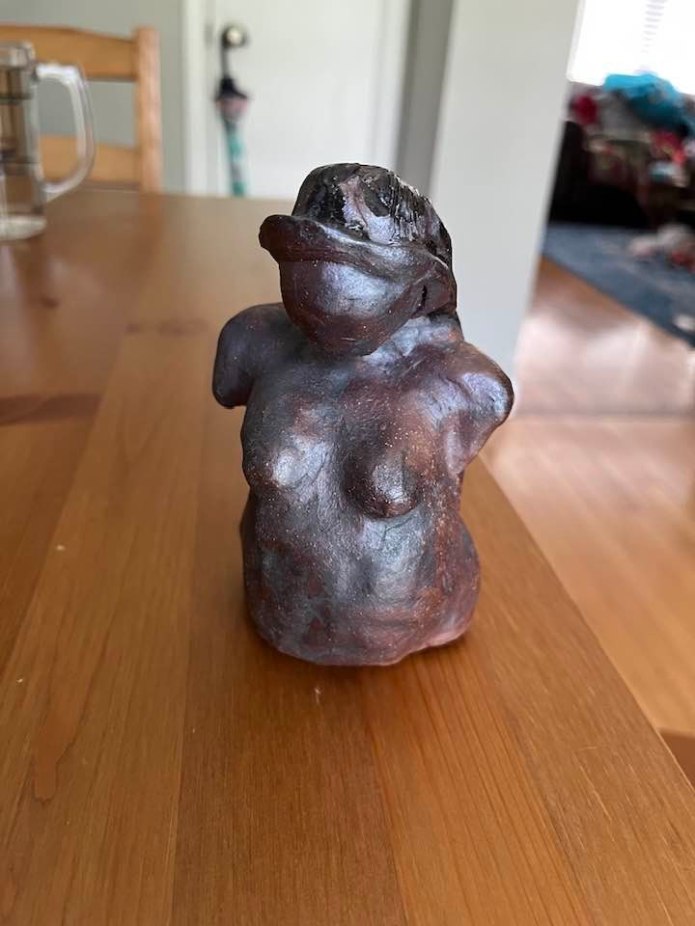
Pottery and photos by Audra Teague Mackey
*my professor was artist Brian Meunier; you can see his sculpture here.
On the Death of an Enemy

I did not wish him pain, or sudden death.
I did not wish his children to suffer bereavement and trauma.
I did not wish for a world where disputes are settled by gunshot.

But now that he is dead, what am I to say?
In life, he was my enemy.

I say this not to describe my feelings for him. In calling him my enemy, I speak only of his actions toward me. I want you to note the direction of the action here, because it’s important and I want to be very clear about this. My enemy is someone who seeks to harm me, not vice versa. If you seek to harm me, you are my enemy. If I seek to harm you – well then, I’m yours.

He was my enemy, but I was not his enemy. He was not my target, but I was his target.

Not me, personally, mind you. I have had very few, if any, personal enemies in my life — for which I count myself very lucky, because it is at least as much due to luck as anything else.

Charlie Kirk was not my personal enemy, because he never met me. Nevertheless, he bore ill will toward me, and people like me, and people that I love. He stirred hatred against us. He tried to convince his followers that I was their enemy, which I was not; but, believing him, some of them became mine.

In the moments before he was shot, Charlie Kirk was engaged in a conversation, about whether transgender people are more likely to be mass shooters. (They are not.) But for Kirk, it was just the latest of his many statements vilifying LGBTQ people – a group which includes me and many of my loved ones, including my dad. He has called us an “abomination” and once said the execution of gay people was part of “God’s perfect plan.”

So what am I to say, now that he is dead?

I did not grow up watching the sort of action films in which avenging superheroes gets to violently destroy the villains in the final scene. Except I did grow up watching the Wizard of Oz, in which not one but two wicked witches are killed, the first by a tornado and the second by a bucket of water. The first death is an act of God, the second an accident. It’s not like the Munchkins took matters into their own hands to rid themselves of their enemy. But when their oppressor dies, the friends of Dorothy celebrate. The little people dance in the streets, singing “Ding Dong the Witch is Dead.” And there were some who took to social media last week, to proclaim essentially the same thing. As the more recent musical version of the same story says, “No one mourns the wicked.”

Except, of course, that someone always does. To quote another musical, “No one is alone.” One person’s enemy is another person’s beloved. Did the shooter know, when he pulled the trigger, that Charlie Kirk’s three-year-old daughter was there in the crowd? I love the Wizard of Oz, but the Wizard of Oz is a fable; in the real world, violence never harms just one person. Trauma and bereavement spread out like ripples from any sudden death.

Charlie Kirk’s alleged murderer is now in custody, delivered to the FBI by a member of his own family. He is 21 years old. He appears to have been radicalized through his online activities. He is therefore part of a pattern, of young men increasingly embracing violence as their personal manifesto. It was initially assumed he must be a far-left extremist; it now appears he may have been a far-far-right extremist. Does it matter? It is the same action, either way. People of all religious beliefs and political ideologies are drawn to the simplicity of a loaded weapon, and its illusion of power.

But the fact that the very same act might have been the result of diametrically opposed political goals should give us pause; and cause us to question, whether the ends justify the means. Or vice versa.

Three months before I was born, civil rights activist Medgar Evers was assassinated. By the time I turned five, John F. Kennedy, Malcolm X, Martin Luther King Jr, and Robert Kennedy had all been shot and killed. It was a dangerous time for public figures in America. Now half a century later, we appear to be in such a dangerous time once again. Just two months before Charlie Kirk’s death, Minnesota state legislator Mellisa Horman was shot and killed in her home.

Does it matter, which side the dead were on? Does it matter, which side the shooter was on? Is the enemy of my enemy my friend? or another enemy?

To make sense of this, I turn as I ordinarily do, to Jesus.

Jesus said, LOVE YOUR ENEMIES.

Not, conquer your enemies. Not, kill your enemies. LOVE your enemies.

For three hundred and fifty years, the First Church of Deerfield has aspired to follow the teachings of Jesus. For some of that time the congregation identified as Trinitarian, and for some of that time the congregation identified as Unitarian, and now we are a sort of theological chimera, a hybrid; but still after all of these permutations our mission statement reads, “as his followers, we accept the religion of Jesus, holding in accordance with his teachings that practical religion is summed up in love to God and love to humanity.” Those of us here today differ in our beliefs about the divinity of Jesus, but we have historically been united by a desire to embody the love of Jesus. So I suggest we at least take his words seriously, and consider them.

Do we take him seriously, when he says, Love your enemies?

The apostles took that teaching seriously. When Jesus was arrested, one of his friends drew a sword to defend him, but when Jesus told him, “NO MORE OF THIS,” he put down his weapon for good. In the early years of the church, Christians had many enemies to fear; but no one had anything to fear from them. It wasn’t until the emperor merged church and state, that the defenders of the faith began using weapons.

What do we make of this teaching? Do we take Jesus seriously, when he says, Love your enemies? Or do we carve out some exceptions, to this rule?  The Reverend Dr. Martin Luther King Jr took him seriously; the German pastor carved out at least one exception, when he joined an assassination plot against Adolph Hitler.

Most of us are not likely to attempt a political assassination. (I’m tempted to say, if you are, don’t tell me – but maybe I should say, if you are, let’s talk.) But do we cheer secretly – or not so secretly – when someone else does it for us? Ding dong, the witch is dead?

What then, am I to say about Charlie Kirk, now that he is dead?

“The evil that men do lives after them; the good is oft interred with their bones.” So says Shakespeare’s Marc Antony, in the play Julius Caesar. In my experience the reverse is just as often true; people are loathe to speak ill of the dead. Marc Antony says those words and then goes on to preach a eulogy so unabashedly praising of Caesar that by the end of his speech, a crowd of mourners has turned into a mob of avengers. We’ve seen a little of that, too, in the last few days. And meanwhile, the family and friends of Charlie Kirk are trying to scrub the internet of any posts that point out his sins.

When I’m working with a family preparing a memorial, they will sometimes share with me difficult things, about the deceased. And they wonder whether perhaps these aspects of the deceased’s life should be avoided, in the eulogy. Should I mention that she was an alcoholic? Can I say that he was really hard on me, when I was a kid? Do we admit that the cause of death was overdose? Just how honest should a eulogy be?

I leave that up to the family, but I do tell them, that when we gather to mourn, we need to mourn the whole person.  If we remember only some sanitized or simplified or glorified version, then we aren’t really remembering the real person at all. It’s some other person we are describing, if we turn our very human neighbors and friends into saints.

Jesus knew who his enemies were. He was under no illusions about their intentions toward him. He loved them anyway. He did not tell his followers, praise your enemies; he said, love them.

So when we speak of the dead — whoever they are — let us speak with both love and honesty. Let our eulogies be honest eulogies, admitting of good and evil. Only in this way, can our love be an honest love.

For this is as good a working definition of grace as any I have heard:  Grace is the experience of being fully known — and yet beloved.

Grace be unto you.

Amen.

Rev. Liza B. Knapp
The First Church of Deerfield
September 14, 2025

all rights reserved

In the Beginning Was the Water

Labor Day has come and gone. School has begun. Vacation days have been spent.

We like Thoreau, have left Walden behind, and are once again sojourners in civilized life. We have returned from our summer retreat of longer days and lowered demands. And maybe our souls have been renewed, and maybe our minds have been refreshed, by this respite. Or maybe not. Either way, as we return from our summer pilgrimage, we wonder, how long until our routines re-assert themselves? How long before the numbness returns, how long before the exhaustion claims us again, how long before we return to autopilot?

I used to savor my summer tan, which lasted well into winter. I understand now, of course, that a tan is not something to be sought, but in my younger years I took it as a hopeful sign, that I had been marked and changed by my time at the seashore. That the ocean’s edge was imprinted on my skin – not a permanent tattoo, but long-lasting enough to see me to the next summer. My father was a teacher, and had a long vacation; for a full month, I was baptized daily in the salt water, and my thoughts were scoured clean by the wind and the water.

Peace of the running wave to you, says the ancient blessing.

And then it would be back to the sweaty city and the long list of labors. But something of the salt clings to us. After the ocean, there is a deep coolness in our core that will take some time for the heat to penetrate.

I wonder if church shouldn’t be more like this: A bracing immersion that shocks us into full presence, and a moment of wonder at the great immensity from which we emerged. A pilgrimage to the edge of the known world, where words fail us and we become our true, nameless selves.

My mother taught me this trick as a child: Hold a seashell up to your ear, and its curving labyrinth will echo back to you the sound of the blood coursing through your veins. It is the sound of the sea. God within, God without. There is no holier place than the ocean’s edge. There is no better sermon, than a seashell.

Today we begin a new season, in our yearly cycle of faith. It is a fairly young liturgical season, only recently adopted by churches around the world. It is the season of creation, when we turn our attention to the abundance and fragility and wonder of the earth. And so this week, and in the weeks to come, we will be considering the stories of creation. For there are several; in the Bible alone, there is more than one creation story. Today, we start with the most famous: the first chapter of Genesis. It goes like this:

In the beginning, there was… water.

Some of us may remember another creation song from the Gospel of John, which begins, In the beginning was the Word. But the song at the start of Genesis begins differently. In this, the first of the Bible’s creation stories – for there are several – we begin with water. There is no point at which God says, Let there be water. It is there, before God speaks a word. In the beginning, all was without form; and the breath of God moved over the waters.

For how long? An instant? An eternity? How does one measure time, when all is without form?

Then God speaks, and shapes the formless chaos, separating light from dark, and the waters below from the waters above; the ocean depths, from the depths of space – both blue by day and black by night, both immense beyond measure. The ancient people who told this story imagined the seas and the skies to be of one substance, separated by a great dome from horizon to horizon like an inverted bowl. A “firmament,” in the old King James translation. When it rained, the waters of heaven return to touch the waters of the ocean.

I touched the ocean only briefly this year, out on Cape Cod, near the town of Wellfleet. The waves there have a strong pull, on both body and soul. I am not a strong swimmer, so my body has a healthy respect for the ocean, a fear of its power. At the same time, my soul is drawn to it, with a sense of wonder and longing. This, I imagine, is the psalmists meant, when they spoke of “the fear of God.” Not some petty or craven fear of punishment, but the fear of a great wave coming toward us, bearing the immensity of the unknown, from which we came.

Life began in water; we only moved onto dry land when our ancestors figured out how to carry some of that brine with us, enclosed in our skins or shells or cell walls. Even now, each of us begins life submerged, in the water of the womb. In touching the water, we touch our source.

Deep peace of the running wave to you.

**

There are other creation myths, some older than Genesis. Some tell of a primordial battle, in which a heroic god slays a primordial sea monster, and forms the earth and sky from the monster’s severed body. The fact that the monster is female – and is in fact the hero’s mother – adds a disturbingly Freudian and misogynistic dimension to the story. Humans fear the chaos from which we came, our primordial formlessness.

While I was on the Cape, I picked up a copy of Moby Dick — and yes, I did read it. To any of you who found it a slog in high school English class, I can only say it is better when read voluntarily.

The plot of Moby Dick is well known: the narrator, Ishmael, sets sail from Nantucket on a whaler under the command of the one-legged Captain Ahab. Once at sea, Ahab reveals to the crew that he sails with a single purpose only: to seek vengeance on the whale that took his leg, the legendary white whale known as “Moby Dick.” The book ends with a catastrophic encounter between the great whale and the ship.

In his first encounter with the whale, Ahab has encountered something greater than himself: not the orderly god of heaven, but the chaos monster of the deep. That this beast should dismember Ahab, and yet live; this, to Ahab, is the unbearable injury. He dreams of conquering the monster, of literally cutting it up into pieces.

It is an old, old story.

But this is the thing that surprises many first-time readers of Moby Dick. The book has 135 chapters; the ship sets sail in chapter 22, but the white whale does not actually appear in person until chapter 133. In between, there are a great many chapters devoted to the subject of whales, in general, and to the sperm whale, in particular. But all this knowledge comes to nothing, in the face of the living whale. When Moby Dick finally appears, it is all over, in three short chapters.

I am reminded of the final chapter of the book of Job, where after many chapters of theological debate, God shows up, in person. God speaking from the whirlwind, and silences Job’s theology with a single question: “Can you catch Leviathan with a hook? Think of the battle. You will not do it again.”

The scripture we read today does not tell of a God who destroys the sea monster. Yonder is the sea, great and wide, sings the psalmist; there go the ships, and Leviathan, whom you formed to sport in it. This no warrior god, at war with nature; but a God at play, among the waters of creation.

Much like the children I saw, on the beach at Wellfleet, suntanned and salty, at play in the waters, at the edge of the great unknown.

Amen.

Deep peace of the running wave to you
Deep peace of the flowing air to you
Deep peace of the quiet earth to you
Deep peace of the shining stars to you
Deep peace of the gentle night to you
and to your dear ones. Amen.

Sermon by Rev. Liza B. Knapp
The First Church of Deerfield, Massachusetts
September 7, 2025

Scriptures references: Genesis 1: 1-10, Job 41:1-8, Psalm 104: 24-30

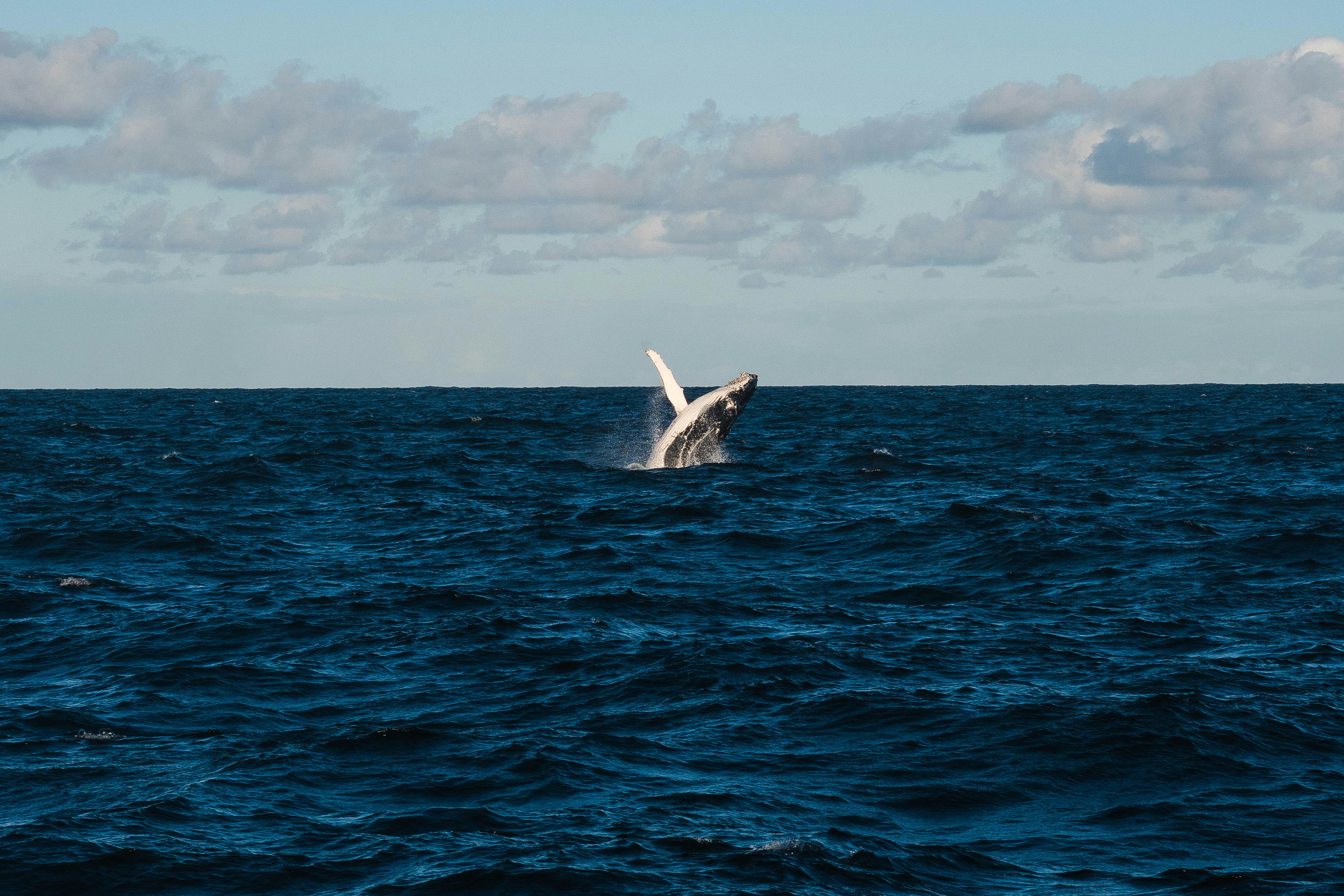
Photo above by Leslie Chappell on Unsplash
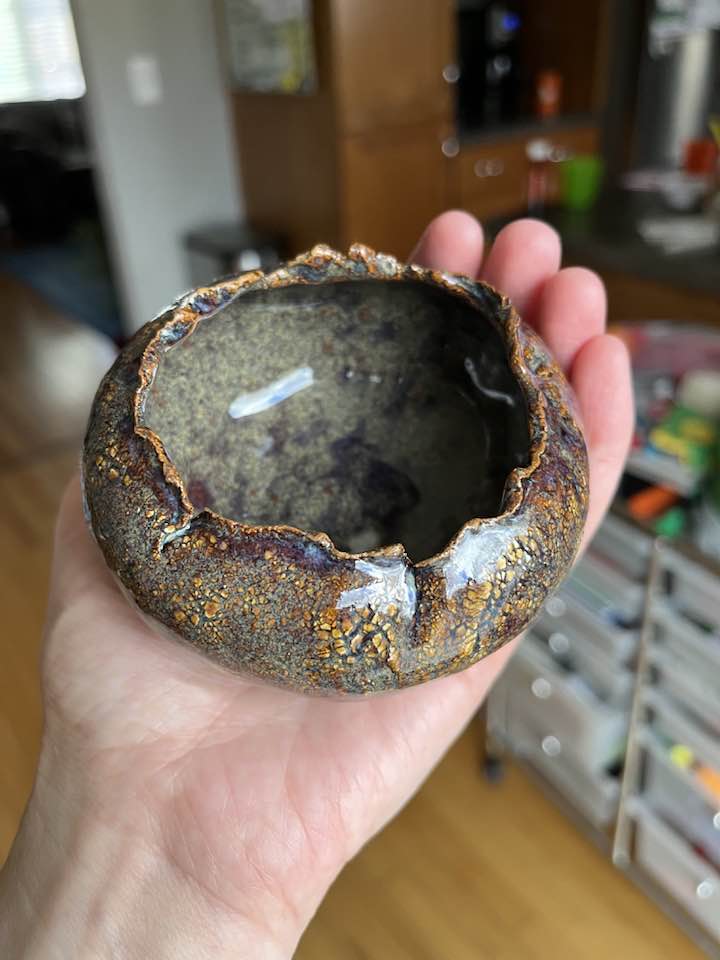
Photo below by Silas Baisch on Unsplash