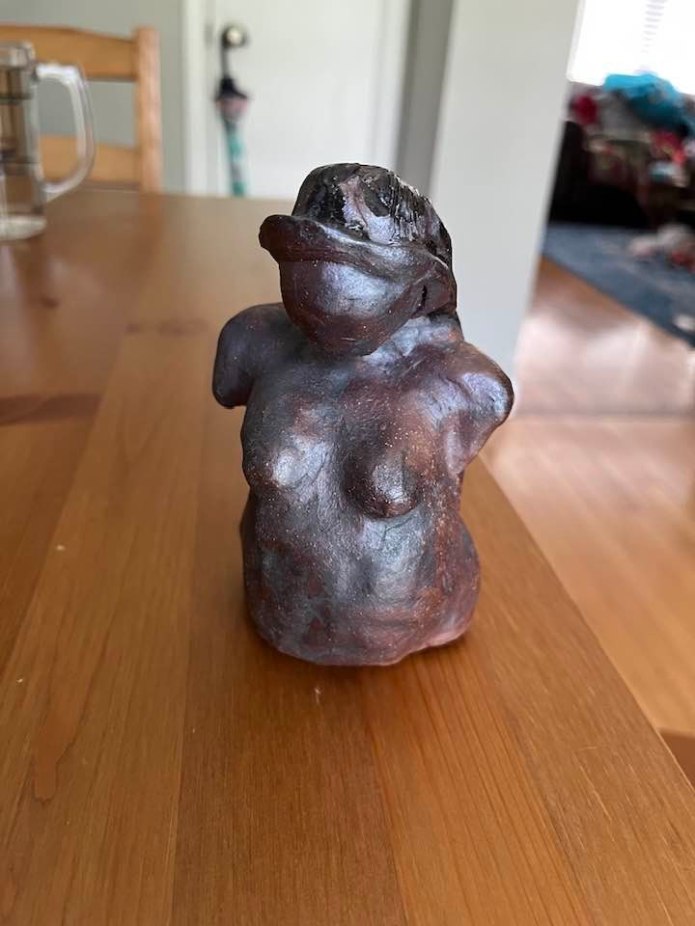
In college I studied both biology and religion. Upon finding this out, people would sometimes ask me, “Do you believe in creation or evolution?”
And I would say, “Yes.”
The staunch creationists of the day – the biblical literalists – were firmly committed to the belief that God created all living things ex nihilo – out of nothing – in their present, fully realized form. Like a magician, pulling a rabbit out of an empty hat. Many creationists do acknowledge the existence of now-vanished life forms, like dinosaurs; although I have encountered some who believe that fossils are a giant hoax perpetrated by God, to test our faith. But most creationists believe there were dinosaurs once; they just believe humans existed alongside them. They accept extinction, sure; but evolution, no.
This is the Biblical story of creation as told in the first chapter of Genesis, in which an omnipotent God brings forth living things, each distinct, according to precise divine specifications. God makes everything exactly according to plan, like an almighty engineer.
But then we get to the second chapter of Genesis, where we find an entirely different creation story.
We know it is a different story, because the order of creation is re-arranged. In the first story, God fills the earth with plants and animals, and only then creates humans – which makes sense, because how could we survive without them? But in the second story, God creates humans before the animals, “when no green things had yet sprouted.”
In the first story, God creates humans, plural, male and female, simultaneously – all, we are told, in God’s apparently non-binary image. In the second story, God makes one human out of clay, and then borrows a bit from it to make another human.
Think about that: no sooner does God create this work of art, than God tears it apart – but not to destroy it. God re-worked the clay, so that we might be not one groundling, but two. What a lovely, generous act, on God’s part – to create a rival, for his creature’s affection! From the beginning, God wanted us to love, not God alone, but one another.
Here creation begins with clay, which is, essentially mud. God is playing in the mud. In the first chapter of Genesis, God calls us forth with a word; but in the second chapter, God gets God’s hands dirty. In the first we have God the Senior Engineer; in the second, we have God the Artist.
**
When I was deeply immersed my biology and religion studies, in my senior year, I decided I needed to have some break from these subjects, so I took a single introductory class in studio arts. It was taught by a dynamic young artist* whose own work was primarily three-dimensional. I remember an exhibit of his work in the college library; it consisted of large wooden sculptures – human sized – that all look somehow biological, like something that you might see through a microscope.
One day, as I was painting my beginner still life (which still hangs in my kitchen because I was so proud of it) our teacher spoke with us about his own artistic process. He told us that he never knew when he started a series, what a given piece would look like when it was done. “If I know exactly how the sculpture will look when its finished,” he said, “then there’s no point in making it.”
He did not desire absolute control over his medium; he wanted an interactive relationship.
“If we are to keep in touch with reality, we must work with some material substance that resists us, and against which we have to pit ourselves to reshape it.” So writes Cistercian monk Andre Louf, in his book The Cistercian Way. He goes on to say, “whatever it is – the soil, clay, wood, water, metal, cheese or chocolate – the monk needs this simple material to measure himself against every day. He will thus be kept in contact with reality, for these things come from God, and are solidly rooted in the earth, of which they are a part.”
As human beings — groundlings, beings of earth, creatures of clay — we are in the paradoxical position, the almost unique position, of being both creators and creatures, both the sculptor and the clay. We are the material God works with, the substance that resists God’s hand. We are the clay on the wheel that sometimes slips so far off center, that the potter has no choice but to start again, and re-form us from scratch.
**
So we come to the prophet Jeremiah, who visited a potter at his wheel, and saw there a parable.
Under the potter’s steady hand, the clay begins to take shape, and something beautiful and useful emerges; but, as Jeremiah observed, sometimes the clay slips off center, and there is nothing for it but to return to the clay to its original formless lump, and start again.
Jeremiah saw in this a parable for his people. Jeremiah lived in tumultuous times. During his lifetime, he would bear witness to the collapse of his nation; he would see his people carried into exile, and his sacred temple razed to the ground, the sculpture reduced to dust. But before these events – before it all spun out of control — he tried to warn them, to tell them, some thing is off center here.
But the powers that be censored his warnings, which they found unpatriotic.
When Jerusalem finally fell, when the clay finally collapsed on the wheel of history, Jeremiah’s people lamented, feeling that God had abandoned them. But Jeremiah, the former prophet of doom, became suddenly, oddly hopeful in their midst. Perhaps he remembered that afternoon in the potter’s shed. He remembered, how the potter patiently reworked the clay, to make it pliable, to see what beautiful thing might yet arise from such a stubbornly resistant medium.
**
In the history of a people, in the life of an individual, there are times when things seem to be taking shape: when we see our family thriving, our vocation unfolding, our nation progressing toward justice and peace. When the form on the wheel becomes lovely, as if shaped by some unseen potter’s hand.
But then how suddenly the shape of our lives can change. The emerging peace vanishes and all is chaos again. Perhaps there was some flaw in the foundation, some persistent imbalance, some bit of resistance and rigidity in us. I know that many of us are experiencing this loss of balance now – some of us in our personal lives, and most of us in our collective life as a nation. The center has shifted, and we are become de-formed. We can no longer recognize our own shape, and we lament the loss of our former beauty.
But let us remember the lesson of the potter’s shed. And let us not despair. There is good clay here still.
We are God’s work in progress. We know what we are, but not what we may be. Or to quote the poet Jan Richardson: “All those days you felt like dust, like dirt… Did you not know, what the Holy One can do with dust?”
O patient artist
shape us for love.
Keep us right-sized and malleable.
Center us, and save us from rigidity.
And when we collapse
under the weight of our own
obstinacy,
cradle us again in your hand,
and warm us
until our hardness yields to mercy.
Amen.
Rev. Liza B. Knapp
The First Church of Deerfield, Massachusetts
Sunday, September 21, 2025
Pottery and photos by Audra Teague Mackey
*my professor was artist Brian Meunier; you can see his sculpture here.
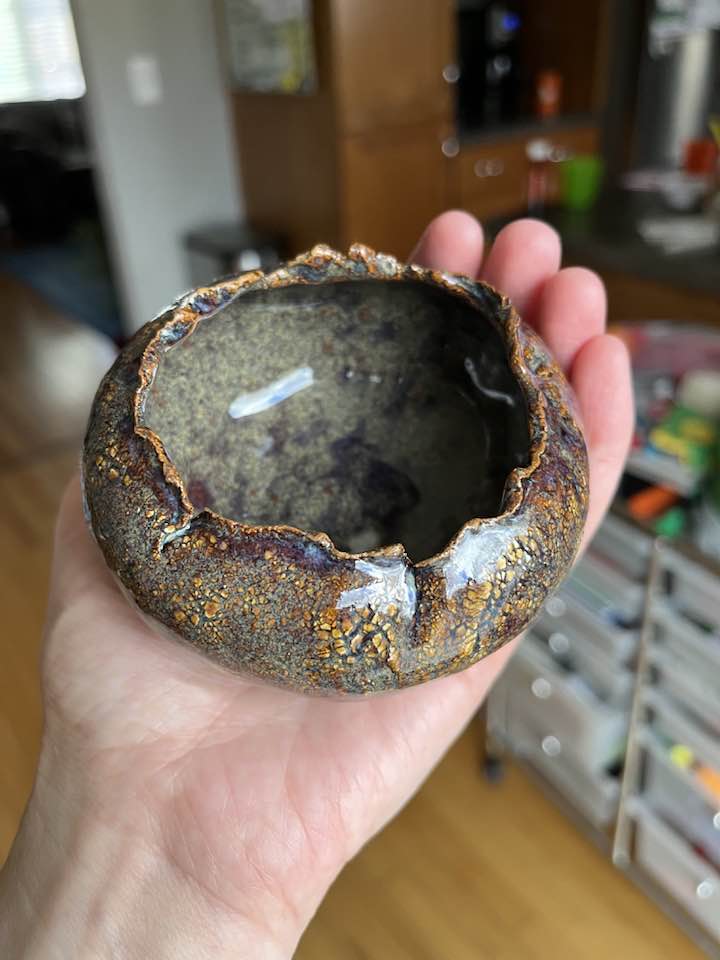
 the Mystery and the Mud