Unwanted Blessing: The Good Samaritan in an Age of Partisanship

In oral story-telling, things usually happen in threes — three bears, three pigs, three wishes. And so in this story, we have three travelers: A Priest, a Levite, and a Samaritan.

Mind you, Jesus could have told this story in a more generic way. The three travelers could have been simply that – three travelers, passing along the road to Jericho; two who did not stop, and one who did.

But no – Jesus is very specific here. The first traveler is a priest, the second a Levite, the third a Samaritan. It’s only the beaten man in the road who is left without any further identification. He alone is a generic everyman. When we are beaten and bloody and left for dead, we become no more – and no less – than a human body.

So perhaps this is the first lesson of this story. Those in need are, simply, human. We need know nothing more.

I say the first lesson of this story, because this is a parable, not a fable. A fable is a story with a clear moral at the end – a single lesson to teach. Like, “Slow and steady wins the race.” Or, “Never cry wolf.” A parable, on the other hand, that’s much less cut and dried. A parable has multiple meanings and multiple interpretations. It raises questions as much as it answers them. The message the parable has for us depends in part on who we are, and where we see ourselves in the narrative.

So let’s return to Jesus’ story.

Unlike the victim, the other travelers are given specific social identities. And with the naming of this cast of characters – the priest, the Levite, and the Samaritan – Jesus’ tale becomes unavoidably political. I use this word, not in its usual sense of “partisan” – we have come to use these two words as synonyms because so much of our own politics is partisan – but in the way that Aristotle once defined it – to be political, is to be engaged in public conversation regarding the ordering of our common life.

When I say this parable is political, I mean it takes the lawyer’s abstract question – who is my neighbor? – and makes it specific and real and therefore controversial. It’s the difference between saying, “All Are Welcome,” and saying, “we welcome gay, lesbian, bisexual, and transgender persons.” It’s the difference between saying, All Lives Matter, and saying, Black Lives Matter. It’s easy to get folks to agree to some vaguely-defined, general moral principle; the devil lurks in the details.

When the lawyer, seeking to justify himself, asks, “who is my neighbor,” Jesus doesn’t just say, “everyone.” He tells the lawyer a story – not about three generic travelers, but about a priest, a Levite, and a Samaritan.

Now, the first two – the priest and the Levite – would both be considered pillars of the Jewish community, moral examplars to be emulated. So if the lawyer was looking for an out, Jesus seems to have handed him one. What’s good enough for the priest, is good enough for the people, right?

Well, maybe not. Not good enough, certainly, for the man lying on the side of the road. Thank God, then, for the third traveller. The one who stops, and binds his wounds, and carries him to safety. Does it matter, that this man is a Samaritan?

Geographically, Samaritans and Jews were, indeed, neighbors, but they were separated by a deep historical divide that was both political and religious. The Hebrew Scriptures tell how the two regions had once been one country, a united kingdom ruled over by David and Solomon. But after Solomon’s reign, the peoples were split by civil war. Samaria became the capital of the northern kingdom while Jerusalem remained the capital in the south. The two groups diverged in their religious practices and customs. They began to view each other with mistrust and contempt. Not long before he told this story, Jesus himself had been denied hospitality, while traveling through Samaria.

So it must have come as a shock for his listeners, when Jesus cast the Samaritan in the role of the hero. It still comes as a shock to me, today.

I mean, I get the idea that we should help those in need. I get the idea that compassion is more important than piety. I get the idea that racial and national and religious borders should not set limits on our common humanity.

But the really weird thing about this story, the thing that we so often don’t get, is that the Samaritan – the outsider, the enemy, the heretic – he isn’t the guy who needs help in this story. He’s the guy who offers help. The guy who needs help? That’s everyman. That’s us.

It is hard enough, to bless our enemies. But to be blessed by our enemies? That is nearly unbearable. After all, I can bless my enemy without ever giving up the moral high ground. I can pick my enemy off the ground, and pat myself on the back, saying “that’s more than they would do for me.” But when I am blessed by my enemy, my world turns upside down.

So I wonder, if Jesus were to tell this story today, to me – who might he cast in the roles of Priest, Levite, and Samaritan? It’s an activity I’ve done with youth groups, a sort of parable Mad Libs where I first have them write down the names of two people they admired, and one they despised, and then we read the parable with those names inserted. For the people they admired, they wrote the names of their favorite teachers, their best friends; one wrote down his own name. But for the person they despised, most of them wrote down – well, let’s just say a prominent political figure of the day.

In recent years, researchers have found that “both Republicans and Democrats increasingly dislike, even loathe, their opponents.” America is becoming as divided by political ideology as by religion, gender, or race. During my own lifetime, interracial and interfaith marriage have increased, but inter-party marriages have declined.  Our media, our news sources, our vocabulary, our voting districts are increasingly segregated by political affiliation. We may not have personal enemies; but we do have political enemies.

So let’s imagine a modern re-telling of this ancient parable, shall we?

One snowy morning, a traveler was driving to work when an aggressive driver forced her to swerve, and her car spun off the road into the ditch. The traveler reached for her cell phone but unfortunately she was in one of those dead zones between towns were there is no cell coverage. So instead she anxiously scanned the road for someone who might help her.

The first car to come by sped by on the opposite side of the road. As it passed, the traveler noticed a campaign sticker on its rear bumper. The sticker said, [insert the name of your favorite Presidential candidate here].

A second car did the same, although this time the driver waved as they went past. As the car disappeared, the traveler noticed a campaign sticker on the rear bumpers. It said, [insert the name of your second-favorite candidate here].

A third car came by, and the driver pulled over, to find out if she all right, and if she needed a ride anywhere. As she thanked him, she noticed the campaign sticker on the rear bumper of the car. The sticker said, [you guessed it: insert here the name of your least-favorite candidate – the one you truly despise.]

The truth is, sometimes we would almost rather hear that our opponents have done something truly despicable, than that they have done something good. We would rather be right, than reconciled.

But Jesus didn’t say, be better than the Samaritan. He said, be like the Samaritan. What a shock that must have been, to that pious lawyer. What a shock it still is, to us.

What a world it might be, if we all went and did likewise.


(sermon preached by Rev. Liza B. Knapp at Belchertown United Church of Christ on Feb 21, 2016)

freezing the moment

Close your eyes, for a moment, and try to remember some place, some time, some moment when you felt that you were in the presence of something sacred. How long ago was that moment? How long did it last?

I remember this one particular afternoon, a sunny spring afternoon at the home of some family friends, a farm in Columbia County, New York, where we often spent school vacations. On this particular day, I was maybe ten years old, and I had wandered by myself out to a hillside above the pond. I was lying on my back in the long grass, eyes closed, feeling the breeze above me and the sun on my face. It was a Sunday afternoon, which meant that any minute my parents would call to tell me it was time to go home. But for that moment, everything was perfect. I was completely at peace. I was basking in the glow of God.

And then my parents did call me, and the moment ended. You can only bask in the glow of God for so long, before someone calls you, and you have to move on.

One day, Jesus takes three of his disciples on a hike up a mountain. They leave the others far below, and climb up to a high place, a place apart from the crowds and the conflict that seemed to be following Jesus everywhere lately. And in that place apart, he is transfigured in his disciples’ eyes. His clothes become dazzling white, whiter than bleach could bleach them, whiter than humanly possible.

Transfiguration isn’t a word you hear every day. Really most of us hear it only once a year, if we happen to be in church on the Sunday before Lent. Its meaning is similar to transformation, or metamorphosis. A transfiguration is a complete change in form or appearance, into something more exalted, more beautiful. Think of caterpillars, turning into butterflies. The only reason that doesn’t totally freak us out, is that we have come to expect it. But just imagine, if it caught you by surprise.

Now mind you, the disciples have seen a lot of wondrous things since they have been travelling in Jesus’ company. Healings, exorcisms, crowds of hungry people miraculously fed, storm waves miraculously stilled, a child miraculously restored to life. Signs of the kingdom, everywhere they looked. But now it is as if a veil has been torn open, as if the scales have fallen from their eyes, because now they can actually see the light of God streaming from him. It catches them by surprise, and it takes their breath away.

Moreover, he is no longer alone with them, but appears to be in the company of the great leaders of Israel’s past, Moses and Elijah, the law-giver and the prophet. Not knowing what else to say, Peter offers to build them houses, tabernacles on the mountaintop. Because that is what humans do, in places where we have encountered the Holy: we build shrines. Jesus is transfigured, and now the only thing Peter can think of to do, is to stay there on the mountaintop, basking forever in the glow of God.

But Jesus declines Peter’s offer of a mountain-view home. Instead, they head back down the mountain together, and Jesus asks them to keep their peak experience to themselves. For ahead of them still lies the cross, and the empty tomb, and their vision of who Jesus is will be even more radically transfigured in the days ahead.

Moses and Elijah have this is in common: they, too, had profoundly vivid experiences of God on a mountaintop. Moses was on Mount Horeb, when he saw the burning bush, and heard the voice of God in the fire, telling him to return to his people in Egypt. Later, Moses again climbs Mount Horeb – it’s also called Mount Sinai, those are two names for the same place – and once again amid fire and smoke, God speaks to him giving him the Law to govern Israel.

But while Moses is up there on the mountain, the Israelites begin to get into trouble in the camps below, so God tells Moses he better get back down there to his people.

Generations later, Elijah, fleeing persecution, climbs the same mountain, and he too hears the voice of God there, not in the fire, but in silence. And that voice says, Elijah, What are you doing here? Elijah comes to seek refuge in God; but like Moses before him, God sends Elijah back down the mountain, to serve the people of Israel.

You can only bask in the glow of God for so long, before somebody calls you, and you have to move on.

When I was in high school, we received word that our family friends would soon be selling the farm of my childhood. It was, after all, not really mine, not even my family’s property, but it was holy to me, and it was hard to imagine losing it. I was a budding photographer at the time, and I spent hours wandering the fields and barns, trying to freeze the farm in time, to capture it with the camera’s shutter. But looking through the lens was not like lying in the grass. Life is like that. Try to pin it down, and it turns into something different. The butterfly’s wings are never more beautiful than at the moment when they emerge fresh from the cocoon. But if we try to preserve it, to pin it down, we end up with something lifeless.

Butterflies exist in motion, just like moments exist in time. Pin them down, and they become something different.

Many of us have had mountaintop experiences, moments when the veil is torn open and we suddenly see things, not just by the light of day, but by the light of God. And it is tempting, in those moments of clarity, to think that perhaps we are done; that we have glimpsed not just the truth, but the whole truth. And so we want to linger on the mountain, to hold on to that particular moment in time. We want to pin it down, put it in a cabinet, and protect it from damage.

But the church is not a shrine, it’s a movement. There’s a reason why the first disciples referred to their faith as “the way.”

Jesus does not linger on the mountaintop; like Moses and Elijah before him, he returns to his people. We see Jesus, transfigured, in garments of dazzling white; but Jesus is ready to get his hands dirty. We try to pin him down, but he is on the move. We look for God on the mountaintop: but God, it turns out, is already down in the valley.

You can only bask in the glow of God for so long, before Somebody calls you, and you have to move on.

(sermon preached by Liza Knapp for Belchertown United Church of Christ, Transfiguration Sunday, 2015)

(photo: Liza B. Knapp, all rights reserved)

What child is this?

An Advent Reflection on Isaiah 11: 1-10

What do we dare hope for? It’s an interesting expression, isn’t it?  Daring to hope. But how else to describe this vision, of a peace beyond our wildest imagination?

We don’t know exactly when these verses were written; the book of Isaiah contains material that ranges over a century or so of ancient Jewish history. Possibly this passage comes from sometime in the eight century BC, when the neighboring kingdom of Assyria laid siege to Jerusalem. Possibly it comes from sometime in the seventh century BC, when the neighboring kingdom of Babylon destroyed Jerusalem. Isaiah’s people were not accustomed to justice, or peace. Yet in these verses, the prophet offers them a bold vision of hope, based in his faith that God was not finished yet.

Isaiah begins with an image of new growth from a felled tree, a shoot from the stump of Jesse — Jesse being the father of King David. This new king of Israel will usher in a reign of justice:

With righteousness he will judge the poor,
and decide with equity for the meek of the earth.
He shall strike the earth with the rod of his mouth,
and with the breath of his lips he shall kill the wicked.

As if this wasn’t already more than his people would dare to hope, Isaiah’s language then explodes into an even more extravagant vision — a Peaceable Kingdom in which conflict and enmity are ended, even between predator and prey; a world in which children will be free from all peril:

The cow and the bear shall graze,
and the lion shall eat straw like the ox.
The nursing child shall play over the hole of the asp,
and the weaned child shall put its hand on the adder’s den.

This, Isaiah tells us, is God’s plan for us. Nothing less than this.

Think about this for a moment, and ask yourself, which seems like a more achievable form of security: a world in which the lion shall eat straw like the ox, or a world from which lions have been eradicated?

Before pursuing my call to the ministry, I was an ecology professor, and I can tell you from a purely biological perspective, there’s no way a lion is going to eat straw. It’s not just a matter of instinct; it’s a matter of digestive enzymes and dental structure. It’s just not going to happen. On the other hand, we humans have come pretty close to successfully driving lions to extinction.

The fact is, that we do routinely fantasize about killing off predators in our midst, or at least fencing them out. But do we dare to imagine a world in which foes are not vanquished, but reconciled? Or is such a world as unimaginable to us as a lion eating hay?

Several Christmases ago, a well-meaning relative sent my then two-and-a-half year old daughter Phoebe a picture book as a gift. It was the story of Henny Penny. Now, for those of you who may need your memories refreshed, Henny Penny is the tale of a chicken who, having been struck on the head by an acorn, becomes convinced that the sky is falling. She gathers together her friends – Turkey Lurkey, Loosy Goosey, and the other barnyard fowl – and they all set off to warn the countryside. On the way, they meet Foxy Loxy. The fox tricks the birds into entering his den, whereupon he promptly gobbles them up.

This particular version of the story was accompanied by remarkable illustrations, collages of photographs in which the animals appeared both realistic and full of personality. So when we turned the page, and there was the image of the fox, gleefully devouring Henny Penny’s friends, my daughter burst into tears. Deep, grief-stricken tears.

You see, to Phoebe, it was not the lion eating hay that was unimaginable; it was the fox eating chickens.

As adults, we have become accustomed to the world as it is. We learn to be realistic in our expectations, and so we avoid the cruelty of disappointment, the grief of loss. We don’t get our hopes up. But then we come face to face with a child. And we remember what hope is like. We remember, not how the world is, but how it should be.

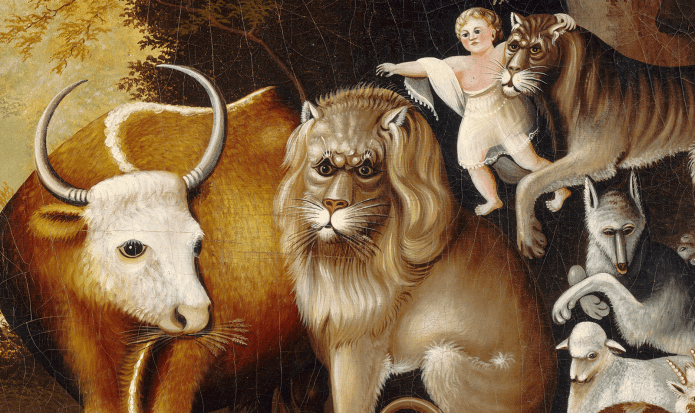
The wolf shall live with the lamb,
the leopard shall lie down with the kid,
the calf and the lion and the fatling together,
and a little child shall lead them.

Who is this child? Who is this child, so at home in this unfamiliar, longed-for world?

In some sense, this child is Phoebe — or any other child.  The child that ushers in this peaceable kingdom is every child. Because, when we come face to face with a child, any child, we remember what hope is like, and we remember who hope is for.

But this child also recalls to us one, particular child. From the earliest days of the church, Christians have seen in Isaiah’s prophecies a foreshadowing of the reign of Christ. When we read these scriptures, we see Jesus: not only in the ideal king, who will judge the poor with righteousness and the meek with equity, but also in this little child, leading the calf and the lion home together.

And it strikes me, what an odd thing it is, that we so often picture the founder of our faith as a child. As often as we see Christ on the cross, still we see him as the baby in the manger. It’s a fairly distinctive feature of our faith. How often does one speak of the baby Mohamed, or the Buddha Child? Yet Christ is for us, somehow, always a child.

Now, some might dismiss this as sentimentality, and it is undoubtedly easy to love a baby who hasn’t yet spoken to us of things we would rather not hear. But I think there is also something deeper going on here.

These verses are part of our worship at this time of year, because they capture the spirit of Advent – that time of year when we become children again, and remember what hope is like. For Advent is not just a season of remembrance; it is a season of anticipation. We sometimes tell our children that on Christmas we celebrate the birthday of Jesus, but this isn’t quite right. For it is not Christ’s birthday that we await during Advent. It is Christ’s birth. Christ was not just born in Palestine, two thousand years ago. Christ is about to be born for us, right now, right here. Christ is our hoped-for child, who teaches us to hope again.

God is about to do a new thing; now it springs forth; do you not perceive it?

A child is coming, to bring us hope.


(sermon preached at Belchertown United Church of Christ, 11.29.2015)

(photo: detail of The Peaceable Kingdom, painting by Edward Hicks)

Make Yourself at Home

Serve the city where God has placed you; for in its welfare, lies your own. — Jeremiah 29:7

Jeremiah was about thirty years old, when the armies of Babylon swept across Syria and Palestine. They left the capital city of Jerusalem standing, but at a price: a good portion of its population was deported – carried off to exile in Babylon. Jeremiah was one of those who remained in his native land.

The Israelite captives were hostages of the state. They were not exactly prisoners, but neither were they free. Living in the midst of strangers, they were exiles, not immigrants; their families, their homes, their hearts were elsewhere.

The mourned, for the old country. They dreamed of returning. They sang songs of lament. (You know the words: by the waters of Babylon, we lay down and wept, when we remembered Zion…)

But then — rumors began to spread, and hope began to grow. There was political unrest in Babylon; the King was losing power. They’d be out of here any day now! They would return home – and their real lives could resume.

It was at this moment that Jeremiah wrote his letter to the exiles, in which he told them: Make yourself at home, because you’re not coming back.

Build houses; plant gardens; have children. Seek the welfare of the city in which you live. For in its welfare, lies your own.

Well, it turned out Jeremiah was right; King Nebuchadnezzar survived the attempted coup, and reigned another 32 years. It would be another 25 after that, before Babylon fell, and the Israelites were allowed to return home.

By then, two generations had been born on Babylonian soil. Did some of them decide to stay? Did they have a choice? When they finally got back to Jerusalem – did it feel like home?

Last August, I brought my kids to see my old neighborhood for the first time. I grew up in Greenwich Village, New York, in an 1840’s carriage house, which had been really barely renovated into faculty housing for NYU. The house was pretty much one enormous, two-story room, with a roof of leaky cross-beamed rafters; the bedrooms were tucked up in what had been the hayloft. The first and second stories were connected by this crazy, open metal staircase that had been put in by a couple of set designers who had lived there a decade earlier. This was the family home for over thirty years, until my Dad retired from NYU and moved out.

That was almost twenty years ago, but sure enough, as I turned the corner onto my block this summer, there was the familiar cobble stone street, looking almost exactly the same as it did during my childhood. There was my house, with its dark brick walls, its heavy wooden door, and the wisteria vine still climbing up the front.

As I stood there with my family, the door suddenly opened, and a couple of workmen came out, who had been doing some repairs inside. They let us peek in through the door.

Gone was the hanging staircase, replaced by a more conventional (and doubtless, safer) enclosed staircase. Gone was the open balcony, replaced by glassed-in second story. Gone was the raftered ceiling.

I told the kids, don’t look inside. That’s not the house I grew up in.

The inescapable truth is that my children are growing up in a different world than the one I think of as home. I don’t know about you, but my experience of aging is sometimes not so much a feeling that I am getting older, but a feeling that the world around me is somehow getting younger. It’s like that old trick with the tablecloth and the plates. I stay in one place, but somehow the ground beneath my feet changes.

Even those of us who stay put may find ourselves longing for the old country, for the way things used to be. It is not only the refugees who find themselves in a strange new world. Many of us live with a persistent sense of dislocation. The world around us changes so quickly.

How do we make ourselves at home, in this brave new world?

Serve the city where God has placed you; for in its welfare, lies your own.

After all, the exiles in Babylon weren’t the only ones who found themselves surrounded by strangers. What did their Babylonian neighbors feel about this influx of foreigners, I wonder? Did they say to these refugees, make yourself at home? Or did they, too, long for the day when the Israelites would finally leave, and their city could return to normal?

It is one thing to live alongside outsiders, but another to let them in – in to our homes, into our families, into our hearts. To seek their welfare, as our own.

In Jeremiah’s letter to the exiles, I hear an echo of a later letter, this one written by the apostle Paul to the newly converted Christians in Ephesus. Some of the other leaders of the early church had balked at the inclusion of Gentiles into what had previously been a monocultural, all-Jewish group of disciples. But in his letter to the Ephesians, Paul proclaimed Christ has torn down the barrier that divided us into two separate peoples. “You are no longer strangers and aliens,” he wrote, “but you are citizens with the saints and also members of the household of God.”

In other words: Make yourself at home.

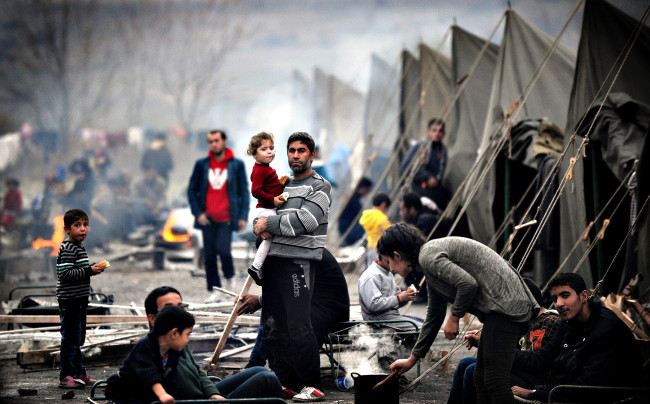
Today, 26 centuries after Jeremiah wrote his letter to the exiles, there is again a mass deportation going on in the middle east. Armed conflict in Syria has driven over four million Syrians to seek refuge across the border in Turkey and beyond. Half of these refugees are children.

A friend recently shared with me another letter, this one written just last month. It was posted on facebook by a grassroots group in Iceland, called Syria is Calling. Earlier this year, the Icelandic government announced that it would accept just 50 Syrian refugees. In response, the group posted this letter, demanding that the government increase the quota:

Refugees are our future spouses, best friends, our next soul mate, the drummer in our children’s band, our next colleague, Miss Iceland 2022, the carpenter who finally fixes our bathroom, the chef in the cafeteria, the fireman, the hacker and the television host. People [to whom we will] never be able to say to: ‘Your life is worth less than mine.” Open the gates.

In other words: Make yourself at home.

So far, the group has generated individual pledges of housing and support for 10,000 refugees.

Jeremiah’s letter is not just for the exiles, but also for those who receive them; not just for the migrants, but also for those of who stay put; not just for his ancient audience, but also for us, right here, right now. Are we willing to echo Jeremiah’s words, and say to the newcomer: make yourself at home? And – just as important – are we willing to make ourselves at home, in this new city, with these new neighbors that God has given us?

Build houses and live in them; plant gardens and eat what they produce. Marry and have children, and let your children have children. But seek the welfare of the city God has given you to live in, and pray to the Lord on its behalf; for in its welfare, you will find your own.


(10.18.2015, Belchertown United Church of Christ)

(Photo Wisance.com)

Holy Turf War, Batman

An Episcopalian, a Lutheran, and a Congregationalist go into a bar.

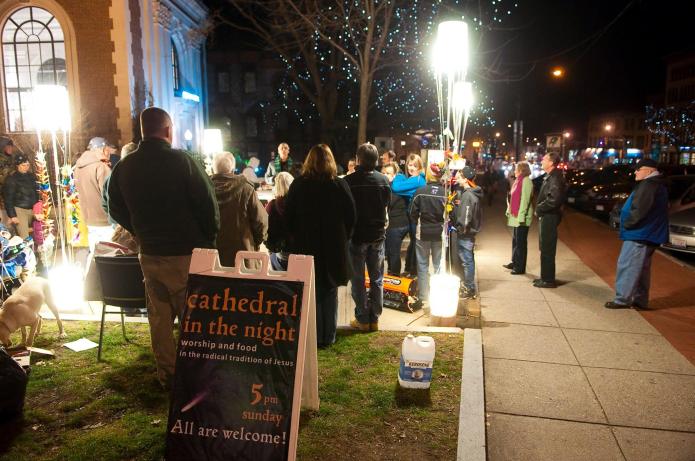
I know this sounds like the start of a joke, but it is actually more or less a true story. Several years ago, my UCC colleague Eric Fistler told me that he and two colleagues were talking together, and they discovered that the three of them shared the same  dream, of starting a new sort of church. A church that would worship outdoors, rain or shine, welcoming the homeless as well as the housed. A church that would celebrate weekly communion as it had been celebrated in the early church: as part of a common meal, at which food was freely given and freely shared.

But before the three friends could turn their dream into a reality, there was some planning to do: obtaining the blessing (and financial support) of their respective denominations; coordinating schedules with local food pantries and churches; finding a location and obtaining city permits.   Finally Eric gave me a call, inviting me to their first worship service in downtown Northampton. It was January, and bitterly cold; one of the volunteers actually got frost bite that night. But slowly, from that first night, Cathedral in the Night began to grow.

Not long afterwards, I arrived one Sunday afternoon to help set up, only to discover that a small group of folks had already gathered just down the block. They had crockpots of stew, and a box of vegetables, that they were giving away free.

And I have to confess, my first thought was: Uh oh. We have competition.

Who did these guys think they were? So much preparation and thought had gone into our ministry; who were these upstarts who just showed up, without permission or planning, to hand out free food on ‘our’ sidewalk? Most frustrating, they seemed to be accomplishing what we were still struggling to do: they were engaged and connecting with the people on the street.

A few moments later, a young man from the group came over to our table. He looked to be in his early twenties; he had a beard, and wore a long skirt. He introduced himself as Tony, and he said:

“We’re packing up for the day but we have some food left over. Would it be okay if we bring it over here, so you could serve it at your meal?”

And he hurried off, to help fill our table.

I am not the first person to mistake an ally for a competitor; this sort of holy turf war is apparently as old as the church itself. In Mark’s gospel, we find the apostle John telling Jesus: We saw someone casting out demons in your name, but we told him to stop, because he wasn’t actually part of our group.

And Jesus tells them: Don’t stop him! Whoever isn’t against us, is for us.

Most of us know this expression the other way around: If you’re not for me, you’re against me. It’s easy to confound the two expressions, as if they were equivalent. And they would be, if the world were neatly divided into friends and enemies, for and against. But we live in a world of in-betweens and unknowns. What do we do, when we are faced with a new face? Do we operate under an assumption of friendship, or an assumption of conflict?

We don’t know who this stranger was, casting out demons in the name of Jesus. How did he know who Jesus was? Had he heard him preach, or maybe even been healed by him? Why did he strike out on his own, instead of following Jesus?

We don’t know what the stranger was thinking, but we can guess how the disciples must have felt. They had been hand-picked by Jesus, called to be his disciples and walk in his footsteps. And now, suddenly, here is this stranger, casting out demons. And I’ll bet the disciples first thought was:

Uh oh. We have competition.

Who did this guy think he was? Who was this unordained upstart who just showed up, without calling or commission, to heal people in Jesus’ name? Most frustrating, he seemed to be accomplishing what the disciples themselves were still struggling to do.

Why just the other day, a man had brought his son to the disciples, asking them to cast out the demon of epilepsy that was sending the boy into convulsions. The disciples had tried, but they hadn’t been able to cure the boy. In the end, Jesus prayed with the boy’s father, and the boy was healed; but it was discouraging, I’m sure, for the disciples, not to have been the ones to help him.

Deep down inside, we all long to be someone’s savior. We want to be the hero, the one who saves the day – or if not the hero, then at least the hero’s right hand man. If we can’t be Harry Potter, at least we want to be Ron or Hermione, and not just another nameless Hogwarts student. If we can’t be Batman, we at least want to Robin.

That’s actually what the disciples had just been arguing about, as they walked along the road together: which among them was Jesus’ right hand man? Jesus reminds them that they are all servants of the same God. And so for that matter is this stranger they met on the road, the one who was walking his own path, casting out demons as he went.

He’s not the competition, Jesus tells them. He’s an ally.

I wonder if it is human nature, perhaps, to be jealous of another’s success, even – or maybe especially – when we are working for the same goal. In a world of scarce resources and limited opportunities, our future depends on our ability to outperform our peers. We fight not just for market share, but also for promotions, and so we compete — not just against the opposing team, but also against our own teammates.. This is how it is, in the kingdom of this world.

But in the kingdom of God, Jesus tells us, things are different. In the kingdom of this world, we try to climb the ladder; but in the kingdom of God, we help another to rise.

We, of course, live in both worlds. As disciples of Christ, we are called to be in this world, but not of it. That isn’t always easy to do, especially when your personal livelihood gets mixed up with your service to others. It’s hard to be pleased for another’s success, if it means they get the job, or the grant, or the glory.

Or the pledges.

The church, too, lives in this world of scarce resources and limited opportunities. And in an era when church membership in America is declining, it is easy to look upon the church across town as a competitor, instead of an ally. We hear of a thriving youth group or a successful outreach program in another church, and instead of rejoicing, we feel a twinge of envy. Why didn’t we think of that first?

But what if we really believed the words of Jesus, that those who are not against us, are for us. What if we really believed, that we were all servants of one God? What if we really believed, that there was enough grace to go around? God knows, there is enough need to go around. What if we were allies, instead of competitors?

And so an Episcopalian, a Lutheran, and a Congregationalist walk into a bar, and a new ministry is born.

Sometime afterwards, as we were setting up for Cathedral in the Night, some loud singing broke out down the block. Tony and a friend were entertaining the folks at their gathering with some old campfire songs. One of our own visitors came over to me and asked:

So who’s the competition?

That’s not the competition, I told him. Those are allies.

(from a sermon preached by Liza B. Knapp at Belchertown United Church of Christ, October 11, 2015).

(photo: Cathedral in the Night)

Land of Bees and Honey

“The only reason for being a bee that I know of is making honey…
And the only reason for making honey is so as I can eat it.”
Winnie the Pooh, A.A. Milne

BEES are mentioned in the Bible only four times.

Three of those verses are about metaphorical bees. For example, in the first chapter of Deuteronomy (1: 43-44), Moses reminds the people, “You rebelled against the command of the LORD and went up into the hill country, and the Amorites who lived in that country came out against you and chased you as bees do.” The other two verses have a similar thrust to them. Metaphorically speaking, bees are an aggressive swarm – an attacking army.

(That’s how some of us experienced bees at last year’s Belchertown fair: as a hostile army, driving us away from our promised land of cotton candy and fried dough.)

The fourth Biblical reference to bees occurs in a story about Samson – you remember Samson, he was the really strong guy with the long hair and the unhealthy marriage – Samson kills a lion with his bare hands, and then some time later returns to site of his conquest, and he sees the carcass of the lion there, and he sees bees, nesting in the skeleton.

(I’m inclined to believe these are real bees, not metaphorical ones; the story just strikes me as too randomly weird to be an allegory.)

Samson grabs a handful of honey out of that skeleton, and shares it with his parents. Which brings me to another piece of Bible trivia: Bees are only mentioned four times in the Bible, but honey – honey is mentioned 58 times.

That’s a lot of honey.

In the book of Exodus, we are told that the manna in the wilderness tasted like honey. In the Song of Songs, the young lover tells his bride that her lips tastes like honey. In the gospels, we learn that John the Baptist ate locusts and wild honey. And in the book of Proverbs, we are warned that eating too much honey can make a person throw up. Always practical, the book of Proverbs.

In the book of Psalms, we are reminded that honey is a gift of God. “Open your mouth wide, and I will fill it,” God says. “Listen to me, and walk in my ways, and I will feed you with finest wheat, and sweet honey in the rock.” (Ps 81).

Over and over, we are told that the promised land – the land that God promises to Abraham and his descendants – is a land flowing with milk and honey. When God calls out to Moses by the burning bush, God says, “I have seen the affliction of my people, and … I have come down to deliver them from the power of the Egyptians, and to bring them up from that land to a good and spacious land, to a land flowing with milk and honey.”

(There are some scholars who have suggested that this “honey” might actually be fig syrup; but it’s the same word, in Hebrew, as in that story about Samuel and the lion and the bees, so I’m inclined to think they are talking about actual honey.)

And if the promised land is a land flowing with milk and honey, then we are forced to the inescapable conclusion:

The promised land was full of bees.

Now let’s think about that for a moment. Most of us are kind of wary of bees. Bees, after all, can sting, and that sting can be not merely painful, but deadly. I have a niece who is allergic to bees; she carries an epipen and tends to avoid flower gardens. She didn’t develop an allergy until her teenage years but I remember when she got her first bee sting. She was maybe three or four years old at the time. She came running in from outside, weeping, and in the midst of her tears she told us: “I wasn’t hurting it! I just wanted to pet it!” She learned on that day that even kindness is sometimes met by cruelty. That sting was a painful experience in more ways than one.

So I find myself wondering: what if we could have the sweetness without the sting? The honey, without the bee?

Would it still be the promised land?

In pondering this question, I decided to turn for counsel to a respected sage, someone known for his kindness and humility, someone whose words are few, but whose insights have touched many.

I am speaking, of course, about Winnie the Pooh.

Pooh knows a thing or two about bees; in fact, in the very first chapter of the book of Pooh, he shares his philosophy regarding the Reason for Bees: “The only reason,” he says, “that I know of for being a bee is making honey. And the only reason for making honey, is so I can eat it.”

The bees, however, beg to differ. You may remember how the story goes – how Winnie the Pooh borrows a balloon from his friend Christopher Robin, and floats up to the bee hive, pretending to be a little cloud. Christopher Robin helps with the deception by walking about with an umbrella. But the bees are not fooled. After a few moments, one of them gives Pooh a nasty sting on the nose.

Which is something of a moment of revelation for Pooh. In the light of this experience, he revises his theory. “I have just been thinking, [he says,] and I have come to a very important decision. These are the wrong sort of bees.”

That sting on the nose is an epiphany: Maybe, just maybe, there is more than one reason for being a bee.

Bees, of course, do more than just make honey. For one thing, they pollinate flowers, making it possible for plants to bear fruit. Bees are directly responsible for about a third of the fruits and vegetables that we eat. Bees make honey, it is true, but they also make almonds, and blueberries, and cucumbers, and squash, and tomatoes. Bumblebees are one of the few insects in the world that can pollinate tomatoes. Tomato flowers hold on to their pollen so tightly. Bumblebees grab onto a tomato flower and vibrate their wing muscles, at a precise frequency, right around middle C, and the pollen shakes loose. Bumblebees literally hum tomatoes into existence.

Ask a bear what bees are for, and he will answer: bees are for making honey. Ask a tomato what bees are for, and it will tell you: bees are for making tomatoes. Ask a bee what bees are for, and she will tell you, bees are for being bees.

There is a human tendency to view other creatures as existing for our benefit. Bees, flowers, other people – we tend to value them based on what they can do for us. And if this really is all they are for — if creatures exist only to serve our needs — then when they no longer do so, we can get rid of them. Why worry about the widespread collapse of honey bee colonies, when we can sweeten our cakes with high fructose corn syrup?

Maybe we get this idea from the fact that we have so much power over other creatures. The Bible tells us that God gave us dominion over the earth, and this century certainly seems to have borne out that fact. We’ve altered our atmosphere, we’ve emptied the seas, we’ve modified our genes, we’ve driven countless species to extinction, all in the space of a century or two. It’s easy to see how we might think of ourselves as the stars of this earthly drama.

But Jesus once reminded his followers that not even a sparrow falls to earth without God taking notice.

Or maybe, not even a bee.

It turns out, by making honey, bees don’t just make life sweeter, they make it possible. Possible for us, possible for the flowers, possible for the bees themselves. So if we start off pondering the reason for bees, we end up pondering the reason for being.

Ask the animals, and they will teach you;
the birds of the air, and they will tell you;
Ask the plants of the earth, and they will teach you;
and the fish of the sea will declare to you.
Who among all these does not know
that the hand of the Lord has done this?
In God’s hand is the life of every living thing
and the breath of every human being.
(Job 12:7-10)

(Sermon originally preached by LIza B. Knapp at the Belchertown Fair Ecumenical Worship Service, September 20, 2015)

Revolutionary Repentance

“What then should we do?” — Luke 3:2-18

In the first chapter of Genesis, God tells the newly created humans to “be fruitful and multiply, and fill the earth and subdue it.”

I think we can safely cross that one off our to-do list.

When Jesus was born, there were fewer than half a billion people on earth, and the concentration of carbon dioxide in the earth’s atmosphere was less than 300 ppm – as it had been for hundreds of thousands of years. Today, there are over seven billion people on earth, and the concentration of carbon dioxide in the earth’s atmosphere is over 398 ppm.

Now, here is a problem our ancestors never saw coming. So what does our faith tradition have to say to those of us who live in this brave new world of overpopulation and industrialization, of climate change and environmental degradation? When we read in the headlines of 500-year droughts and raging wildfires, of melting ice-caps and vanishing species; what scriptures do we turn to? Where do we find resonance? Where do we find hope?

Thursday morning, I was among the millions of people who tuned in to watch Pope Francis as he spoke to the United States Congress. In the middle of that speech, he told the lawmakers, “I call for a courageous and responsible effort to redirect our steps and to avert the most serious effects of the environmental deterioration caused by human activity. I am convinced that we can make a difference. I am sure.”

This is the sort of language that caused Fox commentator Greg Gutfield to describe the Pope as the most dangerous person on the planet. Dangerous, because he calls upon us to change our course. Francis has asked for nothing less than a “bold cultural revolution” to liberate both the planet, and the planet’s poor — and he talks as if he believes it could happen.

In the past year I have been struck by the fact that many of the same people who used to deny the possibility of climate change, are now saying that climate change is already here and there’s nothing we can do about it. One minute it was too soon to tell; the next minute it was too late to act. We seem to have jumped straight from complacency to resignation, without any room in between for urgency. Without any room for hope.

But here is the Pope, claiming that we not only should, but could, do something. Here is the Pope, expressing both urgency and hope.

Of course, there are some who might point out that the Pope is not an authority on climate science, any more than Donald Trump is an authority on pediatric vaccinations. But the Pope makes no claim to know the science better than the scientists. His information comes from published research, not special revelation. But his urgency, and his hope – where do they come from?

Well, I can’t speak for Francis, but let’s go looking for ourselves:

John the Baptist appears at the River Jordan, fresh from the wilderness. He wears a coat of camel’s hair, he eats locusts and wild honey,he is a nature freak if ever we saw one. He stands there, with his feet in the flowing water, and says: Repent, for the kingdom of heaven is at hand.

I suspect that for most of us, a call to repentance wouldn’t really qualify “good news.” In fact, public calls to repentance often produce something of a backlash. No one wants to be publicly taken to task for their errors. It makes us feel ashamed, or defensive, or both. We don’t want to hear that we are “to blame” for global warming and so we tune out the science that makes us feel guilty.

But the word, “repentance” – or rather, the Biblical word metanoia – that word does not mean, “to feel ashamed.” The Biblical word metanoia means to change. To change our hearts and minds, and to change our lives, to change direction. Or, as Pope Francis puts it: “to redirect our steps.”

A better translation might be, “revolution.”

And so it is with John the Baptist; when the people ask John, “What then shall we do?” he doesn’t tell them to fast or to do penance or say five hail Marys . Instead, he tells them: If you have two coats, share one. If you have extra food, share that. If you have power, stop using it for your own profit.

John the Baptist comes along, wearing his cruelty-free clothing, and eating his macrobiotic diet, and calls the powerful to repent. No wonder Herod decided the John was the most dangerous person in Judea. He was calling for nothing less than a “bold cultural revolution.”

“Revolution” may seem like a strong word, but the truth is that repentance is always revolutionary, that hope is always revolutionary. “For who hopes for what he already has?” So asks the apostle Paul, in his letter to the Romans. Such revolutionary hope, Paul believed, was not confined to the human race, but was shared by all creation:

“For the creation waits in eager expectation for the children of God to be revealed…in hope that the creation itself will be liberated from its bondage to decay and brought into the freedom and glory of the children of God.”

Paul may never have envisioned a world with over 7 billion people, or a climate endangered by human activity, but he understood that the redemption of creation and the redemption of the human race were inseparable. And he had hope, that such redemption was possible. A hope based not on a clear vision of the future, but on a firm grounding in the past. God had liberated Israel from Egypt; God had liberated Jesus from the grave; and just as miraculously, God had liberated Paul  from his own prejudice and hatred. If God could do all this, then surely, God might liberate creation as well.

God of creation:
Fill us with the hope of Paul,
and the urgency of John.
May we believe the good news,
and repent.
Amen.

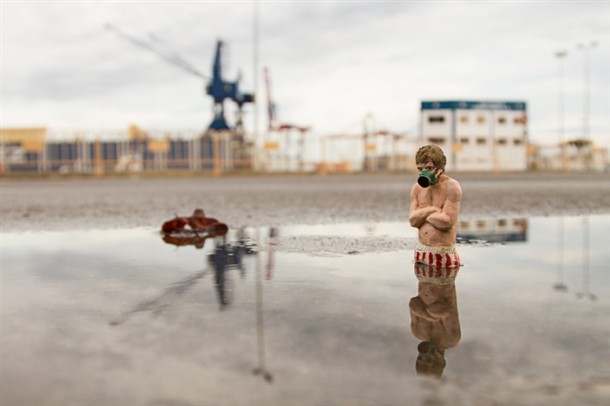
PHOTO is of street art installation by Isaac Cordal; click here for the source, and for more images of his extraordinary work (blog text is in French, but the images need no words…)

TEXT from sermon originally preached by Rev. Liza B. Knapp at Belchertown United Church of Christ, September 27, 2015.


“With a Strong Hand and an Outstretched Arm…”

Remember that you were once a slave in the land of Egypt, and the Lord your God brought you out from there with a strong hand and an outstretched arm; therefore the Lord your God commanded you to keep the sabbath day. – Deuteronomy 5: 12-15 (NRSV, adapt.)

On the last full day of my family’s New York vacation, we spent the whole day in Manhattan. We visited the Sony Technology Museum on Madison Avenue, and the American Girl Doll Store on Fifth Avenue, and then went uptown to have dinner with my Uncle on the Upper East Side. We ordered pizza and shared an expensive cake that had been given to us for free because we happened to be passing by when a delivery boy accidentally dropped it on the sidewalk. (It was still in the box, so it was clean, just messy.)

Afterwards, we drove across the Williamsburg Bridge into Brooklyn, where we were renting an Airbnb apartment for the week. As we came off the bridge, a transformation occurred. Here there were only a few stores open and only a few people on the street: small groups of maybe two or three men walking together, dressed in long black coats and cylindrical fur hats. Most had beards; all had the long curled sidelocks that are the mark of an observant Hasidic Jew. And most remarkably, none of them seemed to be in a rush.

It was Friday evening, and Sabbath had begun.

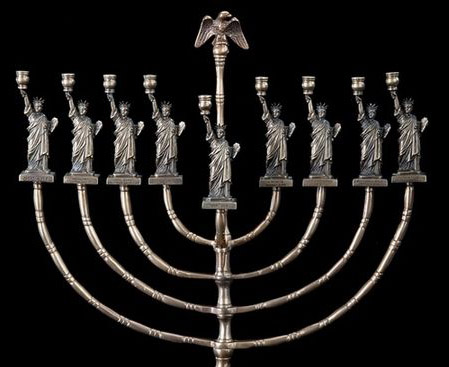
The day before, we had taken our kids on the ferry to see the Statue of Liberty. In the pedestal of the Statue of Liberty, there is a museum, and in that museum, there is a glass case containing a hundred-plus years of Statue-themed souvenirs. Among these artifacts, there is a Menorah, an eight-armed candelabra used during the eight-day celebration of Hanukkah. Each of the menorah’s arms is a small figure of the Statue of Liberty, her arm uplifted to hold the candle.

The man who made that menorah was a German-born Jew, named Manfred Anson. Anson was a teenager when the Nazis came into power. Leaving his parents behind, he managed to escape the country, travelling first to Australia, and then to the United States. Anson’s brother died in a Nazi concentration camp, but his sister survived, and the two of them were eventually reunited in America.

I thought of Anson’s menorah, as we drove through Brooklyn on Friday evening, past the men on their way home for Sabbath. And I wondered at the meaning that the Statue of Liberty must have had for Anson, and for the hundreds of thousands of Jewish immigrants who sailed into New York harbor, to be welcomed by her strong hand and outstretched arm.

On one level it seems like it would be almost sacrilegious, to incorporate such an iconically American figure into an ancient Jewish ritual. But the celebration of Hanukkah, the celebration of Passover, the celebration of the Sabbath, all of these are rituals of remembrance. They are the means by which Jewish families teach their children the story of their deliverance. Maybe the Statute of Liberty helped Anson to remember his.

You shall not oppress the alien who dwells among you; you know the heart of an alien, for you were aliens in Egypt. – Exodus 23:9 (NRSV, adapt.)

The practice of Sabbath traces its origins to the Biblical book of Exodus, to the commandments given by God to Moses on Mount Sinai. On the Sabbath, God tells Moses, the people of God are to refrain from all work; not only that they may take rest, but also so that they may give rest to others. You have six days to work, God says, but on the seventh day, rest from your work, so that your ox and your donkey may find relief, and your servants and even the aliens living among you may be refreshed.

In the midst of the Sabbath, in the midst of this intimate family celebration, God reminds the people to show compassion to the foreignors in their midst – for, as God reminds them, “You know the heart of an alien, for you were aliens in the land of Egypt.” If the core story of our faith is a story of deliverance, then the core practice of our faith is the practice of hospitality. The two go hand in hand. We welcome the stranger, for we know what it is to be strangers in a strange land.

My own ancestors didn’t sail into New York Harbor. They sailed into Massachusetts Bay. William Knapp arrived from England in 1630, aboard the same fleet as Jonathon Winthrop, the first governor of the newly formed Massachusetts Bay Colony. And those of us who are not first- or second- but twelfth-generation immigrants, sometimes forget to remind our children that we, too, were once aliens in a strange land. There’s been a lot of conversation in the news about Donald Trump’s suggestion that we should deny citizenship to what he calls “anchor babies.” But the truth is, that every Mayflower descendent is descended from an “anchor baby” – a child born on American soil to uninvited foreign-born parents. It seems that somewhere along the way, some of us have forgotten the stories of our deliverance.

But today is our Sabbath. So today, let us remember. Let us remember the ancient stories of Israel’s deliverance, and let us remember the stories of our own deliverance. And, having been guided into port at last by God’s strong hand and uplifted arm, let us in turn take up the torch, to shine that light for all to see.

statue of liberty menorah

(Excerpted from a sermon preached 9/6/2015 at Belchertown United Church of Christ)

(Photo credits: Statue of Liberty – Liza Knapp; Menorah – Smithsonian Museum of American History

Jesus Eating a Fish

After his crucifixion, Jesus pays a visit to his disciples. They are terrified, thinking he is a ghost. He tells them, I am no ghost. And to prove it, he asks, do you have anything to eat?

And they give him a broiled fish.

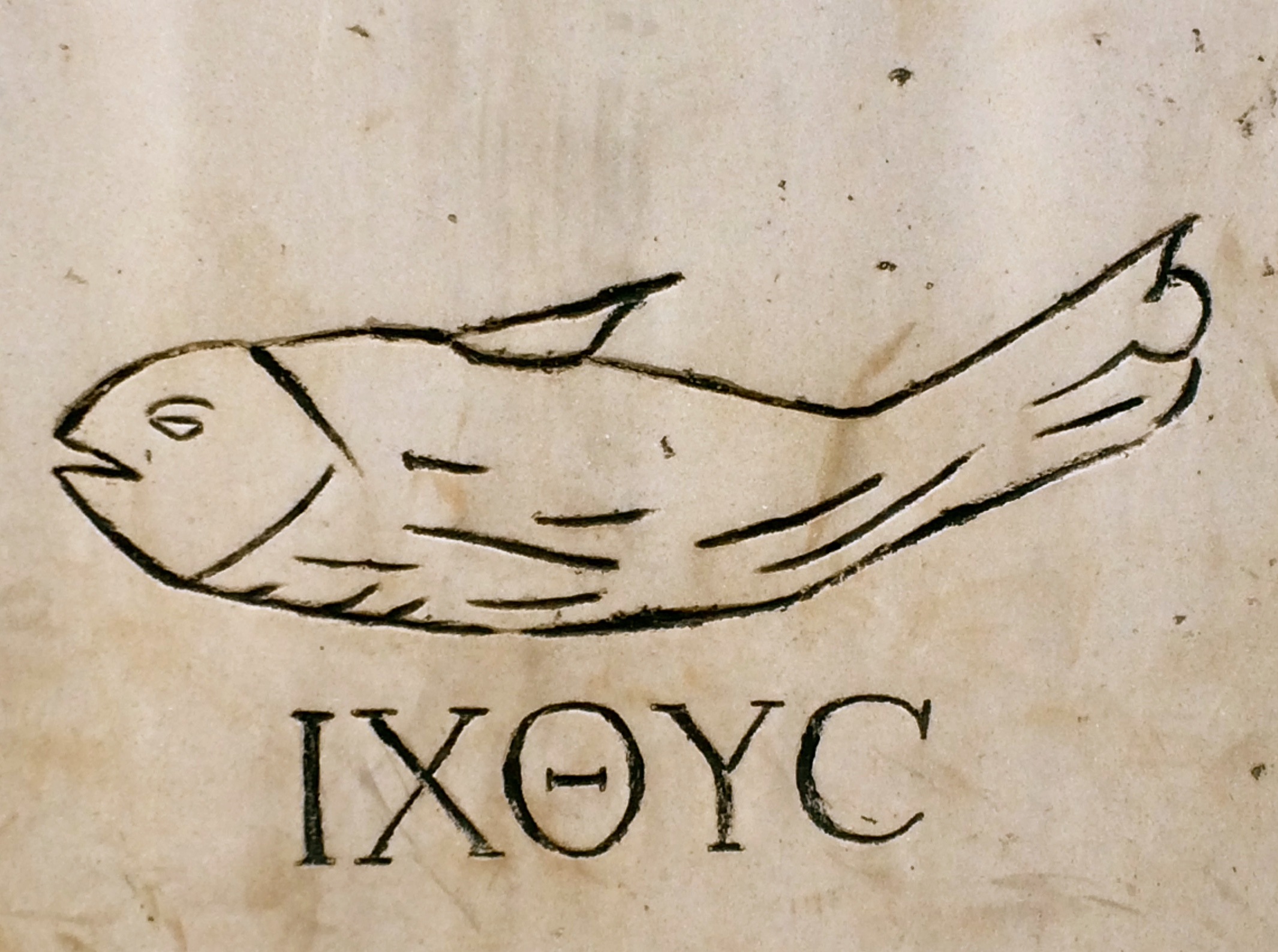
catacomb fish, source unknown

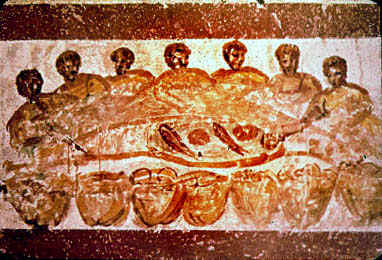
Most of us have seen paintings of Jesus in the manger, or in the cross. But what about Jesus eating a fish? Some of the earliest known Christian art comes from the Roman catacombs, the vaults below the city where tens of thousands of early Christians were buried. Crosses and mangers are rarely seen there, but fish are commonplace. And not just the stylized, abstract-looking fish you see on modern car bumpers; these are actual fish, realistic-looking fish with scales. Sometimes the fish is depicted by itself; sometimes it is part of a dinner scene. There are multiple images of people gathered around a table, sharing a Eucharistic meal — not of wine and bread alone, but of loaves and fishes. To the early followers of Jesus, fish was apparently as integral to communion as bread and wine.

Imagine our deacons passing around plates of smoked salmon at communion, and you begin to see just how much our tradition has changed.

A meal of bread and wine is a tidy affair. You can serve them up as bite-sized wafers and individual, sanitary shotglasses. But eating a fish – that’s a messy, visceral sort of experience. There’s bones, and scales, and gills to contend with. There are eyes, looking up at you. You know you are part of the food chain, when you are eating a fish. And maybe we feel a little uncomfortable, imagining Jesus pulling flesh from bone with his fingers.

But here he is, in Luke’s gospel — Jesus, raised from the dead, eating a fish.

The Greek word for ghost is pneuma – it means literally, breath, and metaphorically, ghost. As in, Holy Ghost. It’s the same word. Nowadays we usually translate it as Spirit. The disciples are terrified, for they think Jesus is a ghost, a spirit. But although Jesus promises the disciples that God will send a Spirit to guide them, he makes it clear that he is no Spirit. Jesus is no Holy Ghost; he is a living human being, eating a fish. Flesh and bone, made from flesh and bone.

Still, there is a sort of dream-like quality to these post-resurrection encounters with Jesus. The disciples start off talking with a stranger, and then somehow that stranger is Jesus. No one ever seems to see him coming, or going; he is just somehow there; and then, he is just somehow gone. These are the sort of things that happen when we dream. But then, on the other hand, here he is, eating a fish. So is Jesus a vision, or is he really there, in the flesh? Does it matter? Saint Paul saw a vision of Jesus on the road to Damascus, and it was enough to change his life. Thomas – also a saint – needed to touch Jesus’ living body with his own living hands. Can we be satisfied with a vision of the resurrected Christ? Or do we need something more, well, earthy?

It’s an old debate in Christianity: is Christ flesh and blood, or merely spirit? From the beginning, there were those that argued that Jesus was not truly a human being, but rather a spirit in disguise — human in appearance only. But it wasn’t just the idea of resurrection that bothered them; it was the whole idea of incarnation. The word made flesh, in the birth of Jesus. It wasn’t just that they couldn’t believe he had come back to life; they couldn’t believe he had been alive in the first place — at least, not in the biological, organic sense of the word. They just could not believe that divinity would sully itself with the blood and guts of biological existence. They wanted a God who would rescue them from the world, not become mired in it with them.

But for others, that was precisely the good news. The union of Word and Flesh – of the Mystery and the Mud.

A couple of years ago, my daughter had a good friend that lived next door to us, so the two kids used to run back and forth between the houses and play in our combined back yards. One day, the kids were outside and both my neighbor and I were inside, doing the dishes or something, and the kids discovered a mud puddle in the backyard. And they began to expand it, and it grew into a sort of a mud wallow. And the hole got bigger and bigger, and they got muddier and muddier, and somewhere along the way they come up with the idea to build a mud slide. On our porch. So they got a couple of buckets, and began hauling mud, and at some point my neighbor and I went out to check on them – whatever you are picturing in your minds right now, it was worse. But the thing is, neither my neighbor or I could bring ourselves to be angry with them. We made them clean it up, to be sure; but there was such delight and exuberance in their bodies and on their faces, that neither of us could bear to change that moment for them. They had found the mystery in the mud.

Now I know there are some of you out there who are probably shaking your heads over my parenting skills. But I do think we sometimes make a mistake, when we equate cleanliness with godliness. Because life is messy. Our bodies are messy, our food is messy, our planet is messy. And yet God created it. And God loves it. So much so, that God became flesh in Jesus, in order to love it better.

What about us? Can we bring ourselves to love the world? Can we say YES to this creation, to our creation? Because I’m not just talking about sunsets and mountains here. Because life is messy, and nature can be harsh, and God knows, people can be cruel. It’s understandable that some of us might want to distance ourselves from our mortal flesh; that we might seek a savior who would rescue us from such a world as this.

But just as the incarnation did not begin with a baby in a manger, so it did not end with a body on a cross. Because even after his death, there is Jesus, eating a fish. When Jesus escapes from tomb, he jumps right back into life, in all its messy biological incarnational splendor. Vision or not, he is, emphatically, not a ghost – not a disembodied spirit, but an embodied one. Like you. Like me.

Agape_feast_07 (Wikimedia)

We are tempted, sometimes, to act as if we were disembodied spirits, or rather, as if our bodies are nothing more than machines, our food nothing more than fuel. If our performance gets sluggish, we add some high-octane caffeine to the tank, and keep driving. One of my seminary professors once observed that now in the digital age we treat our biological bodies as if they were merely our avatars, rather than our selves. We are like Pinocchio in reverse – flesh and blood children, pretending to be puppets. We do not fully inhabit our bodies, or love them, or care for them; just as we do not fully inhabit, or love, or care for the planet that sustains them.

But if we deny our own incarnation, how shall we acknowledge our incarnate God? If we cannot not love creation, how shall we love our Creator?

So maybe it wouldn’t be such a bad idea to serve up some broiled fish for communion now and then. Bread and wine, after all, are a few steps removed from their organic origins; but a fish, that’s another story. Eat a fish, and you know the stuff of which you are made. You are flesh and spirit, mystery and mud; and God loves all of you.

(scripture: Luke 24: 36-49)

(photo credits: Ghanaian fish market: Rahsaan Hall, used by permission; Catacomb Fish: source unknown; Catacomb Agape Feast: Wikimedia)

Cooties

IMAG2716

“If you choose, you can make me clean.”– Mark 1:40-45

Last month, amid great celebration, the Church of England ordained its first woman bishop, an Anglican priest by the name of Libby Lane, who is now Bishop of Stockport. She was ordained to her new calling through the laying on of hands by her fellow bishops, all of them men, all of them bearing witness to, and blessing, her call.

But not everyone was celebrating on that day. Just two weeks later, a conservative Anglican priest by the name of Philip North was ordained as Bishop of Burnley. North is an outspoken opponent of the ordination of women. At his request, none of the clergy who had laid hands on Libby Lane were invited to participate in laying hands on North.

Which prompted one of my old seminary classmates to comment that, apparently, girl cooties are still a thing in the Church of England.

If you look up the etymology of the term “cootie” you will find that it first appeared during World War I, as British Army slang for fleas or body lice. The term was later appropriated by American school children to refer to (and I am quoting from no less a source than the Oxford English Dictionary here) – to refer to an imaginary germ with which a socially undesirable person, or one of the opposite sex, is said to be infected. You remember how this works: someone is declared to have cooties, and from that point on, anyone who touches that person becomes themselves infected. A diagnosis of cooties imposes a social quarantine.

The truth is, cooties are still a thing, and they are by no means limited to British soil. Modern science has failed to eradicate them, even in the most advanced and developed of countries. Although the term ‘cooties’ is most widely used by children, it is not a disease of childhood only; cooties may infect anyone, of any age. And although they are imaginary, they are far from harmless. It is true that cooties, being fictional, cannot directly inflict harm on the body. But the secondary effects of cooties, the disgust and ostracism they engender, can be deadly. To deprive a human being of human touch and human conversation is akin to torture. Prisoners deprived of human conversation develop mental illnesses. Infants deprived of human touch, die.

Cooties are not the same thing as germs, although the two may be correlated. When they do occur together, their impact can be greatly magnified. Think of the early years of the AIDS epidemic; the first victims of that disease were subjected to a level of social ostracism far beyond anything justified by the contagiousness of the virus. The Reverend Jon Walton, pastor of First Presbyterian Church in my childhood neighborhood of Greenwich Village in New York City, tells the story of an acquaintance who was diagnosed with HIV. After leaving the doctor’s office, the man walked down Madison Avenue in a daze; the only word he could think of was “unclean.”

Cooties is not just a game invented by twentieth-century American school children. It is a social illness that has been around for millennia, and “unclean” is one of its most ancient names.

We find evidence of this in today’s gospel reading, in which a leper asks Jesus, not just to make him well, but to make him clean. In Jesus’ day, the term leprosy could refer to any one of a number of diseases that altered the appearance of the skin. Whatever their underlying medical condition, “lepers” were treated as so dangerously contagious that they had to leave their homes and communities, had to live in isolated leper colonies, had to shout out the word “unclean” as they walked along, lest they somehow infect anyone through some casual touch. To be unclean meant more than being sick. It meant being outcast. It meant having not only germs, but also cooties.

Now, some of you may be thinking that the leper’s isolation was not an example of cooties, but rather a reasonable precaution to prevent the spread of germs. But the stigma of disease often lasts much longer than the disease itself. A couple of years ago, I had the opportunity to visit a leper colony, the Home for Cured Lepers near the city of Ho in Ghana. As its name suggests, the people living in this colony have been cured of their disease. But they still bear the stigma of leprosy, along with its visible scars. Many of them have been living at the leper’s home for decades, unvisited by family or friends, unable to return to their villages. Because although modern-day antibiotics can eradicate the bacteria that causes the disease, they have yet to eradicate the fear that leprosy engenders.

Sometimes the germs are long gone, but the cooties linger.

Sometimes, though, it happens the other way around.

Some of you may have heard the news story, some months ago, of an Ebola clinic in Sierra Leone. A sick woman came to the clinic with her young baby, and when the mother died, the staff initially left the baby in a box, to prevent him from infecting others. But one by one, the nurses disregarded the protocol, and picked the baby up. They picked him up, and they held him. The baby eventually died of Ebola, as did eleven of his nurses. They knew the risks; but they could not bear to see the baby alone in that box. They could not bear to see him live his short life without human touch or affection, and so they were willing to risk their own lives, to prevent that from happening.

Germs, they knew, can kill the body; but cooties can kill the soul.

If you can imagine how the nurses must have felt, looking at that baby in the box, well then, maybe you can imagine how Jesus felt, looking at that leper by the roadside. Most English translations of Mark say that Jesus “felt pity for the man,” or even “felt sorry for the man,” but this does not even come close to capturing the meaning of Mark’s gospel. The word Mark uses here conveys a much deeper emotion, a feeling of compassion that compels action. Some of the earliest manuscripts of Mark actually say that Jesus felt, not pity, but anger.

What would you feel, watching a baby abandoned to die in a box?

Sometimes, there is nothing we can do, to cure the disease. Nothing we can do, to overcome the germs. The cooties, however, are another matter.

The leper says, ‘If you want to, you can make me clean.’

And Jesus says, I want to.

And he stretches out his hand.

That’s all it takes.

(Belchertown United Church of Christ, Feburary 8, 2015)

(photo: Liza B. Knapp, all rights reserved)