Working the Clay


In college I studied both biology and religion. Upon finding this out, people would sometimes ask me, “Do you believe in creation or evolution?”

And I would say, “Yes.” 

The staunch creationists of the day – the biblical literalists – were firmly committed to the belief that God created all living things ex nihilo – out of nothing – in their present, fully realized form. Like a magician, pulling a rabbit out of an empty hat. Many creationists do acknowledge the existence of now-vanished life forms, like dinosaurs; although I have encountered some who believe that fossils are a giant hoax perpetrated by God, to test our faith. But most creationists believe there were dinosaurs once; they just believe humans existed alongside them. They accept extinction, sure; but evolution, no.

This is the Biblical story of creation as told in the first chapter of Genesis, in which an omnipotent God brings forth living things, each distinct, according to precise divine specifications. God makes everything exactly according to plan, like an almighty engineer.

But then we get to the second chapter of Genesis, where we find an entirely different creation story.

We know it is a different story, because the order of creation is re-arranged. In the first story, God fills the earth with plants and animals, and only then creates humans – which makes sense, because how could we survive without them? But in the second story, God creates humans before the animals, “when no green things had yet sprouted.”

In the first story, God creates humans, plural, male and female, simultaneously – all, we are told, in God’s apparently non-binary image. In the second story, God makes one human out of clay, and then borrows a bit from it to make another human.

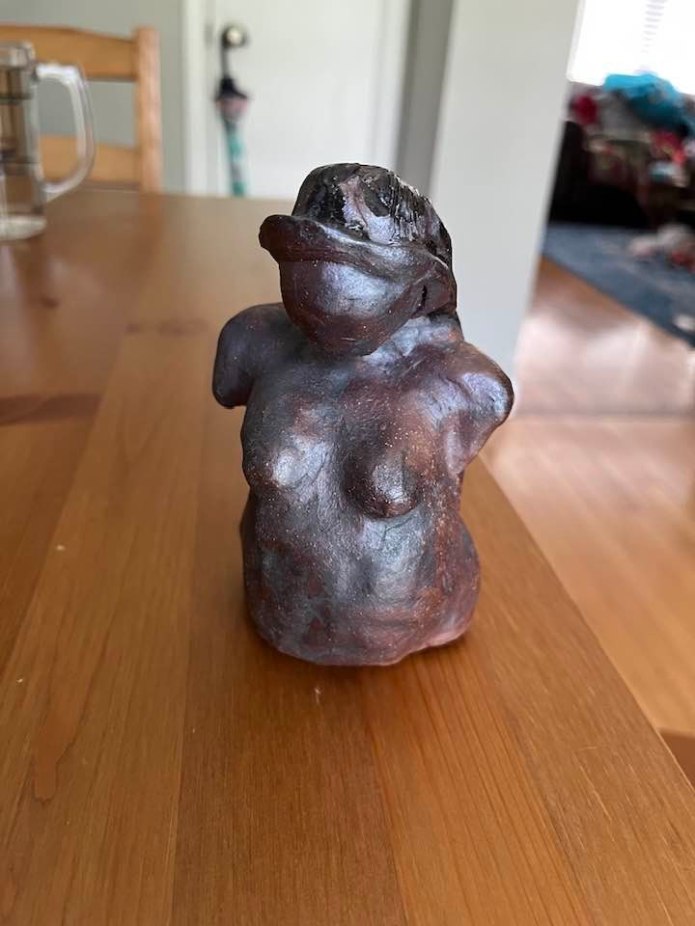
Think about that: no sooner does God create this work of art, than God tears it apart – but not to destroy it. God re-worked the clay, so that we might be not one groundling, but two. What a lovely, generous act, on God’s part – to create a rival, for his creature’s affection! From the beginning, God wanted us to love, not God alone, but one another. 

Here creation begins with clay, which is, essentially mud. God is playing in the mud. In the first chapter of Genesis, God calls us forth with a word; but in the second chapter, God gets God’s hands dirty. In the first we have God the Senior Engineer; in the second, we have God the Artist.

**

When I was deeply immersed my biology and religion studies, in my senior year, I decided I needed to have some break from these subjects, so I took a single introductory class in studio arts. It was taught by a dynamic young artist* whose own work was primarily three-dimensional. I remember an exhibit of his work in the college library; it consisted of large wooden sculptures – human sized – that all look somehow biological, like something that you might see through a microscope.

One day, as I was painting my beginner still life (which still hangs in my kitchen because I was so proud of it) our teacher spoke with us about his own artistic process. He told us that he never knew when he started a series, what a given piece would look like when it was done. “If I know exactly how the sculpture will look when its finished,” he said, “then there’s no point in making it.”

He did not desire absolute control over his medium; he wanted an interactive relationship.

“If we are to keep in touch with reality, we must work with some material substance that resists us, and against which we have to pit ourselves to reshape it.” So writes Cistercian monk Andre Louf, in his book The Cistercian Way. He goes on to say, “whatever it is – the soil, clay, wood, water, metal, cheese or chocolate – the monk needs this simple material to measure himself against every day. He will thus be kept in contact with reality, for these things come from God, and are solidly rooted in the earth, of which they are a part.”

As human beings — groundlings, beings of earth, creatures of clay — we are in the paradoxical position, the almost unique position, of being both creators and creatures, both the sculptor and the clay. We are the material God works with, the substance that resists God’s hand. We are the clay on the wheel that sometimes slips so far off center, that the potter has no choice but to start again, and re-form us from scratch.

**

So we come to the prophet Jeremiah, who visited a potter at his wheel, and saw there a parable.

Under the potter’s steady hand, the clay begins to take shape, and something beautiful and useful emerges; but, as Jeremiah observed, sometimes the clay slips off center, and there is nothing for it but to return to the clay to its original formless lump, and start again.

Jeremiah saw in this a parable for his people. Jeremiah lived in tumultuous times. During his lifetime, he would bear witness to the collapse of his nation; he would see his people carried into exile, and his sacred temple razed to the ground, the sculpture reduced to dust. But before these events – before it all spun out of control — he tried to warn them, to tell them, some thing is off center here.

But the powers that be censored his warnings, which they found unpatriotic.

When Jerusalem finally fell, when the clay finally collapsed on the wheel of history, Jeremiah’s people lamented, feeling that God had abandoned them. But Jeremiah, the former prophet of doom, became suddenly, oddly hopeful in their midst. Perhaps he remembered that afternoon in the potter’s shed. He remembered, how the potter patiently reworked the clay, to make it pliable, to see what beautiful thing might yet arise from such a stubbornly resistant medium.

**

In the history of a people, in the life of an individual, there are times when things seem to be taking shape: when we see our family thriving, our vocation unfolding, our nation progressing toward justice and peace. When the form on the wheel becomes lovely, as if shaped by some unseen potter’s hand.

But then how suddenly the shape of our lives can change. The emerging peace vanishes and all is chaos again. Perhaps there was some flaw in the foundation, some persistent imbalance, some bit of resistance and rigidity in us.  I know that many of us are experiencing this loss of balance now – some of us in our personal lives, and most of us in our collective life as a nation. The center has shifted, and we are become de-formed. We can no longer recognize our own shape, and we lament the loss of our former beauty.

But let us remember the lesson of the potter’s shed. And let us not despair. There is good clay here still.

We are God’s work in progress. We know what we are, but not what we may be. Or to quote the poet Jan Richardson: “All those days you felt like dust, like dirt… Did you not know, what the Holy One can do with dust?”

O patient artist
shape us for love.
Keep us right-sized and malleable.
Center us, and save us from rigidity.
And when we collapse
under the weight of our own
obstinacy,
cradle us again in your hand,
and warm us
until our hardness yields to mercy.
Amen. 

Rev. Liza B. Knapp
The First Church of Deerfield, Massachusetts
Sunday, September 21, 2025
Pottery and photos by Audra Teague Mackey
*my professor was artist Brian Meunier; you can see his sculpture here.

On the Death of an Enemy

I did not wish him pain, or sudden death.
I did not wish his children to suffer bereavement and trauma.
I did not wish for a world where disputes are settled by gunshot.

But now that he is dead, what am I to say?
In life, he was my enemy.

I say this not to describe my feelings for him. In calling him my enemy, I speak only of his actions toward me. I want you to note the direction of the action here, because it’s important and I want to be very clear about this. My enemy is someone who seeks to harm me, not vice versa. If you seek to harm me, you are my enemy. If I seek to harm you – well then, I’m yours.

He was my enemy, but I was not his enemy. He was not my target, but I was his target.

Not me, personally, mind you. I have had very few, if any, personal enemies in my life — for which I count myself very lucky, because it is at least as much due to luck as anything else.

Charlie Kirk was not my personal enemy, because he never met me. Nevertheless, he bore ill will toward me, and people like me, and people that I love. He stirred hatred against us. He tried to convince his followers that I was their enemy, which I was not; but, believing him, some of them became mine.

In the moments before he was shot, Charlie Kirk was engaged in a conversation, about whether transgender people are more likely to be mass shooters. (They are not.) But for Kirk, it was just the latest of his many statements vilifying LGBTQ people – a group which includes me and many of my loved ones, including my dad. He has called us an “abomination” and once said the execution of gay people was part of “God’s perfect plan.”

So what am I to say, now that he is dead?

I did not grow up watching the sort of action films in which avenging superheroes gets to violently destroy the villains in the final scene. Except I did grow up watching the Wizard of Oz, in which not one but two wicked witches are killed, the first by a tornado and the second by a bucket of water. The first death is an act of God, the second an accident. It’s not like the Munchkins took matters into their own hands to rid themselves of their enemy. But when their oppressor dies, the friends of Dorothy celebrate. The little people dance in the streets, singing “Ding Dong the Witch is Dead.” And there were some who took to social media last week, to proclaim essentially the same thing. As the more recent musical version of the same story says, “No one mourns the wicked.”

Except, of course, that someone always does. To quote another musical, “No one is alone.” One person’s enemy is another person’s beloved. Did the shooter know, when he pulled the trigger, that Charlie Kirk’s three-year-old daughter was there in the crowd? I love the Wizard of Oz, but the Wizard of Oz is a fable; in the real world, violence never harms just one person. Trauma and bereavement spread out like ripples from any sudden death.

Charlie Kirk’s alleged murderer is now in custody, delivered to the FBI by a member of his own family. He is 21 years old. He appears to have been radicalized through his online activities. He is therefore part of a pattern, of young men increasingly embracing violence as their personal manifesto. It was initially assumed he must be a far-left extremist; it now appears he may have been a far-far-right extremist. Does it matter? It is the same action, either way. People of all religious beliefs and political ideologies are drawn to the simplicity of a loaded weapon, and its illusion of power.

But the fact that the very same act might have been the result of diametrically opposed political goals should give us pause; and cause us to question, whether the ends justify the means. Or vice versa.

Three months before I was born, civil rights activist Medgar Evers was assassinated. By the time I turned five, John F. Kennedy, Malcolm X, Martin Luther King Jr, and Robert Kennedy had all been shot and killed. It was a dangerous time for public figures in America. Now half a century later, we appear to be in such a dangerous time once again. Just two months before Charlie Kirk’s death, Minnesota state legislator Mellisa Horman was shot and killed in her home.

Does it matter, which side the dead were on? Does it matter, which side the shooter was on? Is the enemy of my enemy my friend? or another enemy?

To make sense of this, I turn as I ordinarily do, to Jesus.

Jesus said, LOVE YOUR ENEMIES.

Not, conquer your enemies. Not, kill your enemies. LOVE your enemies.

For three hundred and fifty years, the First Church of Deerfield has aspired to follow the teachings of Jesus. For some of that time the congregation identified as Trinitarian, and for some of that time the congregation identified as Unitarian, and now we are a sort of theological chimera, a hybrid; but still after all of these permutations our mission statement reads, “as his followers, we accept the religion of Jesus, holding in accordance with his teachings that practical religion is summed up in love to God and love to humanity.” Those of us here today differ in our beliefs about the divinity of Jesus, but we have historically been united by a desire to embody the love of Jesus. So I suggest we at least take his words seriously, and consider them.

Do we take him seriously, when he says, Love your enemies?

The apostles took that teaching seriously. When Jesus was arrested, one of his friends drew a sword to defend him, but when Jesus told him, “NO MORE OF THIS,” he put down his weapon for good. In the early years of the church, Christians had many enemies to fear; but no one had anything to fear from them. It wasn’t until the emperor merged church and state, that the defenders of the faith began using weapons.

What do we make of this teaching? Do we take Jesus seriously, when he says, Love your enemies? Or do we carve out some exceptions, to this rule?  The Reverend Dr. Martin Luther King Jr took him seriously; the German pastor carved out at least one exception, when he joined an assassination plot against Adolph Hitler.

Most of us are not likely to attempt a political assassination. (I’m tempted to say, if you are, don’t tell me – but maybe I should say, if you are, let’s talk.) But do we cheer secretly – or not so secretly – when someone else does it for us? Ding dong, the witch is dead?

What then, am I to say about Charlie Kirk, now that he is dead?

“The evil that men do lives after them; the good is oft interred with their bones.” So says Shakespeare’s Marc Antony, in the play Julius Caesar. In my experience the reverse is just as often true; people are loathe to speak ill of the dead. Marc Antony says those words and then goes on to preach a eulogy so unabashedly praising of Caesar that by the end of his speech, a crowd of mourners has turned into a mob of avengers. We’ve seen a little of that, too, in the last few days. And meanwhile, the family and friends of Charlie Kirk are trying to scrub the internet of any posts that point out his sins.

When I’m working with a family preparing a memorial, they will sometimes share with me difficult things, about the deceased. And they wonder whether perhaps these aspects of the deceased’s life should be avoided, in the eulogy. Should I mention that she was an alcoholic? Can I say that he was really hard on me, when I was a kid? Do we admit that the cause of death was overdose? Just how honest should a eulogy be?

I leave that up to the family, but I do tell them, that when we gather to mourn, we need to mourn the whole person.  If we remember only some sanitized or simplified or glorified version, then we aren’t really remembering the real person at all. It’s some other person we are describing, if we turn our very human neighbors and friends into saints.

Jesus knew who his enemies were. He was under no illusions about their intentions toward him. He loved them anyway. He did not tell his followers, praise your enemies; he said, love them.

So when we speak of the dead — whoever they are — let us speak with both love and honesty. Let our eulogies be honest eulogies, admitting of good and evil. Only in this way, can our love be an honest love.

For this is as good a working definition of grace as any I have heard:  Grace is the experience of being fully known — and yet beloved.

Grace be unto you.

Amen.

Rev. Liza B. Knapp
The First Church of Deerfield
September 14, 2025

all rights reserved

Who Told You?

Who was it who told you?

Was it a classmate, a stranger, a teacher, a relative?

Who was it who told you, that there was something wrong with you – with the shape of your body, or the texture of your hair, or the color of your skin, or your accent, or your gender, or your country of origin?

Did you read it in a book, or see it in a television advertisement? Did you hear it from your parent, or your pastor, or your president?

Who was it who first told you, that you should be ashamed of your self?

The Book of Genesis tells us that, in the beginning, God created all things, and pronounced all things to be good. But Adam and Eve – which is to say, all of us – desired to know both good and evil. Tempted by the serpent, they tasted the fruit of the tree. And so they learned to judge. To divide the world up, into the good and the not-so-good. To compare. To contrast. To condemn. And no sooner had they done that, then they began to fear: perhaps they themselves were not-so-good.

So God comes walking in the garden, and Adam hides. Why are you hiding from me? God asks. I am ashamed because I am naked, Adam replies. And God asks,

Who told you that you were naked?

And I imagine God thinking, because you didn’t hear it from me.

But Adam and Eve – which is to say, all of us – have fallen into the serpent’s trap.

As a parent, I wish I could protect my children from that fall; that no one would ever make them feel ashamed of their appearance, or their abilities. I tell them daily that I love them, and that I am proud of them, in the hopes of somehow building up their immune system against the serpents of self-doubt.  And I am aware, at the same time, that some folks have more of those serpents to battle than I do. How early must we vaccinate our children against racism? or homophobia, or sexism, or ableism, or xenophobia? How often do they need a booster shot of love and affirmation?

Every day, our children venture forth into a society that relentlessly judges them. How we teach them that in God’s eyes – which is to say, in reality – they are not naked, but beautiful?

After all, God forbid us to eat that fruit. God forbid, that we should be ashamed of our wondrously created selves. God forbid, that we should see our neighbors, or ourselves, as anything other than beloved. God forbid, that we should see God’s creation through the serpent’s eyes.

Who tells you who you are? Which voice do you believe?

Which brings me to another Bible story.

John the Baptist invites the people of Israel to come to the River Jordan to confess their sins and be baptized. To come clean, both literally and figuratively. Jesus, too, comes to be baptized by John, to bare his soul before God. And as Jesus rises from the water, something happens. He sees something, and he hears something.

He sees the heavens being torn apart. He sees the Spirit of God coming right to him, like a dove – or a homing pigeon. And he hears a voice, that speaks to him, and says: “You are my Son, my Beloved. On you, my favor rests.”

The first part of that message – You are my Son – is actually a quote from the psalms. The last part – with you I am pleased – is a quote from the prophets. In between, there floats a single, new word: beloved.

You are Beloved.

With that word, God transcends all of our categories of good and bad, of worthy and unworthy.

After all, this is the very first chapter of Mark’s gospel. It’s the very beginning of Jesus’ story, not the conclusion. God’s love isn’t a reward for Jesus’ good deeds and faithful service. It’s just how it is. Jesus is God’s beloved.

Imagine, for a moment, that these words were for you. What if your story began with that voice? What if each and every day, began with those words? How would your life change, if you knew that this was true? That you were God’s beloved, and that was just how it was?

So now ask yourself: what makes you think it’s not?

You are God’s Beloved.

Don’t let anyone tell you otherwise.


Rev. Liza B. Knapp

Note: a version of this sermon was published by The Greenfield Recorder
All other rights reserved.

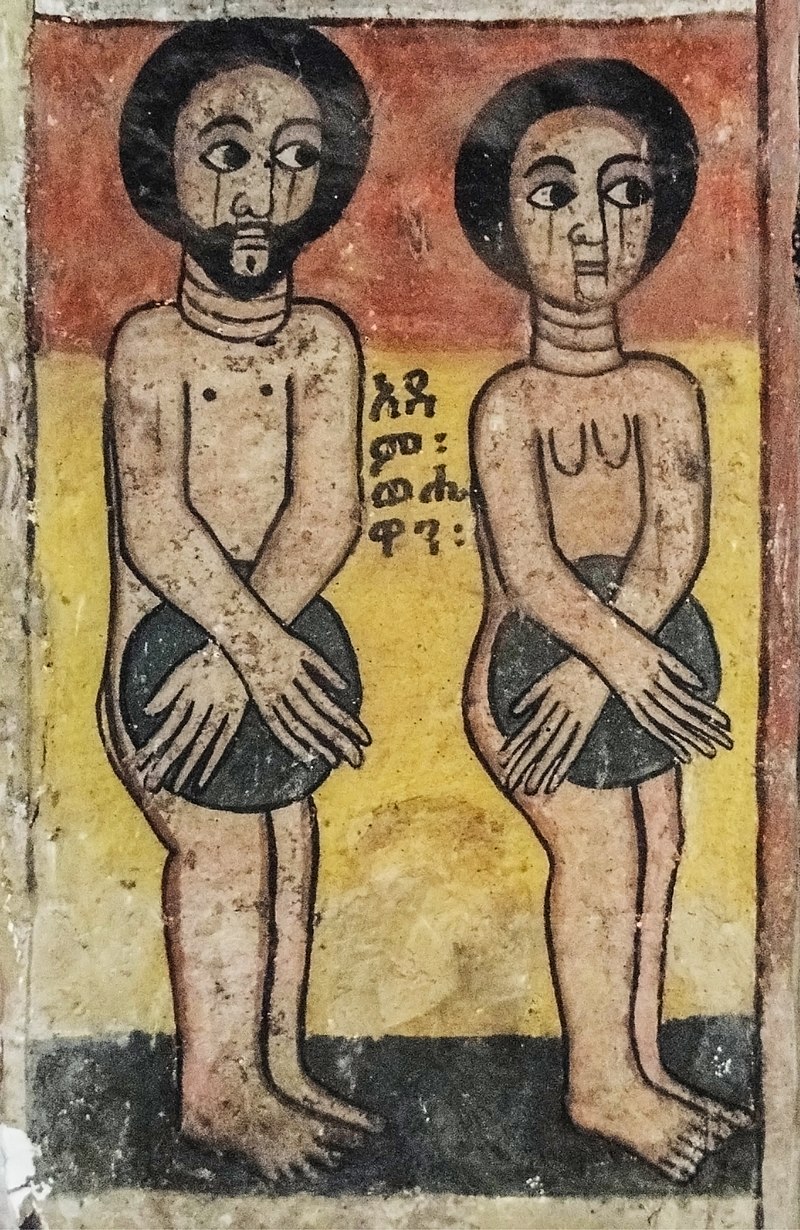
Image: Painting of Adam and Eve inside Abreha and Atsbeha Church, Ethiopia. Photo by Bernard Gagnon, CC BY-SA 3.0

Unfit

(Isaiah 6:1-8; Luke 5:1-11; 1 Corinthians 15:3-10)

When I was a teenager, a dear friend gave me a copy of The Once and Future King, by TH White. The book is an imaginative and introspective re-telling of the story of King Arthur and his knights. I had never read anything quite like it before, and it became an important book to me.

I remember one tale that made a particularly lasting impression on me. A man comes to Arthur’s court because he is suffering from a terrible wound, that will not heal – the result of a curse. He has been told that only the greatest knight in the world can heal his wound; so he has come to Camelot.

Arthur assembles all the knights to have a try, but of course everyone knows that it will be Sir Lancelot who will succeed. Lancelot is known far and wide not only as the mightiest of warriors, but also as the noblest and purest of heart.

But Lancelot knows otherwise. He knows he has betrayed his King through his love affair with the Queen. And he knows, that when he places his hands on the poor wounded man, he will fail; everyone present will know the truth, and Lancelot will be exposed for the fraud he truly is.

Most of us will probably never find ourselves in so fantastical a circumstance.

But perhaps many of us can relate to that persistent doubt, that we are not the person that others have taken us to be, that we are not worthy in fact of their friendship, or their trust. Many of us are familiar with that persistent doubt, that we are not the person God wants us to be, that we are not worthy in fact of God’s trust. That we are, in a word, unfit.

We are in good company.

The lectionary for today sets before us three accounts, from the Hebrew and Christian scriptures, of individuals who declared themselves unfit for duty.  First, we have the prophet Isaiah, in the presence of God and the seraphim, crying out, “Woe is me, for I am a man of unclean lips.” Then, we have the apostle Simon Peter, telling Jesus, “Depart from me, Lord, for I am a sinful man.” And finally, the Apostle Paul, writing to the church he planted in Corinth, telling them that he is in fact “unfit to be an apostle.”

The lectionary could have included other examples. Moses, at the burning bush, tells God to send someone else, for “I am not eloquent, I am slow of speech and tongue.” Jeremiah, called by God to prophesy, tells God that he is too young for the task.

Moses and Jeremiah were concerned about their skill level, their job qualifications, their ability to get the job done; but today’s trio of express a deeper doubt. Isaiah, Peter, and Paul insist that they are unfit for God’s service, not because they are insufficiently skilled, but because they are fundamentally unworthy.

Are all these Biblical figures just being excessively modest?

There is a psychological pattern known as Imposter Syndrome, in which a person persistently fears that they are not as competent as others perceive them to be. It’s fairly widespread; maybe some of you are prone to it. A person suffering from imposter syndrome carries a hidden anxiety, that eventually someone will realize that they are in over their head, that they are faking it, and they will be exposed as a fraud.

A key feature of imposter syndrome, however, is that this anxiety is unsupported by the evidence; the person in question may be performing quite well at their job, and still they fear they don’t belong in their position. A diagnosis of imposter syndrome implies the person is, in fact, quite capable. Hence a cartoon I saw recently, in which a woman is pondering, “I wonder if I’m good enough to have imposter syndrome?”

But what if our assessment is accurate? What if we really are unfit?

We don’t know much about Isaiah’s early life, prior to his prophetic call. We don’t know much about Peter’s life, either, other than his profession. But the Peter of the gospels is overeager, overconfident, and unreliable. The story of Peter in the gospels would almost be a comedy of errors, were the stakes not so high.

As for the author of the Letter to the Corinthians – he was not always named Paul. He was originally named Saul, and he was an aggressively, intolerantly devout Pharisee. In the earliest days of the church, Saul was part of an effort to quash the Jesus movement; in the Book of Acts we learn that he stood by approvingly as one of Jesus’ followers was stoned to death by an angry mob.

Then, one day, Saul was on the road to Damascus when he saw a blinding light, and heard a voice which asked him: Saul, why are you persecuting me? It was the beginning of his conversion, from Saul the persecutor, to Paul the evangelist.

So when Paul tells the Corinthians that he is “unfit to be an apostle,” he is not exhibiting imposter syndrome. He knows what he was, and what he is. “By the grace of God,” he writes, “I am what I am.”

For Paul, as for Peter and Isaiah before him, the experience of call was an experience of grace. His very calling meant forgiveness; and so the proclamation of forgiveness became, in turn, his call.

You might be wondering, what happened to Lancelot, in TH White’s story. White tells us, that after all the other knights had tried and failed, Lancelot came forward to lay his hands on the afflicted man’s head – whereupon his wounds “shut like a box” and his bleeding ceased. The people break into cheering; but Lancelot kneels on the ground, weeping. White writes, “This lonely and motionless figure knew a secret which was hidden from the others. The miracle was the he had been allowed to do a miracle.”

Before God, there can be no imposters. God knows who we are; what we have done, and what we have left undone. We can stop keeping up appearances or worrying that we have been called by mistake. God’s invitation is unconditional; you didn’t receive it in error, it was addressed to you. Go ahead, and open it, and read the good news.

Sermon by Rev. Liza B. Knapp for The First Church of Deerfield, Massachusetts, January 30, 2022.
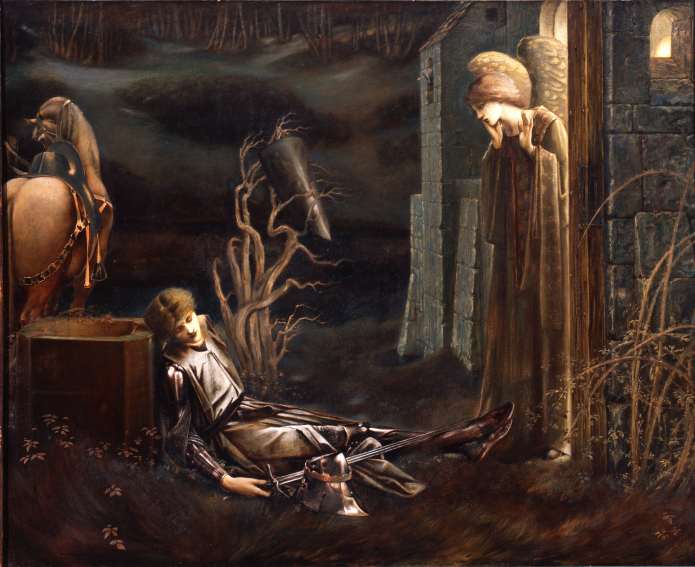
Sir Lancelot at the Chapel of the Grail, by Sir Edward Coley Burne-Jones (1833 – 1898)

A short prayer for “Columbus Day”

Beloved,
You send us messengers of love,
but we prefer other prophets.

For those times when we have
praised the wrong heroes,
followed the wrong leaders,
and chosen the wrong path,
forgive us.

Teach us a better way.

Repenting of the harm we have done,
we ask for another chance
to become your people
by loving your people. AMEN.

Apocalypse III: Here be dragons

I kill where I wish and none dare resist. I laid low the warriors of old. Then I was but young and tender. Now I am old and strong, strong, strong…. My armour is like tenfold shields, my teeth are swords, my claws spears, the shock of my tail is a thunderbolt, my wings a hurricane, and my breath death.

So says the dragon, Smaug, in JRR Tolkien’s fantasy classic, The Hobbit.

Dragons have been part of the human imagination for almost as long as human have had an imagination. They cross cultural boundaries and endure across the ages, emerging in our dreams, our stories, and our art until this very day. The dragon in the myth may be slain, but the myth itself persists.

Why, then, are surprised to find the dragon lurking in the pages of our Bible?

Perhaps it is because we think of such creatures as suitable only for fairy tales and children’s stories. As the old song says, “A dragon lives forever, but not so little boys.” Sooner or later, we grow up and realize that dragons aren’t real, fairy tales aren’t true, and there are no monsters under the bed. So as much as we may enjoy watching Game of Thrones at night, it’s a bit embarrassing to find such creatures appearing here in church on Sunday morning, lurking among the pages of the book of Revelation (Rev 12:1-12).

This is a night vision, this dragon of the Apocalypse. John of Patmos dreamed a dream, told a tale, saw a vision – pick whichever words you wish, but somehow, there came into John’s imagination a great red dragon. Emerging out of the darkness of John’s subconscious, it crouches in wait before a pregnant woman, ready to devour her child at birth.

It is an ancient and powerful image, one that was internationally known in John’s day. The dragon menacing the queen of heaven is a myth that appeared in various forms in Babylonia, Egypt, Greece, and Asia Minor. To a Christian reader, the mother and her child are Mary and Jesus; to a Jewish reader, they are Israel and the Messiah; more universally, they are every mother and every child; they are the present and the future.

The child is hope, and the dragon threatens to devour it.

But in John’s vision, the mother and child are not alone. The child of hope is swept up in the arms of God, the mother flees to a place of sanctuary, and the hosts of heaven wage war on the red dragon. The serpent is cast down, from heaven to earth, where it continues its battle – not against angels, but against the children of the earth.

This is the stuff of high fantasy. Apocalypse is an ancient literary genre unto itself, with no precise modern equivalent; but if I had to shelve it in a bookstore or library, I think I would put it, not in the religion section, but next to Harry Potter, or The Hunger Games, or The Handmaid’s Tale. In saying this, I do not in any way intend to diminish its importance, or to deny its truth.  At its best, speculative fiction creates a counter-reality that can unmask the status quo. It is inherently and powerfully subversive.

How else to explain the fact that in Thailand, following the military coup, young people began signing their resistance by flashing the three-fingered salute from The Hunger Games? Or that, here in the US, during the Kavanaugh confirmation hearing, groups of women took to the streets dressed in the red cloaks and white hoods of The Handmaid’s Tale? In recent years, at anti-Fascist protests around the world, you can see young people carrying signs that say “Dumbledore’s Army.”  Such is the power of myth.

So let us return to our dragon. Defeated in heaven, the red dragon falls to earth, to wage war against its inhabitants. But it does not do so directly; instead, it gives its “authority” – its power – to a great and monstrous beast that arises from the sea. This Great Beast in turn relies on another – a lesser beast from the earth – which acts as its agent and enforcer, demanding loyalty to the Great Beast. (Rev. 13:1-18)

Who, or what, is this Great Beast from the sea, this earthly incarnation of the dragon’s power? John gives us two details: first, that the Beast has seven heads, one of which has a mortal wound, yet lives; and second, that the number of the Beast is 666. These are clues to be deciphered by John’s readers; as he himself says: “this calls for wisdom.”

Here John’s vision becomes less global and more particular; for beasts, in the Hebrew apocalyptic tradition, represent specific earthly empires. In this case the beast with seven crowned heads is Rome and its seven emperors; the seventh head, with the mortal wound, refers to the Emperor Nero, who was at the time variously rumored to have committed suicide or to have survived the attempt.

As for the number of the beast: in Hebrew numerology, each letter has a number, and so each word has a corresponding number that is the sum of all its letters. The sum of the name Nero Caesar, is 666.

At this point, John’s vision becomes less high fantasy, and more political allegory; a bit less like Lord of the Rings, and more like Animal Farm.

Animal Farm, for those unfamiliar with it, is a classic twentieth century fable by George Orwell. It tells the story of a group of farm animals who rise up in revolution against the tyranny of their farmer. In this they are led by the pigs, who encourage them to build a utopian society in which all animals are equal. In time, however, the pigs themselves become as tyrannical as the farmers.

To those familiar contemporary world history, Animal Farm is clearly an allegory of the Russian Revolution, with the pigs corresponding to its leaders: Old Major is Karl Marx, Snowball is Trotsky, and the aptly named Napolean is Stalin. To those who are unfamiliar with this history, the story is still compelling, for its warning against totalitarianism rings true in any age.

And so it is with the book of Revelation. John’s contemporaries would have recognized his symbolism as referring to the particular political realities of their own time. Those of us farther removed from this setting may still find his vision compelling, for the forces of empire are active in every age. But we misinterpret the story if we read it too literally.

Let me be perfectly clear here; to come away from Revelation with a fear of the number 666 is like coming away from Animal Farm with a fear of pigs. In either case, it is to profoundly miss the point.

The purpose of John’s Apocalypse – and arguably, the purpose of Harry Potter or The Handmaid’s Tale as well – is to unveil the true nature of the Empire’s power, and to give courage to those who refuse to bow down before it. Apocalyptic literature is, in John’s own words, “a call for the endurance of the saints.” It is a loud and clear warning to those who drift into tyranny: Here be dragons.

This is no children’s fable. Quite the opposite.

I have been thinking back, this week, on the dragons of my childhood. Pete Seeger introduced me to Puff, the Magic Dragon, who frolicked in the autumn breeze with little Jackie Paper. Disney brought me the Reluctant Dragon, who wrote poetry and shared a cup of tea with the knight who came to slay him. Meanwhile, my books about dinosaurs taught me that giant lizards were a thing of the past.

But real dragons are neither pets or playmates. Real dragons devour and destroy. Take Smaug, for example. Now, that’s a dragon. He sits on a massive pile of plunder, for which he has slaughtered thousands. He craves gold – which is to say, wealth for wealth’s sake, power for power’s sake – and he will stop at nothing to acquire it.

As a child, I was lulled into believing, there were no real dragons. But I am no longer sure of that.

Real dragons cannot be seen by human eyes, or slain by human hands. Dragons exist in our world, the “real world,” only by proxy. They enlist us, to do their damage for them – to despoil and to dominate, to torture and to kill. We cannot lay hands on racism itself, or greed itself, or tyranny itself. But they are real enough. We can choose to serve them; or we can resist.

So, my fellow Hobbits, my fellow Handmaids, my fellow members of Dumbledore’s Army, take heart. You are not alone.

I leave you with this word of encouragement from John’s revelation:

The dragon’s wrath is great, because he knows his time is short.


Sermon by Liza B. Knapp
for the First Church of Deerfield, MA
May 19, 2019

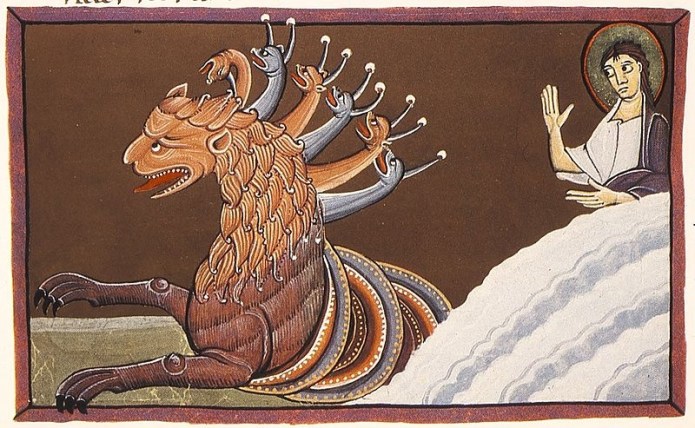
(photo: Image from the 11th century Bamberg Apocalypse. Wikimedia Commons. )

Easter Fools.

Happy—- April Fool’s Day.

It’s not every year that Easter falls on April Fool’s day, but there is always something a bit foolish about it.

For fool’s we must be, to believe this outlandish tale. Empty tombs? Resurrected bodies? Nonsense.

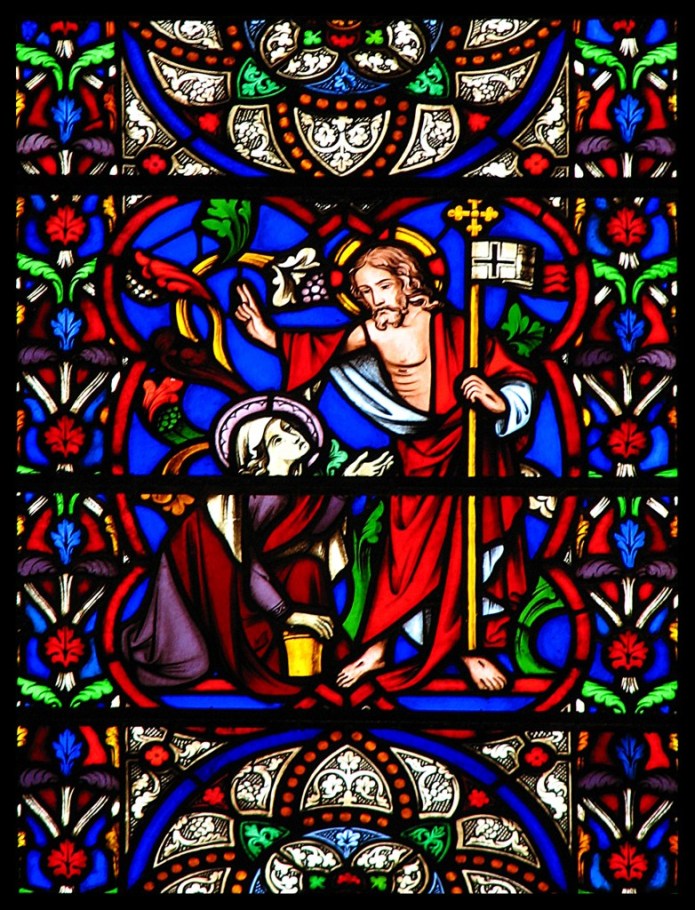
It sounds like an elaborate hoax. You can just imagine the hidden camera waiting near the tomb for the moment when Jesus whips off his gardener costume and reveals the prank at Mary Magdalene’s expense. You can imagine the other disciples emerging from their hiding places, saying “OMG Mary, you should have seen your face!”

Truth be told, as a kid I was never a big fan of April Fool’s Day. I didn’t like the idea of being set up. I didn’t like being tricked. I didn’t like people laughing at me.

Neither, apparently, did the men who followed Jesus. When the women returned from the tomb with tales of resurrection, they dismissed their witness as mere silliness. They weren’t going to fall for it. It was clearly too good to be true. Like those phone messages I get all the time telling me I’ve won a free vacation cruise. Who falls for that?

Fools, that’s who.

But which part, I wonder, did they find more unbelievable? That Jesus was now alive? Or that he had died in the first place? Was believing in a resurrected messiah any more ridiculous than believing in a crucified one? Fool me once…

In the catacombs of Rome, there is an ancient piece of graffiti that shows a young man worshipping a crucified, donkey headed figure. The Greek inscription says, “Alexamenos worships his God.” Whoever this Alexamenos was, his buddies clearly found his religion hysterical.

Well, they were right. If we think this story is anything other than ridiculous, we are probably missing the point. The apostle Paul admits as much:

We preach Christ crucified: a stumbling block to some, and foolishness to others, but to those whom God has called, the power of God and the wisdom of God. For the foolishness of God is wiser than human wisdom.

But notice that the foolishness Paul refers to here is not the resurrection, but the crucifixion. The stumbling block to faith in Christ was not the fact that Jesus rose from the dead, but rather the way that he died in the first place. What sort of messiah gets nailed to a cross?

The job of the messiah was to restore the nation, to vanquish its enemies, to free it from occupation. To make Israel great again. Getting executed was a pretty poor start to that project. Who follows a messiah like that?

Fools, that’s who.

To make things even more ridiculous, some of his followers had now begun to preach that Jesus himself was somehow God, in human form. The supreme creator of the universe, nailed to a cross. Who wants a God like that?

Fools, that’s who.

But really, the foolishness began even before the crucifixion. Jesus had been spouting foolishness from the moment he began to preach. “Blessed are the poor,” for example. That’s just silly. You start off saying blessed are the poor, and right away people expect a punchline – “How blessed are they Johnny?”

Then there was that nonsense about forgiving people not just seven times, but seventy times seven. Who does that? Or that nutty thing Jesus said about turning the other cheek. Only a fool would let down their guard, after they’ve been punched.

Yet, in every generation, in every nation, in every faith, there have been folks who believed this sort of foolishness. Martin Luther King Jr, Mohandas Gandhi, Malala Yousafzai. Saint Francis of Assisi took the blessedness of poverty so seriously that he once stripped naked in public and walked away without his clothing. Talk about embarrassing. That is the stuff of nightmares. But it is also the stuff of sainthood.

Every saint is a fool, one way or another.

Before I continue, I need to pause here a moment for lesson in basic logic. The proposition that “every saint is a fool” does not imply that the converse is true as well.

Not every fool is a saint.

The mere fact that you have appeared on America’s Funniest Home Videos does not qualify you for sainthood. There are as many varieties of foolishness there are human beings, and many of them have nothing to do with saintliness.

Jesus tells this story, of a foolish man who found himself with a surplus of grain. Rather than share it, he built himself a huge barn, so that he might story up a supply to last him all his days. No sooner was the project finished, than the man died in his sleep.

Lord, what fools these mortal be, Shakespeare wrote. Foolishness is our lot in life. It runs in the family. So maybe the only real question, then, is: What kind of fool do you want to be?

Many, many years ago, when I was going through a pretty severe crisis of faith, I sought guidance from my childhood pastor, John MacNab. John had baptized me as an infant and confirmed me as a teenager, and now as a young adult I was hoping that perhaps he could tell me something that could dispel the panic of uncertainty I was feeling.

I asked him bluntly, “What if it’s just not true?”

“What if what isn’t true?” he asked.

“God, Jesus, any of it,” I answered.

“Well,” he replied, “then it sure was a great story.”

I remember finding this a distinctly un-reassuring answer at the time. At the time, I suppose I was hoping for some sort of logical proof or conclusive evidence to secure my faith. But John was expressing what Martin Luther also taught: that faith is ultimately not about certainty, but about love. Perhaps John was a fool. But he was a holy fool.

If you look up the phrase gospel truth, you will find one of its definitions to be “unquestionable fact.” But I don’t buy that. Everything about the gospel is in fact highly questionable. Its claims are outrageous and ridiculous, and nothing can prove them otherwise. So what is the gospel truth?  The gospel truth is the truth that makes us free.

Free to be foolish, in the eyes of the world. Free to love your enemies. Free to respond to violence with peace. Free to walk the extra mile, to turn the other cheek, free to lay down your life, free to speak truth to power, free to embrace the outcast, free to befriend the sinner. Free to love, and do as you will.

Mary Magdalene could offer no proof, of her encounter with Jesus in the garden, and the rest of the disciples were unpersuaded. But she testified to what she knew: that Jesus had called her by name.  For Mary, that was the gospel truth.

This my friends is the gospel truth I share with you today: that God loves you, however foolish that may seem. And nothing can put an end to that.

Christ is risen.

Happy April Fool’s Day.

Samuel Speaks


Then the Lord called, “Samuel! Samuel!” and he said, “Here I am!” (1 Samuel 3: 1-20)

At first, Samuel thinks it is Eli calling—Eli, who has been both priest and adoptive father to Samuel for most of his young life—Eli, who has been the voice of authority, the voice of conscience. In this household of faith, it is Eli who speaks for God, and Samuel listens to Eli. But tonight, Samuel will listen to God directly, without parental supervision.

And tomorrow, Samuel will speak. When he does, he will break the silence surrounding Eli’s grown sons, also priests, who have been abusing their flock, while lining their pockets with offerings intended to God.

It will be Eli’s turn, to listen – and it will be hard listening. For Samuel’s message is the message of Eli’s sin as well. After all, this happened on Eli’s watch. It should have been Eli’s job, not Samuel’s, to call his sons to account. It should have Eli’s job, not Samuel’s, to protect the Temple, and its people.

On Ash Wednesday, a young man entered Stoneman Douglas High School, in Parkland, Florida, and killed 17 students and teachers with an assault rifle. It was the second mass school shooting this year; in January, two students were killed and sixteen more wounded at Marshall County High School in Benton, Kentucky.

The day after the Parkland shooting, the young survivors held vigil. And the next morning, they began to speak. They are speaking still, demanding action to keep schools safe, and keep weapons out of the hands of those who would do harm. They are speaking to their parents, to their Representatives, to their Senators, to their President.

They are calling the elders to account for their failure to protect.

The voices of the Stoneman Douglas survivors have been joined by the voices of thousands of other young people from around the country. In state after state, in school after school, in walkouts and protests, students are demanding legislation to keep dangerous firearms out of dangerous hands. They are fighting for their lives.

Like many of us, I have been inspired by their passion, by the courage, by the persistence of these young survivors. But should we be any less passionate than our children? Should we be any less courageous, any less persistent? And by “we” I mean my generation. After all, it should have been our job, not theirs, to keep them safe. It should have been our job, not theirs, to hold our legislators to account.

We are the grown-ups now. We are Eli. This happened on our watch.

Samuel speaks today, as he does in every generation. Samuel speaks today, through the students of Stoneman Douglas. Samuel speaks, through 19 year old Chris Grady, and 18 year old Emma Gonzalez, and 17 year old Delaney Tarr, and 16 year old Kyle Kashuv, and 15 year old Christine Yarad – who wrote to the New York Times, “If you have any heart, or care about anyone, or anything, you need to be an advocate for change… Don’t continue this cycle.”

I can imagine that Samuel might have said exactly these words.

It’s time for some hard listening.


Photo: Gerald Herbert


God’s Intent

“Even though you intended to do harm to me, God intended it for good, in order to preserve a numerous people from starvation… So have no fear.”  (Genesis 50: 20-21)

God never speaks to Joseph.

God spoke to Joseph’s great-grandfather, Abraham; God told Abraham, “I will make of you a great nation, and I will bless you.”

God spoke to Joseph’s father, Jacob, and told him, “Know that I am with you, and will keep you wherever you go.”

But God never speaks to Joseph; at least, not in so many words.

The God of Genesis is a talkative God. Adam, Eve, Cain, Noah, Abraham, Jacob, Hagar – God speaks to each of them by name. But with Joseph, God’s presence is never a voice – always a dream. And not the kind of dream that Jacob had in the wilderness, the dream where God stood beside him and promised to care for him. No, Joseph dreams of sheaves of corn, and stars in the sky.  He interprets those dreams as signs of a great destiny; his brothers interpret them as a sign of a great arrogance. But really, who is to say? Sometimes an ear of corn is just an ear of corn.

The story of Joseph and his brothers takes up the last 14 of the 50 chapters of Genesis, and in all that time God speaks only once, to Jacob. To Joseph, God speaks not a word.

I find that interesting.

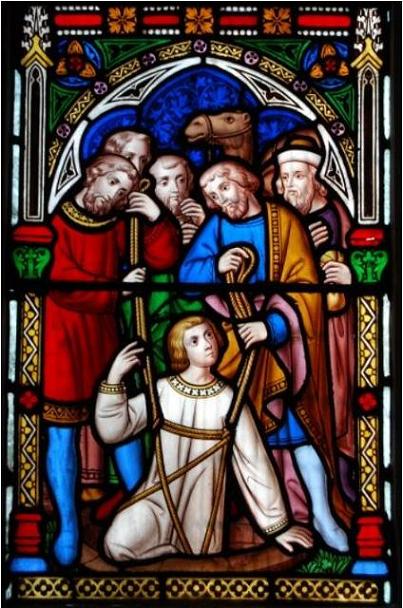
I find that interesting, because, at the end of the story, Joseph is confident that his whole life has been under God’s care, his whole journey bent to God’s purpose. This despite the fact that some really terrible things have happened to Joseph.  As a young man, he is sold into slavery, and taken to Egypt, to live among people who do not understand his language or his faith.  The wife of his first master falsely accuses him of attempted rape (an accusation that, in another country, in another century, would surely have resulted in lynching). Joseph is unjustly incarcerated, for at least two years. Worst of all, this whole chain of events is set in motion by an act of betrayal, for it was Joseph’s own brothers who sold him.

Joseph eventually is freed from prison when Pharaoh hears of his skill in interpreting dreams. It turns out Joseph has also has a gift for predicting agricultural futures, a skill that strengthens Pharaoh’s rule and helps Egypt survive a long season of famine.  It is this famine that brings Joseph’s brothers to Egypt, in search of food.

They do not recognize their brother; but Joseph recognizes them.

Finding his brothers on their knees before him, Joseph does not seize the opportunity to punish them, or even to berate them. He embraces them, and pardons them, and tells them, astonishingly, “it was not you who sent me here, but God.”

Seriously?

When I hear someone describing some tragedy or loss — or, worse, some injustice — as “God’s will,” it always seems to me like a cop out, a convenient way of putting difficult emotions back in the canister. It drives me crazy when people shrug off suffering with a pious platitude. After all, the prophets and the psalmists never let God off the hook that easily. They lamented. They complained. They raged against injustice. And rightly so.

And yet: I also know that experiences in my own life that brought me pain have also given me strength, and compassion, and insight. Through them, I have been shaped, and molded, and equipped for my calling. This is a paradox – that God can use suffering to heal suffering. That God can use evil to defeat evil.

And so, at the end of his long and winding road, Joseph can tell his brothers, “Do not be afraid. You intended it for harm, but God intended it for good, in order to preserve a numerous people from starvation.”  The Hebrew word translated as “intended” here can also be translated as planned, purposed, crafted, fashioned, shaped. God never speaks to Joseph; but God’s hand has been upon him all along, shaping him for service, bending his life toward good.

There are two important points we need to recognize about this conclusion, lest we fall into platitudinous piety.

First: it is Joseph’s conclusion to make – not anyone else’s.

It is Joseph’s conclusion to make, because his suffering, his trials, are his to interpret. Imagine if his brothers had said, “hey, look where you ended up, guess it’s a good thing we sold you.” Only Joseph can say when, and how, his life makes sense. On the other hand, the brothers have their own lives to interpret. What do they make of the famine that brought them to bow down before the brother they had harmed, and lost?

Second: it is a conclusion is made only in retrospect.

It would be nice to know our destination in advance. It would be nice to know, as Abraham did, what God has planned for us. It would be nice to get a set of instructions, as Noah did, telling us exactly what to do.  But most of the time, it doesn’t work that way. God never speaks to Joseph; it is only in retrospect, that Joseph sees his destiny plain. It is only when God’s end is in sight, that Joseph sees the meaning of it all.

Let us be clear. A famine is not a good thing. Betrayal, enslavement, and imprisonment are not God’s will for anyone. But even great harm can summon forth great good, for good is always God’s intent.

Of course, it is hard to imagine what sort of tool is being fashioned, when the metal is still in the fire. When we are being painfully bent out of our old shape, when our previous identity is melting away, it is hard to believe that we might be molded into something new.  And for some of you, perhaps, this is such a time. Indeed, I believe that for our nation, this is such a time. Our country’s path has taken a turn for the worse. The flames of racism and bigotry have been stoked and it remains to be seen what sort of people will emerge from the fire.

But imagine the possibility that, like Joseph, we may emerge from this trial with a new sense of calling. The possibility that, like Joseph’s brothers, we may emerge from this trial with a new sense of humility. The possibility that our own family history of enslavement may be at last exposed, and repented, and redeemed.

Joseph’s story challenges us to look honestly upon the lives we have led— not just the comfortable stuff we put on our resumes,  or post on our Facebook pages, or submit to our college alumni bulletins, or write in our history books, but the betrayals and injustices and injuries as well — and to consider how we might yet employ of all of this toward good.

God never speaks to Joseph. But Joseph’s story speaks to me. And it tells me this:  that whoever we are, wherever we’ve been, whatever kind of shape we are in right now, we may yet be shaped for God’s purpose. God intends all of us for good, and not for evil; for compassion, and not for hatred.

So, Joseph told his brothers, have no fear — neither of the past nor of the present, for the future is yet to be revealed.

May our lives be bent toward good, and may God be with us all.


Matthew 5:45

The man stood on the mountainside
and turned to face the crowd.

Son of Man —
Child of Earth —
speak to us of God.

Whom shall God bless with warmth and sun?
On whom shall sweet rain fall?

On every one, both good and bad,
for God so loves us all.

Whom shall God curse with plague and storm,
with fire, and with flood?

I came to save, the stranger said —
It’s you that call for blood.