Pathways of Peace

…to guide our feet in the pathways of peace. — Luke 1:68-79

I don’t know about you, but I am having trouble feeling peaceful this Advent.

Maybe some of you are having the same difficulty.

It isn’t just about the hustle and bustle of holiday preparations; I haven’t done much of that yet. It isn’t about the commercialism of the season; I can avoid most of that, if I steer clear of malls and stick to Netflix instead of television. I’m not even talking about the pervasive day-to-day stress of life in the hectic post-modern world. I can’t really escape that, but I’m pretty much used to that.

I am having trouble feeling peaceful this Advent because it seems like every few days the peace is shattered by some cry of violence and hatred. Over the past months those shouts have become more and more frequent until they have built to a steady roar that I can’t manage to ignore or dismiss. Each week, the litany of prayers gets longer: Paris, France… Beirut, Lebanon… Nola, Nigeria… Colorado Springs, Colorado… San Bernadino, California.

It’s getting to the point where I wonder, should I continue to post these events on our Facebook page and ask for prayer? Or are we getting as weary of prayer as we are of violence?

Welcome to Advent: the season when the world waits — hopefully, eagerly, and sometimes desperately — for the arrival of the Prince of Peace.

There is a paradox in our celebration of Advent, a sort of folding back of time, as we wait for Christ’s arrival – an event that happened almost two thousand years ago. How is it that we are still waiting? If the Prince of Peace came in Jesus – why is there so little peace in our world?

On the other hand, if we are still waiting, if Christ is coming still, then there is still hope. Hope that the miracle of Bethlehem may yet come to us as well, “to guide our feet in the pathways of peace.”

In my younger years I remember spending some time at a camp where the lawns had been freshly re-turfed, and it was drilled into our young heads that we could play on them or sit on them, but, we were told, “whatever you do, don’t make a path.” You see, if enough of us took the same route across the lawn from the dorm to the dining hall, eventually the grass would wear away, and a path would appear. So we instead had fun running across the lawn in crazy zig-zagging paths, shouting to one another “Don’t make a path! Don’t make a path!”

Here is my point: You make a path by walking it.

Jesus is called the Prince of Peace because he walked the pathway of peace – not a peaceful path, but a peaceable one. Jesus made the path, by walking it. And the more of us walk it with him, the broader it will be.

Welcome to Advent, the season of peace.


(excerpted from a sermon preached at Belchertown United Church of Christ on December 6, 2015)

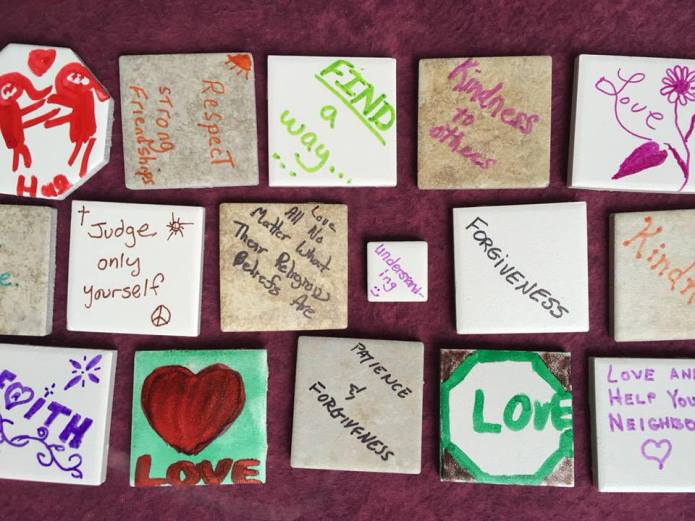
(photo: stepping stones on the pathway to peace, created by members of Belchertown United Church of Christ.)

What child is this?

An Advent Reflection on Isaiah 11: 1-10

What do we dare hope for? It’s an interesting expression, isn’t it?  Daring to hope. But how else to describe this vision, of a peace beyond our wildest imagination?

We don’t know exactly when these verses were written; the book of Isaiah contains material that ranges over a century or so of ancient Jewish history. Possibly this passage comes from sometime in the eight century BC, when the neighboring kingdom of Assyria laid siege to Jerusalem. Possibly it comes from sometime in the seventh century BC, when the neighboring kingdom of Babylon destroyed Jerusalem. Isaiah’s people were not accustomed to justice, or peace. Yet in these verses, the prophet offers them a bold vision of hope, based in his faith that God was not finished yet.

Isaiah begins with an image of new growth from a felled tree, a shoot from the stump of Jesse — Jesse being the father of King David. This new king of Israel will usher in a reign of justice:

With righteousness he will judge the poor,
and decide with equity for the meek of the earth.
He shall strike the earth with the rod of his mouth,
and with the breath of his lips he shall kill the wicked.

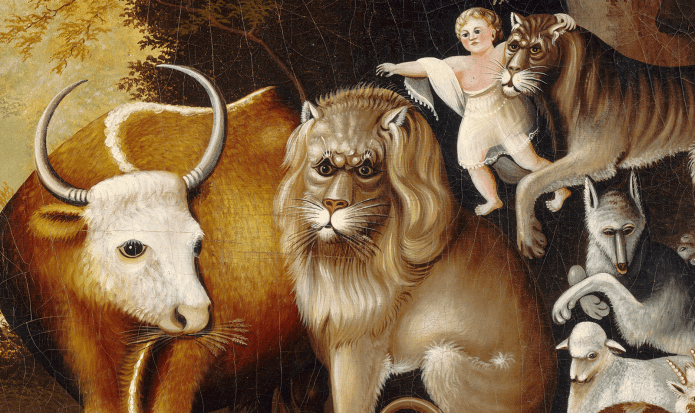
As if this wasn’t already more than his people would dare to hope, Isaiah’s language then explodes into an even more extravagant vision — a Peaceable Kingdom in which conflict and enmity are ended, even between predator and prey; a world in which children will be free from all peril:

The cow and the bear shall graze,
and the lion shall eat straw like the ox.
The nursing child shall play over the hole of the asp,
and the weaned child shall put its hand on the adder’s den.

This, Isaiah tells us, is God’s plan for us. Nothing less than this.

Think about this for a moment, and ask yourself, which seems like a more achievable form of security: a world in which the lion shall eat straw like the ox, or a world from which lions have been eradicated?

Before pursuing my call to the ministry, I was an ecology professor, and I can tell you from a purely biological perspective, there’s no way a lion is going to eat straw. It’s not just a matter of instinct; it’s a matter of digestive enzymes and dental structure. It’s just not going to happen. On the other hand, we humans have come pretty close to successfully driving lions to extinction.

The fact is, that we do routinely fantasize about killing off predators in our midst, or at least fencing them out. But do we dare to imagine a world in which foes are not vanquished, but reconciled? Or is such a world as unimaginable to us as a lion eating hay?

Several Christmases ago, a well-meaning relative sent my then two-and-a-half year old daughter Phoebe a picture book as a gift. It was the story of Henny Penny. Now, for those of you who may need your memories refreshed, Henny Penny is the tale of a chicken who, having been struck on the head by an acorn, becomes convinced that the sky is falling. She gathers together her friends – Turkey Lurkey, Loosy Goosey, and the other barnyard fowl – and they all set off to warn the countryside. On the way, they meet Foxy Loxy. The fox tricks the birds into entering his den, whereupon he promptly gobbles them up.

This particular version of the story was accompanied by remarkable illustrations, collages of photographs in which the animals appeared both realistic and full of personality. So when we turned the page, and there was the image of the fox, gleefully devouring Henny Penny’s friends, my daughter burst into tears. Deep, grief-stricken tears.

You see, to Phoebe, it was not the lion eating hay that was unimaginable; it was the fox eating chickens.

As adults, we have become accustomed to the world as it is. We learn to be realistic in our expectations, and so we avoid the cruelty of disappointment, the grief of loss. We don’t get our hopes up. But then we come face to face with a child. And we remember what hope is like. We remember, not how the world is, but how it should be.

The wolf shall live with the lamb,
the leopard shall lie down with the kid,
the calf and the lion and the fatling together,
and a little child shall lead them.

Who is this child? Who is this child, so at home in this unfamiliar, longed-for world?

In some sense, this child is Phoebe — or any other child.  The child that ushers in this peaceable kingdom is every child. Because, when we come face to face with a child, any child, we remember what hope is like, and we remember who hope is for.

But this child also recalls to us one, particular child. From the earliest days of the church, Christians have seen in Isaiah’s prophecies a foreshadowing of the reign of Christ. When we read these scriptures, we see Jesus: not only in the ideal king, who will judge the poor with righteousness and the meek with equity, but also in this little child, leading the calf and the lion home together.

And it strikes me, what an odd thing it is, that we so often picture the founder of our faith as a child. As often as we see Christ on the cross, still we see him as the baby in the manger. It’s a fairly distinctive feature of our faith. How often does one speak of the baby Mohamed, or the Buddha Child? Yet Christ is for us, somehow, always a child.

Now, some might dismiss this as sentimentality, and it is undoubtedly easy to love a baby who hasn’t yet spoken to us of things we would rather not hear. But I think there is also something deeper going on here.

These verses are part of our worship at this time of year, because they capture the spirit of Advent – that time of year when we become children again, and remember what hope is like. For Advent is not just a season of remembrance; it is a season of anticipation. We sometimes tell our children that on Christmas we celebrate the birthday of Jesus, but this isn’t quite right. For it is not Christ’s birthday that we await during Advent. It is Christ’s birth. Christ was not just born in Palestine, two thousand years ago. Christ is about to be born for us, right now, right here. Christ is our hoped-for child, who teaches us to hope again.

God is about to do a new thing; now it springs forth; do you not perceive it?

A child is coming, to bring us hope.


(sermon preached at Belchertown United Church of Christ, 11.29.2015)

(photo: detail of The Peaceable Kingdom, painting by Edward Hicks)

Make Yourself at Home

Serve the city where God has placed you; for in its welfare, lies your own. — Jeremiah 29:7

Jeremiah was about thirty years old, when the armies of Babylon swept across Syria and Palestine. They left the capital city of Jerusalem standing, but at a price: a good portion of its population was deported – carried off to exile in Babylon. Jeremiah was one of those who remained in his native land.

The Israelite captives were hostages of the state. They were not exactly prisoners, but neither were they free. Living in the midst of strangers, they were exiles, not immigrants; their families, their homes, their hearts were elsewhere.

The mourned, for the old country. They dreamed of returning. They sang songs of lament. (You know the words: by the waters of Babylon, we lay down and wept, when we remembered Zion…)

But then — rumors began to spread, and hope began to grow. There was political unrest in Babylon; the King was losing power. They’d be out of here any day now! They would return home – and their real lives could resume.

It was at this moment that Jeremiah wrote his letter to the exiles, in which he told them: Make yourself at home, because you’re not coming back.

Build houses; plant gardens; have children. Seek the welfare of the city in which you live. For in its welfare, lies your own.

Well, it turned out Jeremiah was right; King Nebuchadnezzar survived the attempted coup, and reigned another 32 years. It would be another 25 after that, before Babylon fell, and the Israelites were allowed to return home.

By then, two generations had been born on Babylonian soil. Did some of them decide to stay? Did they have a choice? When they finally got back to Jerusalem – did it feel like home?

Last August, I brought my kids to see my old neighborhood for the first time. I grew up in Greenwich Village, New York, in an 1840’s carriage house, which had been really barely renovated into faculty housing for NYU. The house was pretty much one enormous, two-story room, with a roof of leaky cross-beamed rafters; the bedrooms were tucked up in what had been the hayloft. The first and second stories were connected by this crazy, open metal staircase that had been put in by a couple of set designers who had lived there a decade earlier. This was the family home for over thirty years, until my Dad retired from NYU and moved out.

That was almost twenty years ago, but sure enough, as I turned the corner onto my block this summer, there was the familiar cobble stone street, looking almost exactly the same as it did during my childhood. There was my house, with its dark brick walls, its heavy wooden door, and the wisteria vine still climbing up the front.

As I stood there with my family, the door suddenly opened, and a couple of workmen came out, who had been doing some repairs inside. They let us peek in through the door.

Gone was the hanging staircase, replaced by a more conventional (and doubtless, safer) enclosed staircase. Gone was the open balcony, replaced by glassed-in second story. Gone was the raftered ceiling.

I told the kids, don’t look inside. That’s not the house I grew up in.

The inescapable truth is that my children are growing up in a different world than the one I think of as home. I don’t know about you, but my experience of aging is sometimes not so much a feeling that I am getting older, but a feeling that the world around me is somehow getting younger. It’s like that old trick with the tablecloth and the plates. I stay in one place, but somehow the ground beneath my feet changes.

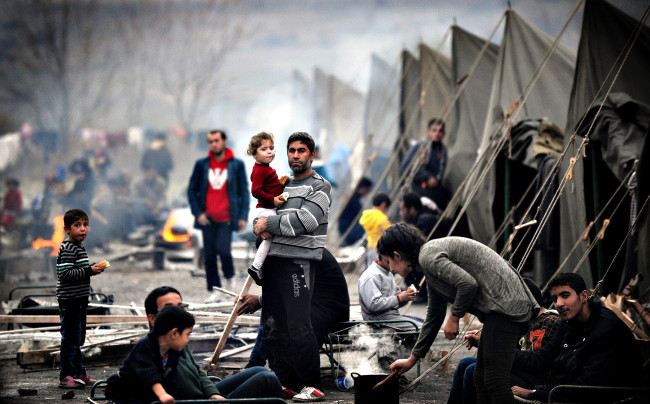
Even those of us who stay put may find ourselves longing for the old country, for the way things used to be. It is not only the refugees who find themselves in a strange new world. Many of us live with a persistent sense of dislocation. The world around us changes so quickly.

How do we make ourselves at home, in this brave new world?

Serve the city where God has placed you; for in its welfare, lies your own.

After all, the exiles in Babylon weren’t the only ones who found themselves surrounded by strangers. What did their Babylonian neighbors feel about this influx of foreigners, I wonder? Did they say to these refugees, make yourself at home? Or did they, too, long for the day when the Israelites would finally leave, and their city could return to normal?

It is one thing to live alongside outsiders, but another to let them in – in to our homes, into our families, into our hearts. To seek their welfare, as our own.

In Jeremiah’s letter to the exiles, I hear an echo of a later letter, this one written by the apostle Paul to the newly converted Christians in Ephesus. Some of the other leaders of the early church had balked at the inclusion of Gentiles into what had previously been a monocultural, all-Jewish group of disciples. But in his letter to the Ephesians, Paul proclaimed Christ has torn down the barrier that divided us into two separate peoples. “You are no longer strangers and aliens,” he wrote, “but you are citizens with the saints and also members of the household of God.”

In other words: Make yourself at home.

Today, 26 centuries after Jeremiah wrote his letter to the exiles, there is again a mass deportation going on in the middle east. Armed conflict in Syria has driven over four million Syrians to seek refuge across the border in Turkey and beyond. Half of these refugees are children.

A friend recently shared with me another letter, this one written just last month. It was posted on facebook by a grassroots group in Iceland, called Syria is Calling. Earlier this year, the Icelandic government announced that it would accept just 50 Syrian refugees. In response, the group posted this letter, demanding that the government increase the quota:

Refugees are our future spouses, best friends, our next soul mate, the drummer in our children’s band, our next colleague, Miss Iceland 2022, the carpenter who finally fixes our bathroom, the chef in the cafeteria, the fireman, the hacker and the television host. People [to whom we will] never be able to say to: ‘Your life is worth less than mine.” Open the gates.

In other words: Make yourself at home.

So far, the group has generated individual pledges of housing and support for 10,000 refugees.

Jeremiah’s letter is not just for the exiles, but also for those who receive them; not just for the migrants, but also for those of who stay put; not just for his ancient audience, but also for us, right here, right now. Are we willing to echo Jeremiah’s words, and say to the newcomer: make yourself at home? And – just as important – are we willing to make ourselves at home, in this new city, with these new neighbors that God has given us?

Build houses and live in them; plant gardens and eat what they produce. Marry and have children, and let your children have children. But seek the welfare of the city God has given you to live in, and pray to the Lord on its behalf; for in its welfare, you will find your own.


(10.18.2015, Belchertown United Church of Christ)

(Photo Wisance.com)
Bring Them Along

Come now, and worship, but do not come alone.

Bring with you all the ones that you have loved.
the hands that held yours, the shoulders that carried you,
the arms that embraced you, the eyes that watched over you.

Bring also the skinned knees that you bandaged,
and the tangled hair that you combed;
the heads that butted yours,
and the feet that kept step with yours.

Come now, and worship, and bring them all along:
for God knows them well,
and welcomes them here.

Lost in Translation

All of them were filled with the Holy Spirit and began to speak in other languages… — Acts 2:1-21

A friend once told me this story: When she was a teenager, her family took a vacation to Germany. They travelled from city to city, staying in little hotels along the way, but on one particular night they found themselves lost, driving around in the pouring rain looking for lodgings, while her father – the driver – became more and more frustrated. Frustrated with the rain, frustrated with the traffic, frustrated with his inability to understand the German street signs. Finally they somehow found their way to a little pension with a vacancy sign in the window, and so they went inside and her father stormed up to the desk and banged on the bell. When the night clerk appeared, her father said, slowly and loudly, “WE… ARE… AMERICANS.”

To which the night clerk replied, “Congratulations, sir.”

We live in a multilingual world, and in a multilingual world, if you want to travel beyond your borders, you have two choices: you can demand that the rest of the world speak your language; or you can learn theirs.

Anglo-Americans tend to choose the former. English, after all, is a dominant world language; pretty much anywhere you go in the world, you can count on finding someone who speaks some English. Which is lucky, because most of us speak only our own language. In Luxemburg, nearly every citizen speaks four languages. The same is true of Aruba. But here in the US, seventy-five percent of us are monolingual English speakers. Because why learn another language, when the whole world speaks yours?

Today is Pentecost Sunday. Each year on this Sunday we celebrate the birth of the church – the moment when the Holy Spirit first swept through Jesus’ disciples. The Spirit swept through like a great wind, like tongues of flame, bringing with it the gift of tongues. Not mystical tongues, not supernatural languages; but ordinary human languages. Peter and the other disciples – native Galileans, all of them – were somehow empowered to share the gospel with travelers from around the world, in their own languages. The Spirit’s first gift, was the gift of translation.

Let’s think about that.

I travelled to Ghana a couple of years ago, and while I was there I had the opportunity to stay with a local pastor, who brought me with him to his church on Sunday. This church met in a school classroom, the only room in the village large enough to hold the congregation. The service was conducted mostly in the native Ewe language. English is taught in school there, and many of the people I met spoke at least some English, but in these small village churches many of the older folks had not been formally educated. So I was sitting next to my host, enjoying the people, and the music, but understanding nothing of what was said. And then, about halfway through, the pastor leaned across to me and said,

“We have a bit of extra time today, why don’t you preach a sermon too?”

The next thing I knew I was standing in front of a group of friendly, welcoming, expectant people, none of whom could understand a word I was saying. The pastor stood next to me, and translated as I went. At least, I assume he did; I of course could not understand a word he was saying.

It was a slightly surreal experience. I had to let go of my sermon in way that I don’t normally have to, because I didn’t know, really, what my words would mean to the congregation — what they would sound like, in their language. And so I had to trust. Trust in my host, trust in my listeners, and trust in the Spirit’s gift of translation — the power of the Spirit to transcend boundaries that I could not cross on my own. So I stumbled along through my improvised sermon, and as I did, I watched the expression on Rev. Dzanku’s face, and on the faces of the people in the congregation.

And I had the distinct impression that his translated version of my sermon was way better than the one I was preaching.

When European Christian missionaries first travelled to Ghana, they too were confronted with the task of translating their faith into the local languages. And immediately they were faced with a theological dilemma: what was the Ghanaian word for God? There were, of course, many words for God in the Ewe language, but the missionaries were convinced that all of these native gods were at best idols and at worst demons. How could they use the existing native words, without validating the existing native gods? How could their one true faith be expressed in the language of a heathen race?

Or, as the psalmist once put it: How shall we sing the Lord’s song, in a foreign land?

If you want to be a missionary, you have two choices: you can demand that everyone else speak your language, or you can learn theirs.

In the 1800’s, the British colonies of Australia and Canada had policies of removing aboriginal children from their families, to be raised in government boarding schools where they would learn both English and Christian religion. Here in the USA, tens of thousands of native children were removed from their homes for the same purpose, and sent to the government’s Indian boarding schools. While there, they were forbidden to speak their native languages, even to their own siblings. By the time they returned home, some of them had forgotten how.

In a multilingual, multicultural, multigenerational world, we still have two choices: we can demand that everyone else speak our language, or we can learn theirs.

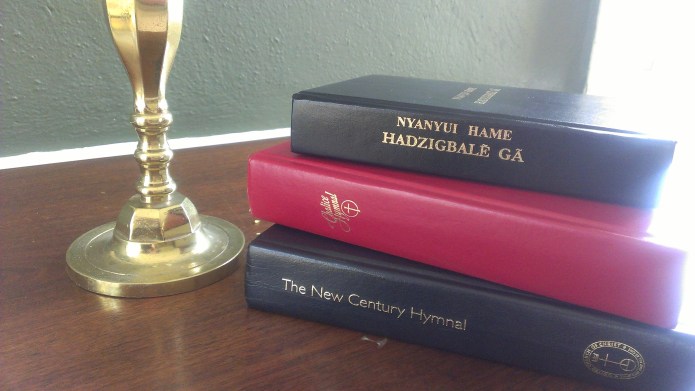
The former may be the American Way; but as the book of Acts reminds us, it is not the Christian Way. Christianity has been a translating faith, from the very beginning. The story of Pentecost reflects a historical reality of the early church. Jesus himself most likely spoke Aramaic; the writers of the gospels translated his teachings into Greek; these Greek texts were quickly translated in Coptic, Syriac, and Latin. True, they got stuck there, for a while, but were eventually translated, again, and again, into every language of the world.

In Islam, the only true Koran, the only true scripture, is the one written in Arabic, the language of Mohammed. But Christianity has no such claim to linguistic purity. Jesus’ actual, original words were already lost by the time the gospels were recorded. For us, the Word of God is not the biblical text, but rather the One whose story it tells. And that One is still speaking.

I understand the concern for authenticity. There have been mistranslations that have sometimes resulted in misunderstandings of scripture. We’ve all played the game of telephone, where messages get garbled as they are repeated from person to person; and those of us raised in the pre-digital era of dittos and Xerox machines remember when a copy of a copy was never as clear as the original. Our sacred texts and traditions are so important to us, it is no wonder that we worry that something might get lost in translation. But what if there is something to be gained in translation?

So what did I tell that welcoming congregation in Ghana?

I told them what the missionaries eventually figured out; that anywhere we might travel in the world, God has been there already. That when we cross the border, we do not bring God with us, but we find God there.

Preaching a way better sermon, perhaps, than the one we had in mind.

(from a sermon preached at Belchertown United Church of Christ on May 24, 2015)