Take it and run with it

 “Since we are surrounded by so great a cloud of witnesses, let us also lay aside every encumbrance and sin which entangles us, and let us run with endurance the race that is set before us…” – Hebrews 12:1

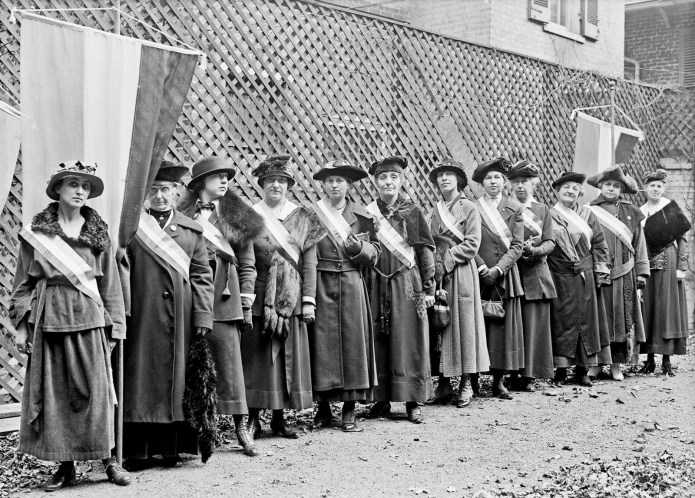
 Last Saturday was All Saint’s Day. Today is Election Day. The proximity of these two events has set me to thinking about a particular saint, a woman by the name of Charlotte Woodward. Not a saint according to the narrower, Roman Catholic definition; but a saint in the broader, biblical tradition.

In the year 1848, Charlotte Woodward was about nineteen years old. She was living somewhere near Syracuse, New York, working from home as a piece-meal seamstress for a glove manufacturer. One day, she spotted a small, unsigned announcement appeared in the paper, calling for a meeting to discuss the condition and rights of women. Charlotte immediately ran, from house to house, looking for neighbors as excited by that announcement as she was. She gathered a half dozen friends, and together they travelled in an open wagon to Seneca Falls. Young Charlotte would become one of 68 women who signed the famous Seneca Falls Declaration, supporting a woman’s right to vote.

Charlotte Woodward was 91 years old, when she finally gained the right to vote, in 1920. Of all the women who signed the Seneca Falls Declaration, she was the only one who lived to see that day.

What a great cloud of witnesses must have surrounded Charlotte Woodward, on that election day in 1920.

There’s something of a mixed metaphor here, in this verse from the Letter to the Hebrews (why is there a cloud surrounding a foot race?),  but the passage is no less beautiful for that. “Since we are surrounded by so great a cloud of witnesses, let us run with endurance the race that is set before us.” Who are these figures in the mist, that bear witness as we run? They are not spectators in the stands; that would make for a more consistent metaphor, but it misses the point. For the cloud of witnesses that this passage refers to are Abraham, and Isaac, and Jacob, and Moses, and all those who have lived and died in faith, those who have run the race before us, and have now passed the baton to us.

People like Charlotte Woodward.

On election day, in 1920, Charlotte Woodward was too ill to travel to the polls, and some historians believe that she never did cast her ballot. But on Tuesday, I will. This is a gift, a baton passed to me by the men and women of Seneca Falls, and it is up to me, to all of us, to take it and run with it, and to pass it on. When I enter the ballot booth today, I will not be alone, but I will be surrounded by a great cloud of witnesses. And I am convinced that Charlotte will be there, by my side.

(based on a sermon preached at Belchertown UCC on November 2, 2014; with thanks to Rev. Peter Wells, who introduced me to Charlotte Woodward)

(Photo: 1917 Suffrage Picket, http://historyinphotos.blogspot.com/2013/05/suffragettes.html)

Exodus 14, or #WhyTheyLeft

“Better to serve the Egyptians, than die in the wilderness.” — Exodus 14: 10-31

The Israelites are finally on their way out of Egypt. A series of spectacular plagues have convinced Pharaoh that he is on the wrong side of history, and Jacob’s children are free at last, to cross the border and head to the Promised Land. Happy ending.

But not so fast: here come the chariots of Egypt, in hot pursuit. Pharaoh isn’t going to let them go so easily. The people try to flee, but they find that their escape is blocked by a body of water, an impassable obstacle.

And there they are. Caught between the devil and the deep blue sea.

In that moment of terror, the Israelites begin to doubt their path, to question their decision to leave. “Was it for want of graves in Egypt that you brought us to die in the wilderness?” they ask Moses. “What have you done to us? Is this not the very thing we told you would happen, when we said,’Let us be, and we will serve the Egyptians, for it is better for us to live in servitude than to die in the wilderness?'”

I know there are reform-minded preachers who like to refer to this story when they want to talk their congregations into adopting some sort of change. They heap scorn upon the Israelites for their lack of courage, for their eagerness to return to their old way of life. They warn their parishioners against a “back-to-Egypt mentality.” As if keeping an old hymnal was somehow comparable to enduring slavery. Or adopting a new order of worship was somehow comparable to death by drowning.

To turn this text into a convenient parable about tradition vs. change is to miss what was really at stake here. Those people standing on the shore of the Red Sea were wondering whether freedom and dignity were worth dying for. Wondering, which was better: to endure oppression, or to die resisting it? Those of us who have never had to face such a choice are perhaps in no position to judge those of us who have.

Back in February, NFL football player Ray Rice was riding in an elevator with his fiancée, when he struck her in the face with his fist, so violently that he knocked her unconscious. The incident was captured by the elevator’s security camera, and the video was eventually released to the public. Rice and his fiancé were married a few weeks after the assault, which has prompted a number of commentators to ask the question: Why did she stay? That question – and the judgment that it sometimes implied – prompted a stream of answers on the social media Twitter, posted by survivors of intimate partner violence.

Over the past week, there have been over 140,000 posts, all linked to the same hashtag: #WhyIStayed. The answers are as complex and varied as the lives they spring from, but some themes appear again and again:

“I was afraid to be homeless. “
“There was no place to go.”
“I had no credit cards, no bank account.”
“I thought he would kill me.”
“No car, no money, and my daughter is here. What am I supposed to do?”

A person in an abusive relationship is often faced with a choice between a dangerously unsafe home and a dangerously uncertain future. What’s more, if she attempts to leave, her partner is liable to respond with greater violence. This is why domestic violence counselors warn victims, Don’t tell your abuser that you plan to leave. Like Pharaoah, he may escalate the violence.

Leaving an oppressive situation is never as easy as just walking away. The Israelites discovered this on the shores of the Red Sea, as Pharaoh’s army thundered toward them. In that desperate moment, they cried out to God. And in that desperate moment, God responded. But God, it should be noted, did not deride the Israelites for their hesitation. Instead, God spoke to Moses: “Tell the Israelites to go forward. And you – lift up your rod and hold out your arm over the sea and split it, so that the Israelites can go forward on dry ground.”

God tells Moses that he is to be the means by which God’s deliverance will begin. Moses, you see, has escaped from Egypt before. If you’re a Bible reader, you might remember that Moses, as a younger man, killed an Egyptian overseer who had been beating an Israelite slave. So Moses fled from Egypt, and lived in exile for many years in the land of Midian – beyond the Red Sea. Moses will be the one to lead the Israelites through the wilderness, because he has been through that wilderness before.

I am reminded of that other Moses, Harriet Tubman, who earned her nickname, not because she escaped slavery, but because she returned, again and again, to show her brothers and sisters that it could be done.

I am reminded of Bill W. and all the AA and NA sponsors and mentors, who bear witness each week that there can be life beyond addiction.

I am reminded of all the LGBTQ adults who joined the “It Gets Better Campaign,” filling YouTube with their personal messages of hope and encouragement for bullied teens.

I am reminded of all those posting on Twitter right now, who are also leaving messages about #WhyILeft – messages of encouragement from those who, like Moses, have gone ahead into the wilderness.

“I left to tell my story and save others.”
“I can and I am making it on my own now.”
“Please don’t give up! “
“You are not alone!”

When we flee from Pharaoh, there are rough seas ahead. But this is the difference, between the devil and the deep blue sea: There is something on the other side of the sea. A different life, a new life, the life that God desires for us. The water is wide, but we do not have to make the crossing alone.

When you pass through the waters, I will be with you;
and through the rivers, they will not overwhelm you.
For I, the LORD, am your God…
You are precious in my sight,
and honored, and I love you.

(Isaiah 43: 2-4)

(Belchertown United Church of Christ, Sept 14, 2014.)

(photo Liza B. Knapp all rights reserved)

Which side are you on?

image

“Get to your labors!”  — Exodus 5:1-6:13

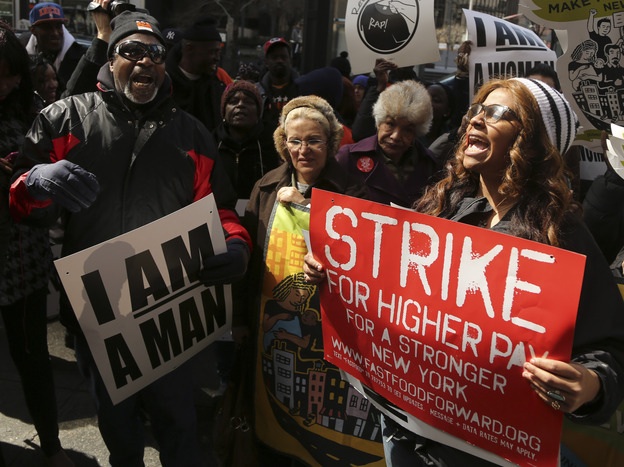
In light of the recent news of striking fast food workers, it is perhaps worth remembering that the Exodus began as a labor dispute.

Moses and Aaron went to Pharaoh and asked him to let the Israelites go — not, initially, forever, but just for a religious holiday. “Let us go a three days’ journey into the wilderness to sacrifice to our God.” A three-day weekend, that’s what they asked for. But management was unwilling to negotiate. “Moses and Aaron, why are you taking the people away from their work?” Pharaoh replied.” Get to your labors.”

Which I guess makes the Exodus the largest mass strike in history.

(photo: Mary Altaffer, AP)

Late Bloomers

“…for in gathering the weeds you would uproot the wheat…” Matthew 13:24-30 (NRSV)

My family never had a garden when we were kids (unless the potted geraniums in the air shaft count). When my Mom finally had the chance to create her first-ever vegetable garden, my now-adult sister was more than willing to lend a hand, but she didn’t have much experience planting and weeding. I remember her coming in from the garden on a hot afternoon and announcing, “I finally figured out how to tell a weed from a vegetable seedling. You pull it out, and if it grows back, it was a weed.”

That’s exactly what the landowner in Jesus’ parable is trying to avoid. His servants tell him there are weeds sprouting among the good grain, and they ask permission to get rid of the interlopers. A little Roundup, some aggressive tilling, and the monoculture will be restored in no time. But the owner of the field says, “No; for in gathering the weeds, you would uproot the grain as well.”

Sometimes it’s awfully hard to tell the weeds from the late bloomers. A “weed,” after all, is just a plant growing where someone thinks it doesn’t belong. Nip it in the bud, and you will never know what fruit it might have borne.

It’s the mistake George Zimmerman made, when he pulled the trigger on Trayvon Martin.

Be patient with us, God, as we learn to be patient gardeners.

Birthright

“I am about to die; of what use is a birthright to me?” — Genesis 25:29-34

If you have a small child in your family, you can try this experiment at home: Ask her which she would rather have, a cookie or an ice cream sundae? Then ask her whether she would rather have a cookie right now, or an ice cream sundae next week. (And be prepared to deliver.)

When I was a small child, I learned the story of Esau and Jacob, and I thought of it as a sort of human version of the grasshopper and the ant, a fable about the wisdom of delayed gratification. Esau comes home to find his brother Jacob cooking stew, and demands, “Give me some stew, now!” Jacob agrees, but at a price: he will give his brother some stew, but only in exchange for his birthright. Esau, you see, is the elder son, and someday he will become his father’s sole heir. But that is someday, and Esau is hungry now. He chooses the cookie, and misses out on the sundae.

When I was a teenager, I became less interested in the moral of the story and more interested in the differences between the two brothers. Jacob – the quiet one, his mother’s favorite – is home cooking, while Esau – the hairy one, his father’s favorite – is outdoors, presumably doing something more conventionally masculine. The story became for me a liberationist tale about defying gender roles and overturning patriarchy. Jacob was not the prudent ant shaking his head at the grasshopper. He was Br’er Rabbit, outwitting Br’er Fox again.

But now, in middle age, I find my attention riveted by the story’s final sentence: Thus Esau despised his birthright. I am tripped up by that word, despise; it is not a word to be uttered lightly. The story has taken a new and sobering turn for me. It is no longer a comedy about Jacob, but a tragedy about Esau.

Esau was the heir to a great promise. The son of Isaac, the grandson of Abraham, he was next in line to be the patriarch of God’s chosen clan. God had something extraordinary in store for him, and he tossed it aside. It’s got me thinking, about all the ways that we despise our own birthrights. The ways that we underestimate the promise of our lives, trading away our potential in exchange for convenience, or comfort, or security.

What is your birthright? What is the talent you were born to cultivate, the garden you were born to tend, the problem you were born to solve, the injustice you were born to fight? What would you trade it for?

Keep me hungry, God. Don’t let me settle for anything less than being the person you created me to be.

Night Life

image

…and God separated the light from the darkness, and called the light Day and the darkness Night. (Genesis 1:4-5)

My family has a log cabin in the Catskill Mountains, right up against the state forest. There are other houses along the road, but they aren’t visible from our property, and there’s not a single streetlight. At night, if the sky is clear, you can see an incredible number of stars. And if the sky is cloudy, you can’t really see anything at all. Peering out the cabin door into the dark lawn, my five-year-old nephew once memorably declared: “I need the light so I can see the dark.”

I spent my childhood in Manhattan, the city that never sleeps. Where you could probably live your entire life and never experience true darkness, at least not outdoors. People talk about the New York City nightlife, but really there is no nightlife in the city, just more day-life. But in the Catskills, the darkness is still dark, and the night still lives.

Last weekend, we passed some of that nightlife along the road to our cabin. The moon was bright, so we were able to see deer browsing at the forest edge. We even startled a bear as it was crossing the road with its cubs. One of the cubs scooted up a tree, until its mother reassured it that we were not a threat. My daughter announced at that moment that this was the Best Vacation Ever. And we weren’t even there yet.

“In the beginning,” the story goes, “the earth was a formless void, and darkness was upon the face of the deep….Then God said, let there be light, and there was.” But the light was not instead of the darkness; the light was in addition to the darkness. God separated darkness from light, so that creation would no longer be formless. From an undifferentiated sea of sameness, God brought forth diversity.

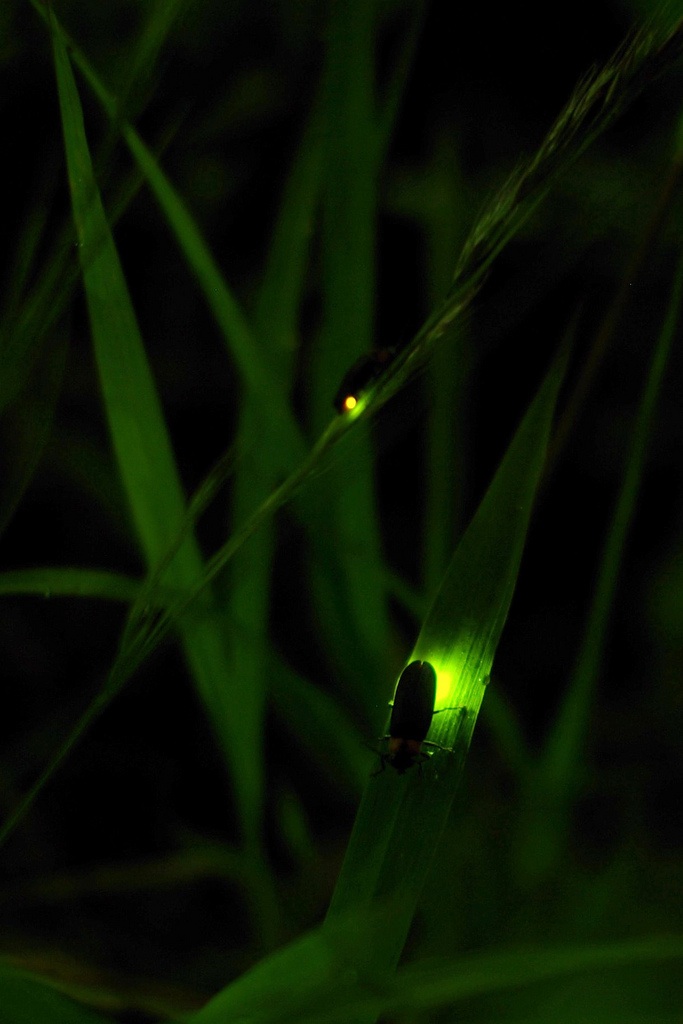
Last weekend, I saw my first firefly of the season. As we watched it twinkle, my wife remarked that there didn’t seem to be as many of them now as she remembers from her childhood. She’s right; fireflies, like so many other species, are on the decline. They are subject to all the same challenges that impact other species – habitat loss, pollution, global warming – but they also face some unique challenges of their own. The glow of a firefly is a form of communication, by which they signal their presence to others of their species. But we humans are constantly generating light of our own. It spills from our televisions and street lamps, onto our lawns and parking lots, blurring the line between night and day. Fireflies are disappearing, because they can no longer find each other.

They need the darkness so they can see the light.


(Photo credit: Takashi Ota, Flickr.com. Some rights reserved)


…so nothing else has to be.

“All of them were filled with the Holy Spirit and began to speak in other languages, as the Spirit gave them ability.” Acts 2:4-6

Once upon a time, the story goes, all humankind had one language. We spoke the same words, and this made us powerful. But God confused our language, so that we could no longer understand one another. Until, at the feast of Pentecost, the Spirit of God descended upon the apostles, and empowered them to overcome the language barrier – the barrier that, according to Genesis, God had created in the first place.

So what was the point of that detour? Didn’t God just bring us back where we started?  Not quite. Once upon a time, we shared one common language; but at Pentecost, all heard the good news in their own separate languages.

One language may sound like a utopian ideal. But one language can also mean one culture, one worldview, one-party politics. No wonder they were so powerful: they had no opposition. When God confused human language, God created human diversity. This should not surprise us at all, really. It’s what God has been doing all along, ever since God separated the darkness from the light: bringing forth diversity, out of uniformity.

God’s ways are not our ways; we aren’t always comfortable with those who don’t speak our language. When God confused our language, the story goes, we became scattered and divided. The price of our human diversity was that we became strangers to each other. And for the most part we remain strangers to this day. Humanity seems to be faced with a choice, between the unity of uniformity, and the discord of diversity.

But there is a third way. When the apostles gathered for the feast of Pentecost, people of every nation heard the good news in their own languages. God’s Spirit empowered them to bridge the gap between languages and cultures — not by erasing diversity, but by embracing it. The church was born in that moment. To borrow a phrase from William Sloane Coffin: “Church is the place where all hearts are one, so nothing else has to be.”


Raising the Roof

“And when they could not bring him to Jesus because of the crowd, they removed the roof above him….”   Mark 2:1-12

This was not Jesus’ first trip to the fishing village of Capernaum. According to Mark’s gospel, he’d been there just a few days before. On that previous visit, he had stopped by the home of his two newest disciples, Simon and Andrew, and while he was there, he had healed Simon’s mother-in-law of a fever. News of the miracle spread quickly through the town, and by that evening a crowd had gathered at the house. But the very next morning, much to everyone’s disappointment, Jesus had awakened before sunrise, slipped quietly outside, and left town.

But now, Jesus was back! The miracle worker had returned to Capernaum! You can imagine how quickly the news spread through the village, as everyone put aside their daily tasks and hurried through the streets to Simon’s house. Everyone, that is, except for four men, who were hurrying, not to Simon’s house, but in the opposite direction.

They were on their way to the home of a friend, who was bedridden, paralyzed. They had heard of Jesus’ arrival as well, and they were determined that this time, their friend would not be left out of the miracle. So the four of them rushed to his house and hurriedly explained to him what was happening. Then they hoisted his bed up on their shoulders with their friend still in it, and the five of them made their way as quickly as they could toward Simon’s house.

But they were too late; the narrow doorway was already clogged with people. There was no way for their friend to get through to Jesus. The door was open, but he just couldn’t fit inside.

* * *

Now, we all know there are churches today which draw such large congregations that the people spill out doors, into the narthex, and latecomers have to watch the worship service on a closed circuit TV in the fellowship hall. But I have personally never been to a church like that. Most of the congregations I know are concerned instead about the number of empty pews on Sunday morning. But the truth is that whatever the size of the church, there are some of us who, like the paralytic in the gospel story, still find it hard to fit inside.

Sometimes the barriers to access are external: a flight of stairs we can’t scale, a small-print bulletin that we can’t read, a sound system that we can’t hear. Sometimes the barriers are internal: memories of past experiences in church which wounded us and left us feeling invisible or judged. The barriers that keep us outside may not be obvious, but they are there, underground, like one of those invisible electric fences that keep dogs in their place. Sometimes the memory of past pain can be enough keep us from crossing the boundary.

I have a friend who, as a young man, felt called to a religious vocation. He entered a monastery, and began the process of preparation and discernment that leads up to the taking of vows. At some point in the process, he confessed to his priest that he was gay. My friend recalls that at the time he honestly did not realize that this might be an obstacle to his becoming a monk; after all, monks take a vow of celibacy, and he was prepared to make that commitment. But within hours of making his confession, my friend was expelled from the monastery, literally pushed out the door onto the sidewalk without even a bus ticket home.

It took many years for the wounds from that rejection to heal, and during that time my friend stayed away from church. But then, after literally decades, he began to feel again a call to be part of a community of faith. In his town, he had seen a church with a rainbow flag outside. And so one Sunday, he stepped inside. My friend once described to me his feelings as he stepped across the threshold. “My heart was pounding,” he said, “and I was sweating, and my hands were shaking. I was terrified.” He took a seat in the very back pew, keeping open the option of escape.

My friend later became a deacon of that same church, but he still remembers how hard it was to come through the door. And his story is a reminder, I think, for all of us on the inside of the church doors. If it was that hard for him to cross the threshold, there must be people who just can’t get through the door at all.

There is a song that I learned from the good people at Haydenville Congregational, maybe some of you know it too. Its opening words are printed as the meditation at the top of today’s worship bulletin. “We are a church where everyone is welcome..” do you know this? “We are a church where everyone is welcome/I know it’s true cause I got through the door/ We are a dazzling bouquet of every kind of flower / So jump in the vase cause we got space for more.” It’s a great song. But every time I sing it I am struck by the fact that there is a flaw in the logic of the lyrics. Maybe some of you have noticed it too. It’s there in the second line: “I know it’s true ‘cause I got through the door.” Those of us who have struggled to find a church home that would welcome us may be perhaps excused for breaking into song when we finally found one. But the truth is, the fact that I got through the door doesn’t mean it was accessible to everyone else. I have never seen a church sign that read, “You are not welcome here.” But the fact that you and I feel welcome somewhere, doesn’t mean that everyone feels welcome.

That room in Capernaum, after all, was filled with people who had got through the door just fine.

***

Which brings me back to our gospel story.

So there they are, where we left them, outside Simon’s house. The paralyzed man lying on his bed, the four friends standing there, breathless and discouraged, with no way to get through the door, no way to get to Jesus. And then… whose idea was it? The man on the bed, or one of his friends? We don’t know. But one of them suddenly gets a gleam in his eye, and he looks at his friends, and says, “Boys: let’s raise the roof.” Maybe one of them objects – “We can’t, what would Simon say” – but the idea has already caught hold of them, there’s no turning back now – and the next thing they know they are up on the roof, ripping up the tiles. Making a way out of no way.

And the folks inside hear some commotion up above, as bits of tile begin to rain down on them, and suddenly sunlight breaks through from a hole in the roof. And then down he comes, on his bed, right to the very center of the room. And I imagine his four friends peering down after him, grinning at the holy mess they have made of Simon’s house.

The story of the paralytic and his four friends is a story of healing, and of forgiveness; but it is also a story about access, about who gets in, and about who is left out. In Jesus’ day, as in our own, those who differ from the norm were often forced to the back of the crowd, the margins of society. For the physically disabled, physical barriers were only part of the problem; disability and illness were often assumed to be a punishment for some sin. In Jesus’ day, as in our own, people with disabilities were relegated to the edges of the community, held at arm’s length, viewed as inferior to the able-bodied. This is why Jesus’ first priority is to tell the paralyzed man that his sins are forgiven; Jesus recognizes that the stigma of disability can be its greatest burden. With his word, Jesus completes what the four friends have begun: he brings the outsider in, to the true center, which is God’s love.

***

So why am I telling you this particular story, today?

I work for a Northampton ministry called Cathedral in the Night. For those of you who haven’t yet had a chance to be part of it, Cathedral in the Night is an ecumenical fellowship that meets every Sunday at 5pm on the corner of Main Street and Center Street in downtown Northampton. We worship outdoors, and then, thanks to the efforts of partners such as Center Church, we share an outdoor meal which is free to all comers. We do this every Sunday, rain or shine, winter or summer.

People sometimes ask us – not so much on weekends like this, but on January weekends when it’s well below freezing – why we worship and eat outdoors. After all, it is a lot of work to set up lights and heaters, and even then there are nights when we have to pass out those little pocket hand-warmers to stave off the frostbite. I sometimes play guitar for the services, and I have to admit that as the temperature drops, so does the quality of my accompaniment. So, why do we insist on doing this outside?

Well, the simplest answer is this: We worship outside, because that’s where outsiders are. It’s the one place where they know they belong. On any given Sunday, our street corner congregation may include people who are living in poverty, people who are homeless, people in the grip of alcoholism and other addictions, people who are illiterate, people with disabilities or illnesses or other traits that place them outside of the mainstream, and people whose personal histories have forced them to the very edge of their community. On any given Sunday, our congregation may also include those who are housed, employed, able-bodied, educated, and esteemed by their communities. We gather on the street corner, because it’s a place where no one is really an outsider, because no one is really an insider. It’s the place where the edge meets the center.

This is why we worship outside: We’re trying to tear a hole in the roof, and everyone who comes to worship with us, is helping to rip up the tiles.

So this story is by way of thank you, and also by way of invitation. As you go through your week, look around, and ask yourself, who is missing here? Because who knows? Maybe you will be the friend to raise the roof for them.

(Originally preached at “Center Church,”  a.k.a. First Congregational Church, UCC, South Hadley, MA, on March 25, 2012.)
What are mosquitoes for?

image

“Consider the lilies of the field…. Therefore, do not be anxious.”  Matthew 6: 25-34

What are mosquitoes for?

A student of mine once asked me that question. I was spending the summer in Florida, co-teaching an intensive high school ecology course on Sanibel Island. Each day we would divide our time between field studies and classroom lectures, and each evening we would sit outdoors swatting the mosquitoes and studying classics of environmental literature. One of these was Silent Spring, Rachel Carson’s eloquent indictment of toxic pesticides.

Every few days, helicopters would fly over the island, spraying a pesticide called malathion, to reduce the mosquito population. The next morning, during our field studies, we would find honeybees floating dead in the Gulf waters. And while we all welcomed the respite from the mosquitoes, my students were questioning the costs and benefits of controlling them by such draconian means. So one of them asked me, What are mosquitoes for?

Now, that’s an interesting question. What, exactly, was she asking? I could have described for her the place of mosquitoes in the island’s food chain – how mosquito larvae provide food for aquatic animals, how the mature insects are a food source for many species of birds. Or I could have described the role that mosquitoes play in the spread of disease, and spoken of the hundreds of thousands of deaths due to malaria each year. These are some of the things that mosquitoes do. But is any of this what mosquitoes are for?

My student’s question presupposes that mosquitoes are here for some purpose. This is where we leave the realm of ecology and enter the realm of theology. The ancient creeds of our faith affirm that all creation is called into being by God. The psalmist declares,

How manifold are your works, O God!
In wisdom you have made them all:
The earth is full of your creatures.
When you open your hand, they are filled with good things,
When you take away their breath, they die,
When you send forth your spirit, they are created.

But to what end are they created? What might God’s purpose be? Why should God desire to make such creatures? What are mosquitoes for?

The first chapter of Genesis tells us that humans were created last of all God’s creatures, and from this some have concluded that humans were the end-goal of all creation; that all other creatures are here for our benefit, and that even mosquitos must somehow be good for us – even if only to teach us some patience and humility. Yet the creation story also tells us that God declared each part of creation “good,” even before humans appeared on the scene. Not good for us. Just good.

What are mosquitoes for? To say that other creatures are here for our benefit merely begs the question. What are we for?

* * *

In today’s reading from the Gospel of Matthew, Jesus tells his followers, Do not be anxious. I suspect that for many of us this is a difficult teaching — almost as difficult as being told to love our enemies. How many of us can remember the last time we spent a day, or even an hour, free from anxiety?  Yet here is Jesus saying, “Do not anxious. Do not be anxious about what you will eat, or about what you will drink, or about what you will wear. Do not be anxious about tomorrow, for tomorrow will be anxious for itself. Let the day’s trouble be enough for the day.”

How often do we go to sleep at the end of the day with the feeling that we have done enough for the day? Instead we lie awake, worrying — that we haven’t saved enough, or worked enough, or studied enough, or prepared enough. That we haven’t protested enough, or prayed enough, or exercised enough, or cleaned enough, or spent enough time with the kids. No matter what we do, it’s never enough, and there’s just not enough to go around. So anxious are we, that even the words, Do not be anxious, can seem like yet another impossible demand, another item on our to-do list that we have failed to accomplish. Do the taxes, clean the house, get the oil changed, don’t be anxious.

Somehow, I think this was not what Jesus had in mind.

The truth is that most of us cannot imagine a life without anxiety. We are, after all, fragile and finite creatures, and all that we have is perishable. How should we not be anxious?

Well, Jesus in fact gives us some concrete advice here. Look at the birds, he says. Consider the lilies. Jesus is not just telling us to stop and smell the roses and listen to the birdsong. He’s not just saying that spending time outdoors will help restore our perspective. That may be true – I know it’s often true for me – but I don’t think that’s the point he’s making here.

Look at the birds of the air, he says. They don’t sow, they don’t reap; they are of no use whatsoever. A bit later in Matthew’s gospel, Jesus mentions that sparrows were sold two for a penny (Mt 10:29). In terms of market value, a sparrow is worth next to nothing.

So what are sparrows for? Not much, apparently. And yet…

“And yet your heavenly father feeds them.” You see, God does not measure value as we measure value. We have become so used to measuring the value of others by what they can provide for us, that we don’t stop to consider that this may not be God’s perspective. We don’t stop to consider that other beings may be intrinsically good. Not good for us. Just good.

Jesus continues: Consider the lilies of the field, he says. They don’t toil, they don’t spin; they are good for nothing, except to be thrown in the fire.

What are lilies for? Not much, by our standards. And yet..

“And yet Solomon in all his glory was not clothed like one of these.”

If we are anxious about our worth in God’s eyes, perhaps it is because we are so accustomed to judging and measuring the worth of our fellow creatures, or even of our neighbors. If we spent less time measuring the worth of others, perhaps we would be less anxious about how we measure up. (In Matthew’s gospel, today’s teaching is immediately followed by the words: Judge not, that you be not judged.)

In a world where sparrows are measured by their market value and people are measured by their wage earning potential, it is no wonder we find it hard to believe that God might love even the least of these. That God might love even the least of us. And yet…

The twentieth century French mystic Simone Weil once wrote that “God, if he exists, is good, because he takes delight in something other than himself.” Why does God feed the sparrows? Perhaps because God delights in sparrows. Perhaps God even delights in mosquitoes. Perhaps God even delights in you. Therefore, do not be anxious.

This is what Jesus told his disciples: Therefore, do not be anxious. It was not so much a commandment as a conclusion – a conclusion based on the premise that all creatures live and move and have their being in God.

Maybe that’s what we are for: the mosquitoes, the sparrows, the lilies, and you and I. To live, and move, and have our own unique and beloved being.

(This sermon was originally preached at First Churches of Northampton, MA, 2.27.2011.)

(photo: Liza B. Knapp, all rights reserved.)

Come to the Table

image

I wrote this hymn for Cathedral in the Night, an ecumenical, outdoor ministry in Northampton, MA, where I served as seminary intern from 2011 to 2012. Each Sunday evening, Cathedral’s mixed congregation of housed and homeless people gathers together on a downtown street corner for worship, communion, and a free common meal. At Cathedral, I gained a new awareness of the presence of Christ at the Table.  For we are the body of Christ, broken and divided from one another, made whole when we break bread together.

(Tune: Be Thou my Vision)

Come to the table and break bread with me;
Drink of one cup, and one body we’ll be.
Hungry for justice or hungry for bread,
Come to the table where the hungry are fed.

Come to the table, from near and afar;
No need to fear, you may come as you are.
Broken in body or broken in soul,
Come to the table and be part of the Whole.

Come to the table, let grace now be shared;
O taste and see what our host has prepared!
Empty of pocket or empty within,
Come to the table: let the banquet begin.

(Photo: Liza B. Knapp, all rights reserved)