
Labor Day has come and gone. School has begun. Vacation days have been spent.
We like Thoreau, have left Walden behind, and are once again sojourners in civilized life. We have returned from our summer retreat of longer days and lowered demands. And maybe our souls have been renewed, and maybe our minds have been refreshed, by this respite. Or maybe not. Either way, as we return from our summer pilgrimage, we wonder, how long until our routines re-assert themselves? How long before the numbness returns, how long before the exhaustion claims us again, how long before we return to autopilot?
I used to savor my summer tan, which lasted well into winter. I understand now, of course, that a tan is not something to be sought, but in my younger years I took it as a hopeful sign, that I had been marked and changed by my time at the seashore. That the ocean’s edge was imprinted on my skin – not a permanent tattoo, but long-lasting enough to see me to the next summer. My father was a teacher, and had a long vacation; for a full month, I was baptized daily in the salt water, and my thoughts were scoured clean by the wind and the water.
Peace of the running wave to you, says the ancient blessing.
And then it would be back to the sweaty city and the long list of labors. But something of the salt clings to us. After the ocean, there is a deep coolness in our core that will take some time for the heat to penetrate.
I wonder if church shouldn’t be more like this: A bracing immersion that shocks us into full presence, and a moment of wonder at the great immensity from which we emerged. A pilgrimage to the edge of the known world, where words fail us and we become our true, nameless selves.
My mother taught me this trick as a child: Hold a seashell up to your ear, and its curving labyrinth will echo back to you the sound of the blood coursing through your veins. It is the sound of the sea. God within, God without. There is no holier place than the ocean’s edge. There is no better sermon, than a seashell.
Today we begin a new season, in our yearly cycle of faith. It is a fairly young liturgical season, only recently adopted by churches around the world. It is the season of creation, when we turn our attention to the abundance and fragility and wonder of the earth. And so this week, and in the weeks to come, we will be considering the stories of creation. For there are several; in the Bible alone, there is more than one creation story. Today, we start with the most famous: the first chapter of Genesis. It goes like this:
In the beginning, there was… water.
Some of us may remember another creation song from the Gospel of John, which begins, In the beginning was the Word. But the song at the start of Genesis begins differently. In this, the first of the Bible’s creation stories – for there are several – we begin with water. There is no point at which God says, Let there be water. It is there, before God speaks a word. In the beginning, all was without form; and the breath of God moved over the waters.
For how long? An instant? An eternity? How does one measure time, when all is without form?
Then God speaks, and shapes the formless chaos, separating light from dark, and the waters below from the waters above; the ocean depths, from the depths of space – both blue by day and black by night, both immense beyond measure. The ancient people who told this story imagined the seas and the skies to be of one substance, separated by a great dome from horizon to horizon like an inverted bowl. A “firmament,” in the old King James translation. When it rained, the waters of heaven return to touch the waters of the ocean.
I touched the ocean only briefly this year, out on Cape Cod, near the town of Wellfleet. The waves there have a strong pull, on both body and soul. I am not a strong swimmer, so my body has a healthy respect for the ocean, a fear of its power. At the same time, my soul is drawn to it, with a sense of wonder and longing. This, I imagine, is the psalmists meant, when they spoke of “the fear of God.” Not some petty or craven fear of punishment, but the fear of a great wave coming toward us, bearing the immensity of the unknown, from which we came.
Life began in water; we only moved onto dry land when our ancestors figured out how to carry some of that brine with us, enclosed in our skins or shells or cell walls. Even now, each of us begins life submerged, in the water of the womb. In touching the water, we touch our source.
Deep peace of the running wave to you.
**
There are other creation myths, some older than Genesis. Some tell of a primordial battle, in which a heroic god slays a primordial sea monster, and forms the earth and sky from the monster’s severed body. The fact that the monster is female – and is in fact the hero’s mother – adds a disturbingly Freudian and misogynistic dimension to the story. Humans fear the chaos from which we came, our primordial formlessness.
While I was on the Cape, I picked up a copy of Moby Dick — and yes, I did read it. To any of you who found it a slog in high school English class, I can only say it is better when read voluntarily.
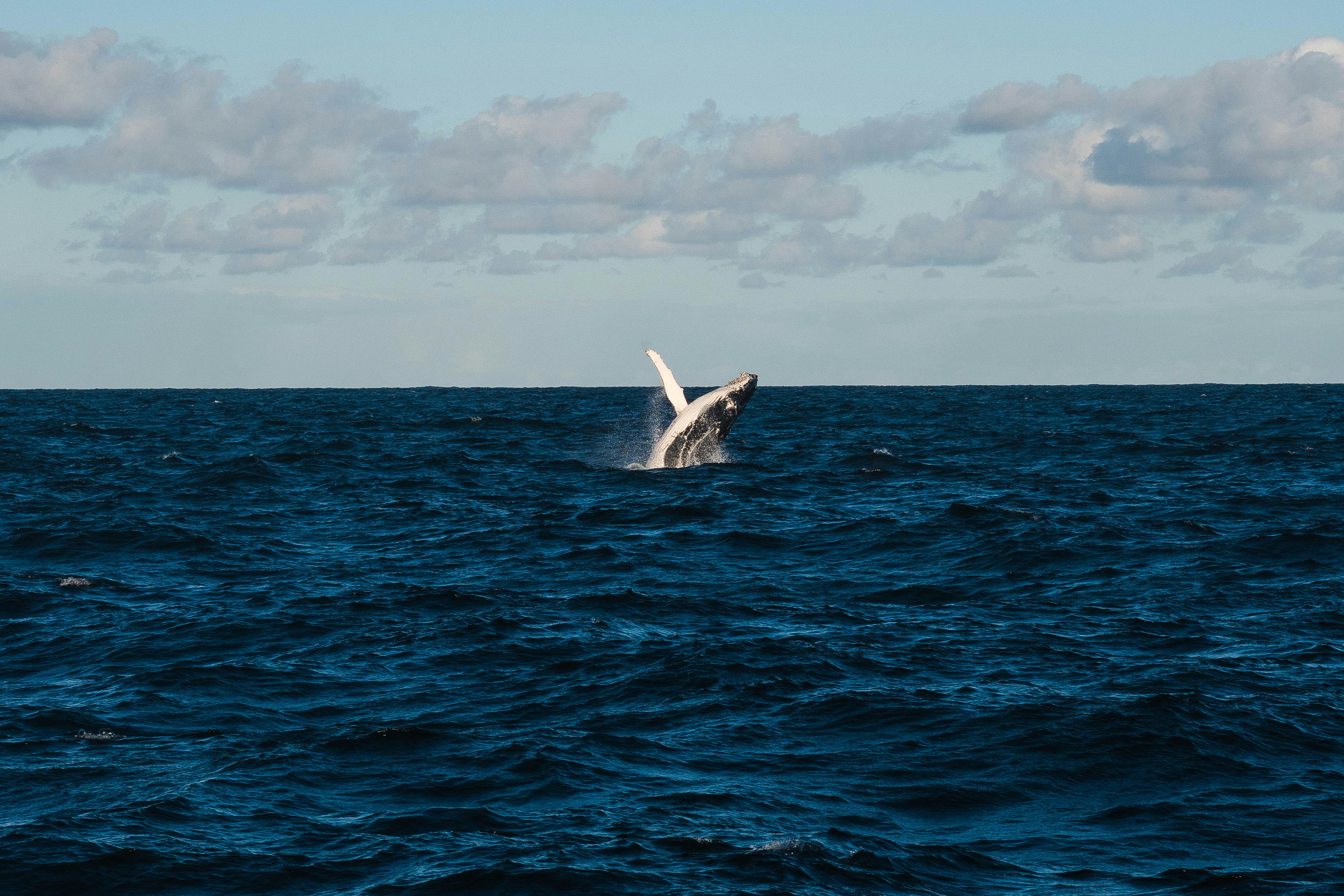
The plot of Moby Dick is well known: the narrator, Ishmael, sets sail from Nantucket on a whaler under the command of the one-legged Captain Ahab. Once at sea, Ahab reveals to the crew that he sails with a single purpose only: to seek vengeance on the whale that took his leg, the legendary white whale known as “Moby Dick.” The book ends with a catastrophic encounter between the great whale and the ship.
In his first encounter with the whale, Ahab has encountered something greater than himself: not the orderly god of heaven, but the chaos monster of the deep. That this beast should dismember Ahab, and yet live; this, to Ahab, is the unbearable injury. He dreams of conquering the monster, of literally cutting it up into pieces.
It is an old, old story.
But this is the thing that surprises many first-time readers of Moby Dick. The book has 135 chapters; the ship sets sail in chapter 22, but the white whale does not actually appear in person until chapter 133. In between, there are a great many chapters devoted to the subject of whales, in general, and to the sperm whale, in particular. But all this knowledge comes to nothing, in the face of the living whale. When Moby Dick finally appears, it is all over, in three short chapters.
I am reminded of the final chapter of the book of Job, where after many chapters of theological debate, God shows up, in person. God speaking from the whirlwind, and silences Job’s theology with a single question: “Can you catch Leviathan with a hook? Think of the battle. You will not do it again.”
The scripture we read today does not tell of a God who destroys the sea monster. Yonder is the sea, great and wide, sings the psalmist; there go the ships, and Leviathan, whom you formed to sport in it. This no warrior god, at war with nature; but a God at play, among the waters of creation.
Much like the children I saw, on the beach at Wellfleet, suntanned and salty, at play in the waters, at the edge of the great unknown.
Amen.
Deep peace of the running wave to you
Deep peace of the flowing air to you
Deep peace of the quiet earth to you
Deep peace of the shining stars to you
Deep peace of the gentle night to you
and to your dear ones. Amen.
Sermon by Rev. Liza B. Knapp
The First Church of Deerfield, Massachusetts
September 7, 2025
Scriptures references: Genesis 1: 1-10, Job 41:1-8, Psalm 104: 24-30
Photo above by Leslie Chappell on Unsplash
Photo below by Silas Baisch on Unsplash
 the Mystery and the Mud