
There is more than one saint, in the city of Assisi.
There is of course Saint Francis of Assisi, the city’s most venerated saint; his feast day is celebrated each year by the Catholic Church, on October 4th, the anniversary of his death.
But then there is also Saint Clare, who was a disciple of Francis and founder of the order of the Poor Clares. She is remembered each year on August 11th, the feast of Saint Clare.
The official patron saint of Assisi, however, is neither Clare not Francis, but Saint Rufino, the city’s first bishop. His feast day is also on August 11th, but in Assisi they celebrate it on the 12th, to avoid conflict with the feast of Saint Clare.
There are more than 10,000 saints officially recognized by the Catholic Church, so with only 365 days in a year, some overlap was inevitable. It would be impossible to mark each saint’s passing with a separate feast day; and so in time, the Church designated a day for the collective celebration of ALL saints – the well-known, the lesser known, and the unknown.
Yesterday, November 1st, was the celebration of All Saints.
But today, November 2nd, is the celebration of All Souls.
What is the difference between these two days, between these two words?
The phrase “all souls” is a term of universal embrace, including at the very least all humans, and possibly others as well. The word “saint,” on the other hand, has been traditionally used to describe a subset of all souls. In common parlance, we use it to describe an especially giving or virtuous person. Someone who cares for others. Someone of courage, and integrity. In Hebrew, a tzaddik, perhaps, or in Yiddish a mensch. A good person.
The apostle Paul (himself commonly called “Saint Paul”) used the word with a slightly different sense. In every one of his letters, “the saints” refers to al those who have been baptized, living or dead. So he can write, please send some money for the needs of the saints. He’s writing about living people.
In the Catholic church, the title of Saint has come to have a more narrow meaning still. A person is designated a saint only after death, and then only after a lengthy process of canonization. A life of virtue is a necessary for sainthood, but not sufficient. The exact criteria for Catholic sainthood have evolved over the centuries, but they are basically threefold: first, of course, the candidate must be Catholic; second, they need to have lived a life of heroic virtue; and third, there must be miracles attributable to their intercession. A saint must be a blessing, even in death.
There is more than one saint, in the city of Assisi. There is Saint Francis, and Saint Clare, and Saint Rufino; and there is Saint Carlo – Assisi’s newest saint.
Carlo Acutis, the only child of his parents Andrea and Antonia, died suddenly of acute leukemia in the year 2006, at the age of fifteen. In life he was by all accounts a kind, generous, bright boy with a gift for computer programming. He was also a boy with what has been described as “a precocious hunger for God.” From a surprisingly young age, he developed a passionate interest in the eucharist – the ritual of the Lord’s supper. He made a website about it. He even created a travelling exhibit on the subject. After his death, his parents petitioned the church to declare their son a saint.
This past September, nineteen years after his death, Carlo Acutis was formally canonized in the city of Assisi by Pope Leo, making him the first millennial saint. The first saint of the digital age.
Last month I went on pilgrimage to Assisi, in the company of a group of other clergy women. We arrived in Assisi, by chance, just days before the first celebration of the feast of Saint Carlo, on October 12th. On our first day there, despite our jet lag, a few of us took the short but steep walk uphill, to get our first glimpse inside the old city walls.
We had come to Italy primarily walk in the footsteps of Saint Francis and Saint Clare, but on that first walk the first thing we saw was a shop front entirely filled with images of Saint Carlo. His youthful face appeared on t-shirts and tote bags and magnets and figurines, all celebrating Assisi’s newest saint. It was the same throughout the city; the image of Carlo’s youthful face appeared everywhere. There were posters on the street announcing his canonization. There were crowds of teenagers, Catholic youth groups, come to venerate the body of a perpetually teenage saint, and to light candles, asking for his care and guidance.
Of course, there are also images of Francis everywhere, on the walls and in the churches and in the shops.
But I confess that something about Carlo’s omnipresent image bothered me, so I had to think about that. Because it continued to bother me each time we came across another poster, or statue, of this young boy. I did not go to see his body; somehow it felt inappropriate for such crowds to be gazing upon one so young.
I found that I could not think of him as a saint. I could think of him only as a kid. As precious and extraordinary as every kid.
I came home from Assisi to a message from a local family whose teenage son had died suddenly the week before. Like Carlo, he was an only child.
Was he, also, a saint?
Does it matter?
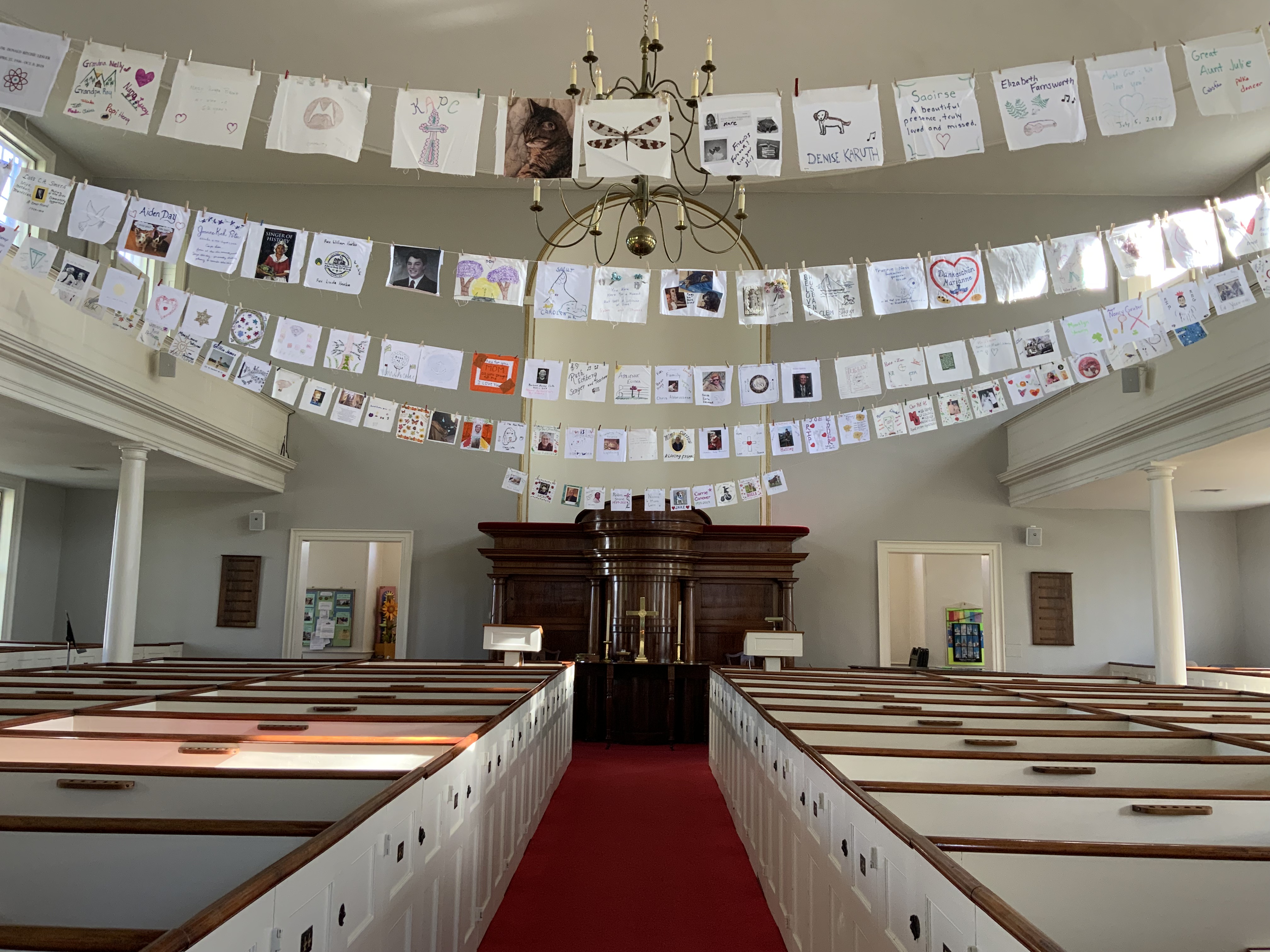
As I look around this room, at the prayer flags above and the faces below, I cannot help thinking that most of the souls here, living or dead, would probably never be considered candidates for sainthood – at least, not according to the criteria applied to Saint Carlo.
Some – many, perhaps – were saints in the sense that the Apostle Paul used the word, having been baptized into the body of Christ, either as infants or as adults. And some – many, perhaps – were saints in the everyday sense of the word: loving and giving, brave and just.
But maybe – just maybe – they were not all saints.
But that’s okay. Because All Saints Day was yesterday. Today, we celebrate All Souls.
And the thing that all souls have in common, is that they were, and are, beloved. Beloved of God. Beloved of us. Beloved to those whose hands made these prayer flags in remembrance of them. Perhaps they were not all saints, but they all mattered.
And the thing, I think, that all saints have in common, is that they know that.
And so today, we give thanks, for all these souls.
May their memories be a blessing. Amen.
Rev. Liza B. Knapp
The First Church of Deerfield
November 2, 2025 – All Souls Sunday
all rights reserved
photographs (by Liza):
Street posters in Assisi, celebrating the 800th anniversary of Saint Francis’ Canticle of Creation and the first celebration of the feast day of Saint Carlo.
Prayer flags hung in remembrance of loved ones at the First Church of Deerfield, Massachusetts.
 the Mystery and the Mud