And the devil said to him: If you are the son of God… (Luke 4:1-14)
It is important to note when the story begins: Jesus is returning from the River Jordan, where he went to be baptized by John. But instead of returning home, he ventures into unfamiliar territory.
Something happened there at the river, something that drove him to the wilderness. As he was baptized, he heard a Voice. “You are my beloved Son,” the Voice said; “In you I am well pleased.” The story really begins with that Voice, the Voice that sends Jesus into the wilderness. He goes there to confront it. For what does it mean, to be the Son of God?
In the wilderness, Jesus hears other another voice. A voice offering answers to that question. Luke’s gospel tells us it was the voice of devil.
In most English translations of this story, the devil’s temptation begins with the words “If” – “If you are the Son of God.” But in Luke’s original Greek, the devil’s words don’t necessarily imply any doubt about the matter. An equally accurate translation would begin with the word “Since” – “Since you are the Son of God, why not turn this stone to bread?” The devil is not questioning Jesus’ divinity. He’s defining it. He’s not saying, “If you’re really a god, then prove it”. It’s more subtle than that. Essentially, the devil tells Jesus: ‘You’re a god…. Act like one.’
For what else does it mean, to be the Son of God?
The devil tells Jesus, “Since you are the Son of God, tell this stone to become bread.” For surely a god should be always free from want?
Next, the devil shows Jesus all the kingdoms of the world in a moment of time, and offers him dominion over them. For surely a god should command the respect of others?
Finally, the devil dares Jesus to throw himself down from the pinnacle of the Temple. For surely a god is exempt from the consequences of his own behavior?
So what does it mean, to be the Son of God? According to the devil, it means privilege. It means power. It means invulnerability.
This picture of divinity that the devil paints for Jesus was a familiar one in the ancient world. The official public gods of the Roman Empire weren’t exactly moral exemplars; they were worshipped more for their power, than for their goodness. Morality in first century Rome was the realm of philosophers, not priests. The defining characteristics of the gods were privilege, power, and invulnerability.
No wonder that Caesar who was called the “Son of God.” For who on earth could be more god-like than the Emperor? He was at the top of the social and economic pyramid.
He had everything the devil had to offer.
The devil’s theology is tempting indeed, and history is full of those who have succumbed to it. The Europeans who colonized the Americas succumbed to the devil’s temptation when they justified their invasion with the argument that they were more godly than the native peoples they conquered. The slaveholders in the antebellum South succumbed to the devil’s temptation when they justified slavery with the argument that they were more godly than the African peoples they enslaved. If you equate privilege with godliness, it becomes easy to confuse tyranny with divinity. After all, who seems more god-like, the master, or the slave?
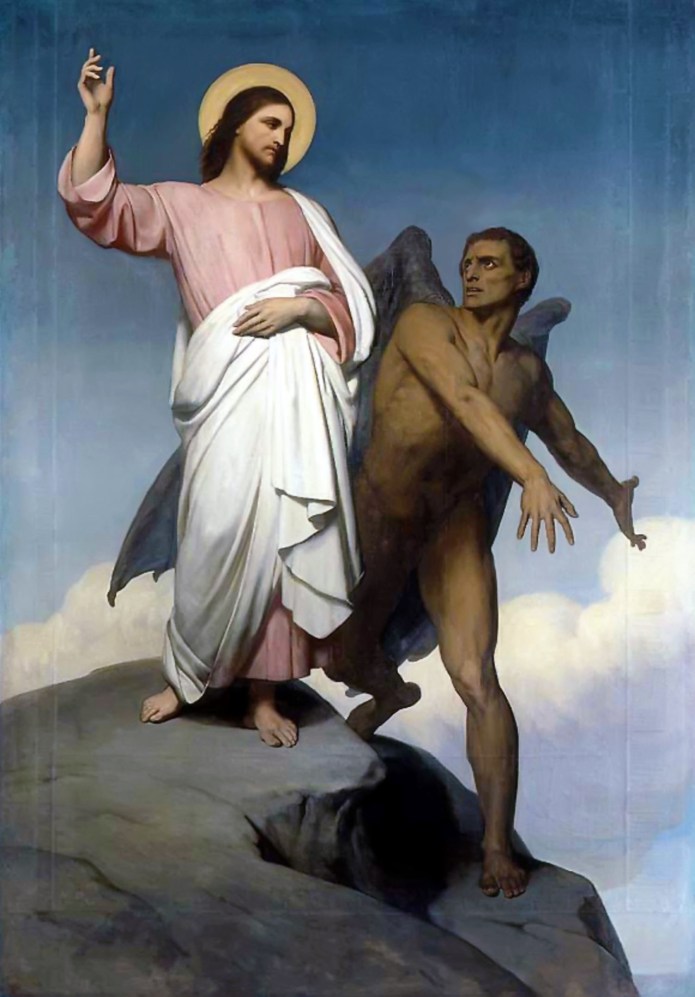
(Ask yourself why, in many paintings, Jesus is white, but the devil is black.)
But Jesus rejects the devil’s temptation, saying, “You shall worship the Lord your God and serve him only.” Jesus has an entirely different picture of divinity in mind, so he turns down the devil’s gifts of privilege and power and invulnerability. Jesus will be everything that Caesar is not. He will identify with the poor and hungry. He will be arrested and convicted by the rulers of this world. He will be beaten, and publicly executed.
What could be less god-like than that? Yet Jesus’ followers insisted that it was in his very lowliness, that the nature of God was revealed.
Nearly a half-century ago, an African-American Christian theologian named James H. Cone ignited controversy by boldly declaring that “God was Black.” The statement “God is Black” sounded pretty shocking to 20th-century white American ears – but perhaps no more shocking than the statement that “Jesus is Lord” must have sounded to 1st-century Roman ears.
In declaring “God is Black,” James Cone did not just mean that God loves all people, or that all people are made in the image of God. Nor was he referring to the fact that Jesus himself was in all likelihood a brown-skinned man. In America, “blackness” was a not just a shade of human pigmentation but a condition of oppression. And so, as radical as it may have seemed to talk about the “the blackness of God,” Cone was in fact expressing an ancient Christian belief – that in Christ, God chose to make the oppressed condition his own.
It was the same belief that the apostle Paul expressed nineteen centuries before, when he wrote to the Philippians, saying, “Let the same mind be in you that was in Christ Jesus – who, although he was in the form of God, did not regard equality with God a thing to be grasped, but emptied Himself, taking the form of a slave” (Philippians 2:6-7).
When we are on top of the pyramid, it is always tempting to believe that we are somehow closer to God up there, that our view of the world is a God’s eye view. The gospels tell us that the devil takes Jesus to “a high place” and shows him all the kingdoms of the world. But if you survey your kingdom only from some high place, it is impossible to see or hear the people below. To look down on others is not to look at them with God’s eyes.
Jesus chose to look at the world not from the top down, but from the bottom up. Jesus rejected power and privilege, and the invulnerability they can purchase. Jesus turned down the devil’s invitation to rule from the mountaintop. He chose instead, to walk that lonely valley down below.
This week marks the beginning of Lent, a period of time traditionally associated with Jesus’ forty days of fasting and temptation in the wilderness. The season of Lent is an invitation to follow Jesus into that wilderness, and to confront, as Jesus did, the promise of our own blessing.
For what does it mean, to be a son — or daughter — of God?
During Lent, we can emulate Jesus by fasting, by giving up some favorite food or activity; or we can emulate Jesus by giving up our claims to privilege and power, and becoming vulnerable to one another. For the devil tempts us still, to set ourselves above and apart from others, whether by virtue of wealth or education, gender or orientation, age or ability, race or nationality.
But it turns out that power, privilege, and invulnerability are not marks of divinity, but of its very opposite. What would it be like, to empty ourselves of that privilege? What would it be like, to be truly God-like?
Remember that you, too, are a child of God.
Act like one.
Sermon by Rev. Liza B. Knapp for the First Church of Deerfield, Massachusetts, February 18, 2018.
Photo: The Temptation of Christ, Ary Scheffer (1854). Source: Wikimedia Commons.


 the Mystery and the Mud