Religious Freedom

An Open Letter to my Open and Affirming Church

Dear Friends:

Last summer, my wife and I took our young daughters to Indiana, to visit my sister’s family and to explore the Indiana dunes. This past week, the governor of that state signed a law permitting businesses there to refuse service to families like mine, claiming “religious freedom” as their justification. So I have to admit, that part of the heartache I am feeling right now is personal; but part of it is pastoral. And so I share these thoughts now with you.

Each week, at our church, we proclaim and celebrate the love of Christ; and all week, in our lives, we seek to embody that love. We give thanks for those moments of grace in our own lives, when someone opened the door to us in the name of God. And we can perhaps imagine what our lives would be, if instead someone had shut the door.

But I fear that this is the exactly message that Indiana’s new law sends. Go ahead and shut the door on your neighbor, it says – as long as you do it in God’s name.

Before I ever met you, before you called me to be your pastor, you were already an ‘open and affirming’ church. You had already covenanted with one another to be an inclusive family of faith, welcoming people of all orientations and gender identities. I know that the process was costly for you; but then, most callings are. And by that covenant, you became a ‘port in the storm’ for those seeking spiritual shelter. You have been blessed to be a blessing.

As a community, as a congregation of people walking in faith together, you have committed yourselves to welcoming the stranger, embracing the outcast, and affirming the blessedness of those whom others call cursed. How shall we make God’s love known, to our brothers and sisters and siblings in Indiana, and here at home? How shall we bear witness to our religious freedom — the freedom we find in Christ, to be wholly ourselves, to live in love and grace without fear of condemnation?

In light of the news from Indiana, let us remember and reaffirm our covenant, and our call. We may be blessed to live in a state that protects us, to have family and friends that support us, to belong to a church that embraces us. But let us not just count our blessings. Let us be one.

Yours in Christ,

Liza

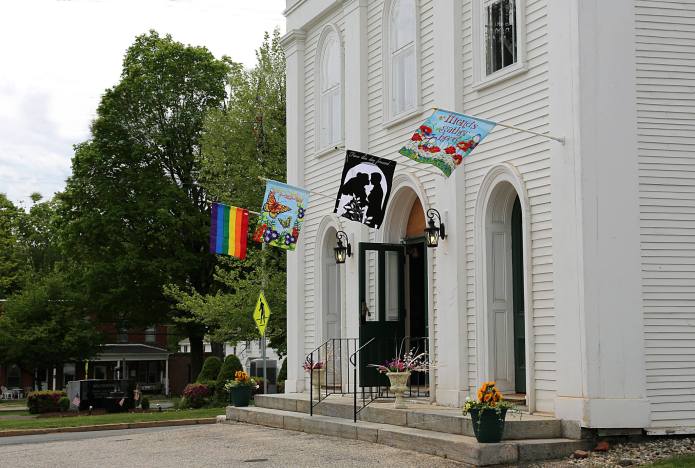
(photo: Belchertown United Church of Christ)

Holy Week

“Peace I leave with you….” John 14:27

During the summer of 2013, I completed a unit of chaplaincy training at a large hospital. One afternoon, I received a call requesting a visit, from a patient whom I had spoken with a few days before. His long, progressive illness had a taken a final turn, and he now had very little time left until it reached its inevitable end. He had asked me to return, because he had a favor to ask. Could I help him write letters to his sons? His hands were no longer strong enough to hold a pen; could I write down his words for him? And so I sat by his bedside, and we spent a sacred hour, together, as he spoke to his sons through my hands, and told them how much he loved them.

I have been thinking about him, as I prepare for the week to come, the week that begins with Palm Sunday and ends with Easter. There’s this long passage in John’s gospel, where Jesus has gathered with his disciples for what will turn out to be their last meal together before his death. As they sit there together, Jesus begins to pour out his heart to them, trying to prepare them for what lies ahead. Because the moment Jesus entered Jerusalem, his ministry took its final turn toward its inevitable end. Jesus knew he had very little time left, to tell them how much he loved them.

The last week of a life is — always — holy week.

(meditation from the Belchertown Cantata for Holy Week, March 29, 2015, Belchertown United Church of Christ, MA)

(photo: stock photo from daily mail )

Prayer for Serpents and Doves

God of all beings, through Christ you bid us:

be wise as serpents, and innocent as doves.

But we insist on choosing between the two.

Forgive us, God, our educated cynicism.

Forgive us, too, our ignorant bliss.

Open our eyes to see the world through yours,

lest we mistake ignorance for innocence,

or worldliness for wisdom.

In Christ’s name we pray, Amen.


(image: http://www.forwallpaper.com/wallpaper/bird-versus-snake-678294.html. And yes, I do realize that is not a dove, but its such a cool picture I couldn’t resist.)


Not an easy peace…

Not an easy peace, not a lazy peace, not an uneventful peace,

But the peace of a heart at one with its God.

Not an easy path, not a well-worn path, not a predictable path,

But the path that leads to a world reborn.

Not an easy faith, not a blind faith, not a guaranteed faith,

But a faith that dares and asks and risks.

This is what we have come here seeking:

Nothing less than the living God.

Mark 1:40

I am no healer.
God is the healer.
God sometimes heals
while I am standing by, but I
do not effect the cure.

I never know which ones
will find relief.

this sometimes
happens in my hands

God knows why

perhaps it is that I
am not afraid to touch

(Liza B. Knapp, 11.8.08)

(photo by Liza B. Knapp, all rights reserved)

Cooties

IMAG2716

“If you choose, you can make me clean.”– Mark 1:40-45

Last month, amid great celebration, the Church of England ordained its first woman bishop, an Anglican priest by the name of Libby Lane, who is now Bishop of Stockport. She was ordained to her new calling through the laying on of hands by her fellow bishops, all of them men, all of them bearing witness to, and blessing, her call.

But not everyone was celebrating on that day. Just two weeks later, a conservative Anglican priest by the name of Philip North was ordained as Bishop of Burnley. North is an outspoken opponent of the ordination of women. At his request, none of the clergy who had laid hands on Libby Lane were invited to participate in laying hands on North.

Which prompted one of my old seminary classmates to comment that, apparently, girl cooties are still a thing in the Church of England.

If you look up the etymology of the term “cootie” you will find that it first appeared during World War I, as British Army slang for fleas or body lice. The term was later appropriated by American school children to refer to (and I am quoting from no less a source than the Oxford English Dictionary here) – to refer to an imaginary germ with which a socially undesirable person, or one of the opposite sex, is said to be infected. You remember how this works: someone is declared to have cooties, and from that point on, anyone who touches that person becomes themselves infected. A diagnosis of cooties imposes a social quarantine.

The truth is, cooties are still a thing, and they are by no means limited to British soil. Modern science has failed to eradicate them, even in the most advanced and developed of countries. Although the term ‘cooties’ is most widely used by children, it is not a disease of childhood only; cooties may infect anyone, of any age. And although they are imaginary, they are far from harmless. It is true that cooties, being fictional, cannot directly inflict harm on the body. But the secondary effects of cooties, the disgust and ostracism they engender, can be deadly. To deprive a human being of human touch and human conversation is akin to torture. Prisoners deprived of human conversation develop mental illnesses. Infants deprived of human touch, die.

Cooties are not the same thing as germs, although the two may be correlated. When they do occur together, their impact can be greatly magnified. Think of the early years of the AIDS epidemic; the first victims of that disease were subjected to a level of social ostracism far beyond anything justified by the contagiousness of the virus. The Reverend Jon Walton, pastor of First Presbyterian Church in my childhood neighborhood of Greenwich Village in New York City, tells the story of an acquaintance who was diagnosed with HIV. After leaving the doctor’s office, the man walked down Madison Avenue in a daze; the only word he could think of was “unclean.”

Cooties is not just a game invented by twentieth-century American school children. It is a social illness that has been around for millennia, and “unclean” is one of its most ancient names.

We find evidence of this in today’s gospel reading, in which a leper asks Jesus, not just to make him well, but to make him clean. In Jesus’ day, the term leprosy could refer to any one of a number of diseases that altered the appearance of the skin. Whatever their underlying medical condition, “lepers” were treated as so dangerously contagious that they had to leave their homes and communities, had to live in isolated leper colonies, had to shout out the word “unclean” as they walked along, lest they somehow infect anyone through some casual touch. To be unclean meant more than being sick. It meant being outcast. It meant having not only germs, but also cooties.

Now, some of you may be thinking that the leper’s isolation was not an example of cooties, but rather a reasonable precaution to prevent the spread of germs. But the stigma of disease often lasts much longer than the disease itself. A couple of years ago, I had the opportunity to visit a leper colony, the Home for Cured Lepers near the city of Ho in Ghana. As its name suggests, the people living in this colony have been cured of their disease. But they still bear the stigma of leprosy, along with its visible scars. Many of them have been living at the leper’s home for decades, unvisited by family or friends, unable to return to their villages. Because although modern-day antibiotics can eradicate the bacteria that causes the disease, they have yet to eradicate the fear that leprosy engenders.

Sometimes the germs are long gone, but the cooties linger.

Sometimes, though, it happens the other way around.

Some of you may have heard the news story, some months ago, of an Ebola clinic in Sierra Leone. A sick woman came to the clinic with her young baby, and when the mother died, the staff initially left the baby in a box, to prevent him from infecting others. But one by one, the nurses disregarded the protocol, and picked the baby up. They picked him up, and they held him. The baby eventually died of Ebola, as did eleven of his nurses. They knew the risks; but they could not bear to see the baby alone in that box. They could not bear to see him live his short life without human touch or affection, and so they were willing to risk their own lives, to prevent that from happening.

Germs, they knew, can kill the body; but cooties can kill the soul.

If you can imagine how the nurses must have felt, looking at that baby in the box, well then, maybe you can imagine how Jesus felt, looking at that leper by the roadside. Most English translations of Mark say that Jesus “felt pity for the man,” or even “felt sorry for the man,” but this does not even come close to capturing the meaning of Mark’s gospel. The word Mark uses here conveys a much deeper emotion, a feeling of compassion that compels action. Some of the earliest manuscripts of Mark actually say that Jesus felt, not pity, but anger.

What would you feel, watching a baby abandoned to die in a box?

Sometimes, there is nothing we can do, to cure the disease. Nothing we can do, to overcome the germs. The cooties, however, are another matter.

The leper says, ‘If you want to, you can make me clean.’

And Jesus says, I want to.

And he stretches out his hand.

That’s all it takes.

(Belchertown United Church of Christ, Feburary 8, 2015)

(photo: Liza B. Knapp, all rights reserved)

Because you called

And immediately they left their nets and followed him. — Mark 1:14-20

Why did they follow him?

It’s the burning question here, isn’t it? Those very first disciples — Simon, Andrew, James and John – what made them drop their nets, and go? I mean, if a stranger approached you and asked you to follow him, would you go? Wouldn’t you at least ask for some references, maybe google him first?

Okay, so… maybe he wasn’t a stranger, after all. Maybe the fisherman had heard Jesus preach. Maybe they had known him for weeks, or years. Maybe.

Or maybe there was something about Jesus himself, something different, something compelling. Maybe there was some sort of aura about him. Maybe.

Or maybe it wasn’t something they saw in Jesus; maybe it was something Jesus saw in them. In the story, Jesus calls out, specifically, to Simon and Andrew, James and John. So maybe he saw something in them, something ripe for the harvest. Maybe they were ready to go, and just waiting for a good strong breeze to shake them loose from the family tree. Maybe.

Maybe, but Mark doesn’t say so.

This story would be a whole lot easier to understand if it came later on in Mark’s gospel. If Jesus had already performed some miracle, some sign. Cured a leper, exorcised a demon, walked on water, something. But all that will come later on.

All Mark’s gospel tells us, is that Jesus calls them, and they follow.

So maybe I’m trying too hard here.

I remember a student I taught many years ago, let’s call him Matt, who auditioned for a play I was directing. He did a terrific job at the audition, but I didn’t have a part for him; so I asked him if he would be my stage manager, help with sets and props, help actors learn their lines and blocking, stand in for other kids when they were absent. He did a terrific job at this, as well, always ready to help.

After a few weeks of rehearsal, Matt’s advisor took me aside and asked, “What is your secret with Matt?” I was puzzled by the question until she told me that apparently, some of Matt’s other teachers found him to be something of a problem in the classroom. But I honestly had no idea why he behaved differently with me. So I told her, “I don’t have any secret. I mostly just boss him around.  I feel like the only thing I say to him is, Matt, I need you to move the chairs, Matt, I need you to run lines with the cast…”

The other teacher smiled and said, “And what he hears is, Matt, I need you.”

So maybe there is no secret behind today’s gospel reading, either. Maybe the only miracle here, is that Jesus called them.

(excerpt from sermon preached at Belchertown UCC on January 25, 2015)

(photo: Elmina, Ghana, January 2012, by Liza B. Knapp, all rights reserved)

Ready for Samuel

(Text: Samuel 3:1-10 (11-20))

Take a look at the scripture reference for today. Notice the parentheses? That’s exactly how the lectionary lists this Sunday’s reading. Sometimes these parentheses are just a matter of brevity, an alternative, shorter version. But sometimes they are a sort of ratings warning: mature themes, Parental Guidance suggested.  They say to the preacher, you might want to skip this part. Some folks might not be ready for it.

Well, as you might expect, this just tends me make me a lot more interested in what is inside those parentheses.

Today’s lesson, then, comes to us in two parts. The first part of the story – the part before the parentheses — is the one we usually hear for the children’s message. It’s an appropriate scripture for a G-rated sermon. But we do not live in a G-rated world, and so our faith cannot be G-rated, either. The Bible certainly isn’t.

So here’s the full, uncensored version of the story:

Samuel was the first born son of a woman named Hannah, born to her after she prayed to God to give her a child. As soon as Samuel was weaned, Hannah brought him to the Temple at Shiloh, and she left him there, offering him as a servant to God. From that time on, Samuel was raised by the Temple priest, Eli. Eli already had two grown sons of his own, Hophni and Phineas.

The priesthood at that time was a hereditary office, and so Eli’s sons served under him at Shiloh. And although Eli himself was by all accounts devout and responsible in his own priestly duties, his sons were not. Whenever someone brought an animal to sacrifice to the LORD, Eli’s sons would demand the best portion of the meat for themselves – though by law, this portion should have been offered to God.  Moreover, they seduced – or perhaps coerced – the young women who served at the tent of meeting. They were guilty of embezzling from the church and sexual misconduct with their flock. And Eli, the head priest, knew all of this; and though he privately chastised his sons, he took no action to remove them from their offices, but allowed the abuse to continue.

Some things haven’t changed much, in the past few millennia.

It is into this dysfunctional family of faith that young Samuel is adopted. How much of this clergy abuse had he witnessed himself, as he grew up? We don’t know. But as he grows, as he approaches adolescence, a moment comes when God awakens him in the night, and tells him, this cannot continue.

At first Samuel thinks it is Eli calling. Eli, who has been both father and priest to Samuel for most of his young life. Eli, who has been the voice of authority, the voice of conscience. In this household of faith, it is Eli who speaks for God, and Samuel listens to Eli. But tonight, Samuel will listen to God, directly, without parental guidance or priestly interpretation. Tonight, Samuel will listen; and tomorrow, Samuel will speak.

Samuel lies awake all night. It is never easy, to speak truth to power. How much harder, when the one in power is one whom we love. How much deeper the disappointment; how much greater the risk.

I’m going to fast forward us in time, now, from ancient Israel, to twentieth century America, to year of my birth, in fact. 1963 was a significant year in American history, and not because I was born in it. Four months before I was born, on Good Friday, 1963, there was a civil rights protest in Birmingham, Alabama. The Birmingham police used police dogs to break up what was an otherwise peaceful protest, and they carted many of the protestors off to jail. Among them was the Reverend Dr. Martin Luther King, who had travelled from Atlanta to Birmingham at the invitation of local civil right leaders.

King spent several nights alone in a narrow jail cell, equipped with a metal cot but no mattress. It can’t have been comfortable, trying to sleep there. I imagine Martin, like Samuel, lay awake all night. At some point, King began writing out the words of a letter – a letter addressed, not to the perpetrators of racial violence, but rather to the clergy. Not to those who abused his people, but to those who had observed the abuse, and had remained silent.

In his Letter from a Birmingham Jail, King commended those few white clergy who had fought to integrate their own congregations. But he went on to say:

In deep disappointment I have wept over the laxity of the church. But be assured that my tears have been tears of love. There can be no deep disappointment where there is not deep love. Yes, I love the church. How could I do otherwise? I am in the rather unique position of being the son, the grandson and the great grandson of preachers. Yes, I see the church as the body of Christ. But, oh! How we have blemished and scarred that body.

I’m guessing young Samuel’s speech to Eli was probably a lot less eloquent, but the tears and the disappointment must have been much the same.

So let us return to Samuel, standing there in Eli’s room after a sleepless night. In fear and trembling, Samuel relays God’s word to Eli: that Eli is destined to outlive both his sons, and watch the family line come to an end. And Eli, to his credit, listens; he recognizes the word of God when he hears it. Indeed, according to the story, it is Eli that teaches Samuel to listen for God’s word. Eli has done his best to teach the faith to his young charge, and he has taught him well.

But as Christ reminded his disciples, all of us are forever students, when it comes to knowing God. As a colleague recently commented, the church doesn’t need a learned clergy, so much as we need a learning clergy; and there is a time when even a teacher needs to be taught.

Some of you know that before entering the ministry I was for many years a teacher, at a private school in Washington, DC. The school’s mission statement, as crafted during the years I taught there, described us as a faculty of life-long learners, dedicated to creating for our students a culture of “nurtured risk-taking.” Nurtured risk-taking is something of a paradox, I’ll admit, but not that far from the mission of the church, when you think about it. Samuel knew something about nurtured risk-taking. So did Martin Luther King Jr.

During the years that I taught there, the majority of Washington DC’s citizens were African American, but the great majority of both faculty and students at the school were white. I should clarify, that this was not because of any intentional policy of exclusion, but because of all the constellation of factors that tend to perpetuate our historical legacy of racism. As teachers, we liked to think of ourselves as a welcoming and inclusive community, dedicated to making our classrooms safe for all.

One day, I walked into our usual weekly faculty meeting in the school auditorium. On the stage, there was a row of chairs; on the chairs, there were maybe eight or ten high schoolers. There were sophomores and seniors, boys and girls, artists and athletes – but all of them, students of color.  A substantial percentage, actually, of the school’s African American student body at the time. The head of the school explained to the faculty that this group of students had come to her, requesting an audience with the faculty; and that our job was to listen.

The students then spoke, each in turn, about their experience at our school.  About the subtle ways in which they were reminded, constantly, of their minority status. Of the ways in which the history of white Americans was treated as the main storyline, and the history of African Americans was treated as an optional sidebar. Of the ways in which the experience of white Americans was assumed as the norm, and the experience of black Americans was treated as an exception. Of the times they felt pressured to keep silent – or, just as frustrating, pressured to speak for their entire race. They spoke of the failure of us, as white teachers, to educate ourselves better.

This was hard listening, for us.

We wanted to defend ourselves. We wanted to reassure them of our good intentions. We wanted to distance ourselves from responsibility – after all, I was just the science teacher, I could hardly be blamed for the history curriculum, right? But thank God, we did not. None of us. We listened, as our courageous students spoke truth to power. I’ve never felt so humbled and so proud all at the same time.

I wonder if Eli felt that same way.

We all love the story of the eager young boy, called by God in the middle of the night. Kids hearing this story naturally identify with Samuel, as they should. But what about those of us who are no longer children?  Where are we in this story? We all want to identify with the young hero who speaks truth to power; but what if we are the power? What if we are not Samuel? What if we are Eli?

Are we ready, for Samuel? Will we recognize him, when he stands before us?

Each week, after our scripture reading, we sing that God is still speaking, and that we are listening. Well, then, we better be prepared for some hard listening. Because maybe God is speaking to us, as God spoke to Samuel. Or, maybe, God is speaking to us, as God spoke to Eli. Either way, it is the same God. Are we ready to listen, either way? Are we ready to recognize injustice, even when it is our own? Are we ready, not merely to recognize it, but to do something about it?

Are we ready, for Samuel?

Let us pray:

God of Samuel and of Eli, Give us the courage to speak when it is time for us to speak, the courage to listen when it is time for us to listen, and the wisdom to know the difference.        Amen.

(this sermon preached at Belchertown United Church of Christ, January 18, 2015; in remembrance of Martin Luther King, Jr.)

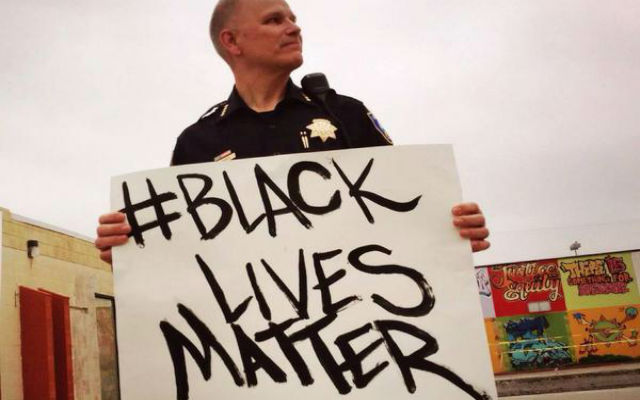
(Photo: “Richmond, Calif., Police Chief Chris Magnus gained nationwide attention recently for holding a “BlackLivesMatter” protest sign. (Twitter)” )

Ready or Not

“…and all who heard it were amazed at what the shepherds told them.” — Luke 2:1-20

Close your eyes, and picture a crèche, a nativity scene. Maybe the one from your childhood home, maybe one from a church or a town square. Look at it carefully, in your mind’s eye.

Got it? Okay, now you can open your eyes.

We have three nativities set up in our house right now, from three distant countries: Italy, Denmark, and Ghana. As you might imagine, each differs quite a bit from the others. The Italian crèche is tiny and delicate; the Danish crèche is sturdy and simple; the Ghanaian figures are roughly carved and unpainted. But whether the figures are fragile or rough-hewn, china or wood, light-skinned or dark, solemn or cheerful, we recognize the scene, because we recognize the figures in it: Mary and Joseph; the babe in the manger; shepherds and sheep; and of course, the three kings.

But here’s the thing: the story we heard tonight doesn’t mention any kings. Mary and Joseph are there, and the babe in the manger; and to be sure, there are shepherds. But the kings are nowhere to be seen. So close your eyes again, and picture again that nativity scene in your mind, with no camel, no royal robes, no precious gifts.

Got it? Okay, you can open your eyes.

Friends, that’s what the first Christmas looked like. It belonged, not to the kings, but to the shepherds.

Tonight’s story of angels and shepherds comes from the gospel of Luke. The story of the kings comes from the gospel of Matthew, where they are described not as kings but as Magi — wise men, scholars, astrologers maybe. According to Matthew’s story, the Magi saw the star that appeared at Jesus birth, and then went searching for the child. So on Christmas day, they were still pretty far away.

It was the shepherds who were close at hand.

Unlike the Magi, the shepherds were poor and uneducated. They worked and slept outdoors in all weather. Because of this, they were often ritually unclean – meaning they were considered unprepared to participate in religious ceremonies. Yet these were the first to hear the angels, the first to see the baby, the first to spread the good news.  The shepherds were the first people in history to celebrate Christmas.

Somehow, along the way, we got the impression that we should celebrate this day, not as shepherds, but as kings. Like astrologers, we consult our calendars and make our plans and preparations. How much of our gold can we afford to spend on gifts this year?  Would Aunt Violet rather have the frankincense, or the myrrh? Sometimes we get so preoccupied by our preparations that Christmas comes and goes and we are still getting ready.  In my own household, we find ourselves still addressing Christmas cards, long after Christmas. Some years they become New Year’s cards, or Valentine’s Day cards. One year we sent them out at Easter. Think about that for a minute. We spent so much time getting ready for the birth, that we missed both birth and life and went straight to the resurrection.

Christmas Eve belongs, not to the kings, but to the shepherds.

Somewhere, tonight, a child is being born to a homeless family. Somewhere, tonight, an expectant mother is sleeping on the streets, or in a shelter, or in a borrowed room. Somewhere, tonight, there are shepherds, living on the margins, keeping watch in the night. Somewhere, tonight, God is going to surprise us, and the shepherds will be the first to know.

The Magi are on their way. They’re preparing for the journey, packing their things, checking their maps, picking out expensive gifts. And they’ll get here eventually too.  But tonight, we celebrate with the shepherds.

And the good news they tell us is that Christ comes, even to the unprepared and empty-handed. And thank God he does.

Unto us a child is born. Ready or not, here he comes.

(Christmas Eve meditation, 2014, Belchertown United Church of Christ)

(photo: Liza B. Knapp, all rights reserved)

When was it

Lord, when was it that we saw you hungry or thirsty or a stranger or naked or sick or in prison, and did not help you?  — Matthew 25:31-45

It was a raw, chilly day. Late November, maybe, but I’m not sure. I’m not sure of the year, either, although I know I was a young adult. I think I was walking alone, but even that I am not sure of.

This is what I do remember:

I was walking along the streets of midtown Manhattan. I was dressed in a wool coat, and I had a large, rectangular wool shawl wrapped around my shoulders as well. I passed another young adult, lying curled up on the sidewalk. She was half naked. Naked enough that it was clear something dreadful must have happened to her; it was far too chilly a day for anyone to be dressed that way by choice. She had a piece of something, paper maybe, pulled over her. Her eyes were closed.

And I kept walking.

I wish there was more to this story. Another ending, some information about what became of this young woman. But I have no other ending to give you, because I walked by. I assumed someone else would take care of her. But later that day I found myself haunted by that moment. I kept seeing that woman, lying on the street, shivering. And I kept seeing myself, hurrying by in extra layers of warm clothing.

Lord, when was it that we saw you naked, and did not clothe you?

Jesus tells of a day when all the people of the world come to stand before their king. The king blesses those who showed compassion on the hungry, the thirsty, the naked, the stranger, the sick, the imprisoned. The king curses those who showed no compassion.

But here is the surprising thing: Both groups – the sheep and the goats, the blessed and the cursed, the compassionate and the indifferent – both groups reply to the king with the same question:

“Lord, when was it that we saw you?”

It apparently did not occur to either group that by feeding the hungry they would be serving their king. Whether they received the king’s blessing or the king’s curse did not depend on how well they recognized their duty. It depended on how well they loved one another.

We ask, When was that it we saw you?

But Jesus asks us, When was it that you truly saw anyone?

(photo: Liza B. Knapp, all rights reserved)